The Battle of Two Rivers: A Key Event in Early Medieval Britain
686 · unknown, Scotland
The Battle of Two Rivers took place, where the Picts defeated the Northumbrians, marking a significant event in the power struggles of early medieval Britain.
May 20, 0685
The Battle of Dun Nechtain (also known as the Battle of Nechtansmere) took place. It was a pivotal battle where the Picts, under the leadership of King Bridei III, defeated the Northumbrians led by King Ecgfrith. This battle significantly curtailed Northumbrian expansion and secured Pictish independence from Northumbrian dominance.
Nechtansmere, Scotland | Pictish forces
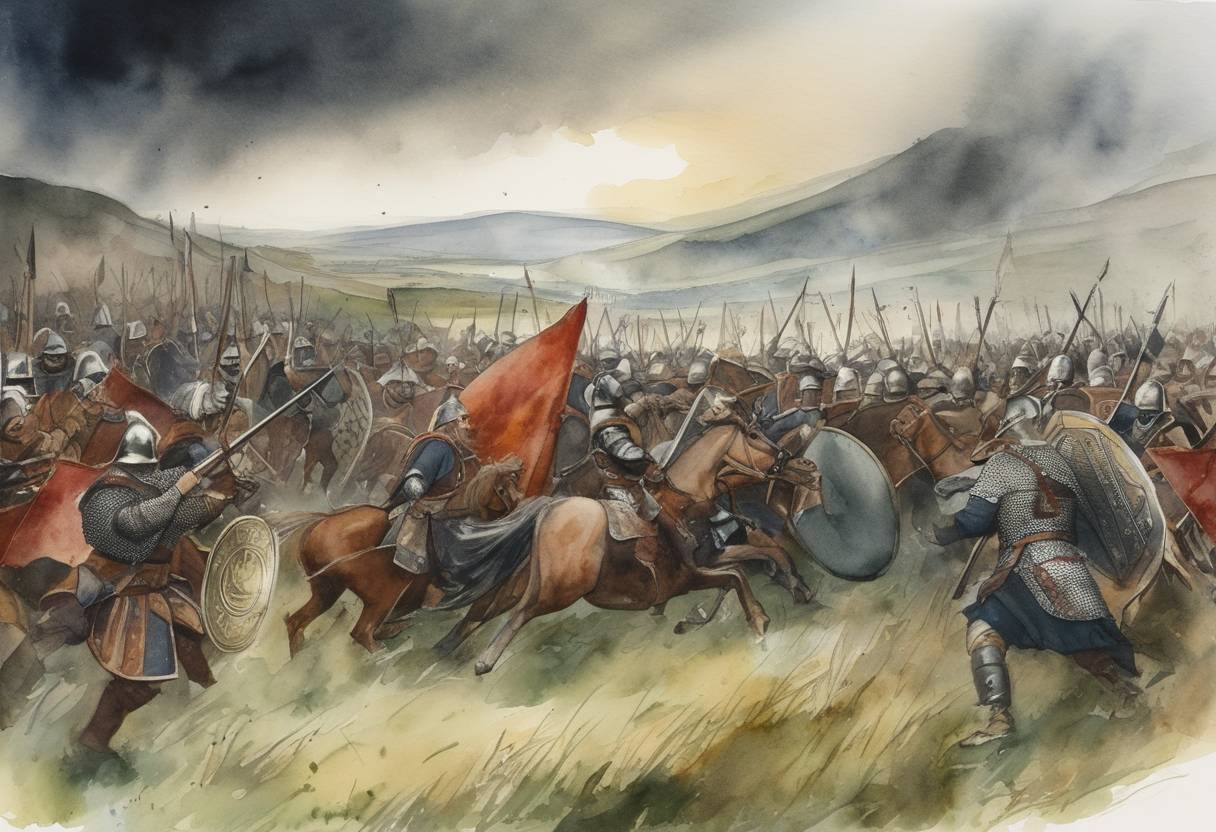
The Battle of Dun Nechtain, also known as the Battle of Nechtansmere, was a significant confrontation that took place on May 20, 685, marking a critical point in the history of the British Isles. This battle saw the Picts, led by King Bridei III, achieve a decisive victory over the Northumbrians, commanded by King Ecgfrith. The battle is noteworthy for its impact on the power dynamics in early medieval Britain, effectively halting Northumbrian expansion into Pictish territories.
In the centuries leading up to the battle, Northumbria had risen as a dominant force in what is now Northern England and Southern Scotland. Under the reign of King Ecgfrith, Northumbria sought to extend its influence further north. The Picts, who occupied the lands now corresponding to modern-day Scotland, were under constant pressure from these expansionist aspirations.
King Bridei III, also known as Bridei mac Beli, became the ruler of the Picts around 671. Bridei’s reign focused on strengthening Pictish resistance against foreign domination, and tensions between the Picts and Northumbrians grew. In 685, sensing an opportunity or responding to provocations, Ecgfrith led a campaign into Pictish territory.
The two forces met near what is today Dunnichen in Angus. The geography of the battlefield played a crucial role in the outcome. Bridei likely had the strategic advantage, using the terrain to orchestrate a trap for the Northumbrian forces. Accounts suggest that the Picts attacked the Northumbrians in a manner that left them unable to fully engage their superior numbers and weaponry effectively.
King Ecgfrith, underestimating the Pictish forces and perhaps misjudging the support they could garner from local tribes, pressed into a terrain favorable to Bridei. The Pictish forces, motivated by the necessity of maintaining their independence, fought fiercely. The battle ended with King Ecgfrith being killed, his army decimated, and the survivors in disarray.
The aftermath of the Battle of Dun Nechtain was transformative. The death of Ecgfrith threw Northumbria into a period of political instability and weakened its hold over the northern territories. This victory allowed the Picts to consolidate their control over their lands, leading to a period of strengthened Pictish sovereignty and identity.
The battle not only curtailed Northumbrian expansion but also ensured Pictish independence from further Northumbrian political or military influence. It is often regarded as a turning point that preserved Pictish culture and political autonomy during a time when they faced encroachment from powerful neighbors.
In the longer term, Dun Nechtain showcased the resilience of indigenous groups like the Picts against more sizable adversaries and altered the trajectory of power in the region for subsequent generations, with the Picts remaining a significant force until the eventual unification of Scotland.
By demonstrating the vulnerability of larger kingdoms to strategic defeats, this battle also influenced military strategies and alliances in the centuries that followed, underscoring the importance of understanding local geographies and respecting the capacities of smaller forces.
Source: en.wikipedia.org