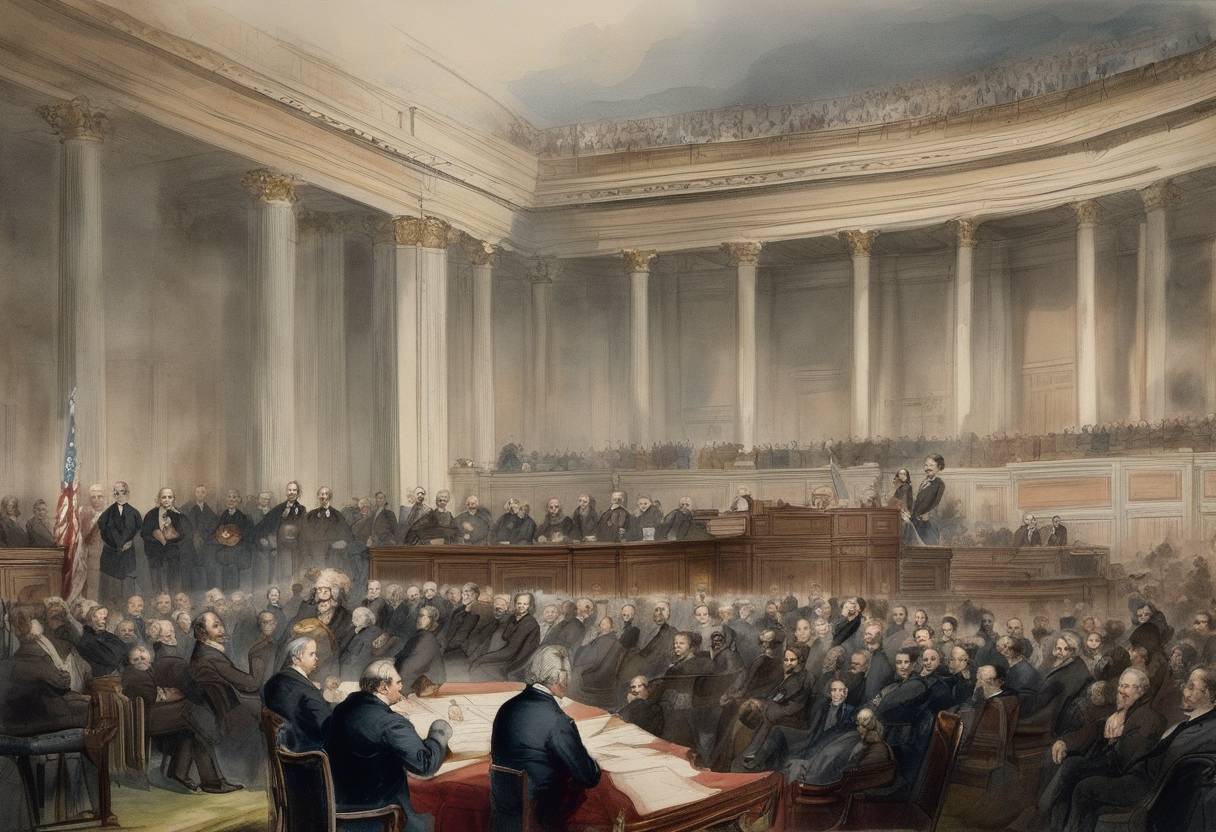
Impeachment Trial of President Andrew Johnson
On May 16, 1868, the United States Senate held a pivotal vote in the impeachment trial of President Andrew Johnson. This event marked a significant moment in American history as it was the first attempted impeachment of a U.S. president. The Senate fell just one vote short of the two-thirds majority required to convict Johnson, allowing him to remain in office.
Context and Background
The impeachment of Andrew Johnson was deeply rooted in the political tensions following the American Civil War. As the 17th President of the United States, Johnson assumed office following the assassination of President Abraham Lincoln in 1865. A Southern Democrat who had remained loyal to the Union, Johnson’s approach to Reconstruction differed sharply from the Radical Republicans in Congress. These differences resulted in a significant political struggle over the governance and rebuilding of the Southern states.
Key Events Leading Up to the Vote
The primary charge against Johnson was his violation of the Tenure of Office Act, a law enacted by Congress over his veto in March 1867. This act restricted the President’s authority to remove certain officeholders without the Senate’s consent. Johnson’s dismissal of Edwin M. Stanton, the Secretary of War and a staunch ally of the Radical Republicans, was the catalyst for his impeachment.
The House of Representatives formally impeached Johnson on February 24, 1868, passing 11 articles of impeachment that included charges of violating both the Tenure of Office Act and the Reconstruction Acts.
Senate Vote on May 16, 1868
During the Senate trial, which began in March 1868, Johnson’s legal team argued the Tenure of Office Act was unconstitutional and that Stanton’s removal was within Johnson’s rights. The trial was a spectacle, drawing immense public and press attention.
On May 16, the Senate voted on the first article of impeachment. A two-thirds majority, or 36 of the 54 senators, was required to convict. The outcome was 35 votes in favor of conviction and 19 against, falling just one vote short. Seven Republican senators broke ranks and voted to acquit, primarily motivated by concerns about the legality of the impeachment and its implications for the balance of power between the Presidency and Congress.
Aftermath and Consequences
The failure to convict Johnson preserved the office’s independence by setting a precedent limiting the grounds for presidential impeachment. However, his political influence was significantly weakened, and he did not secure the Democratic nomination for the subsequent election.
The Tenure of Office Act itself was later repealed in 1887 and declared unconstitutional by the U.S. Supreme Court in 1926. Johnson’s acquittal underscored the complexities of Reconstruction and the ongoing national struggle to redefine and rebuild the nation.
Historical Significance
The impeachment of Andrew Johnson remains a critical episode in American political history. It showcased the tensions of post-Civil War governance, tested constitutional limits, and affirmed the principle that removal of a President should not be pursued solely for political disagreements, requiring instead clear constitutional violations.