The Battle of Allatoona Pass: October 5, 1864
1864 · Allatoona, United States
The Battle of Allatoona took place during the American Civil War, where Union forces successfully defended the Allatoona Pass against a Confederate attack.
November 16, 1863
The Siege of Knoxville began during the American Civil War, with Confederate forces under General James Longstreet laying siege to the Union garrison commanded by Major General Ambrose Burnside.
Knoxville, United States | Confederate Army
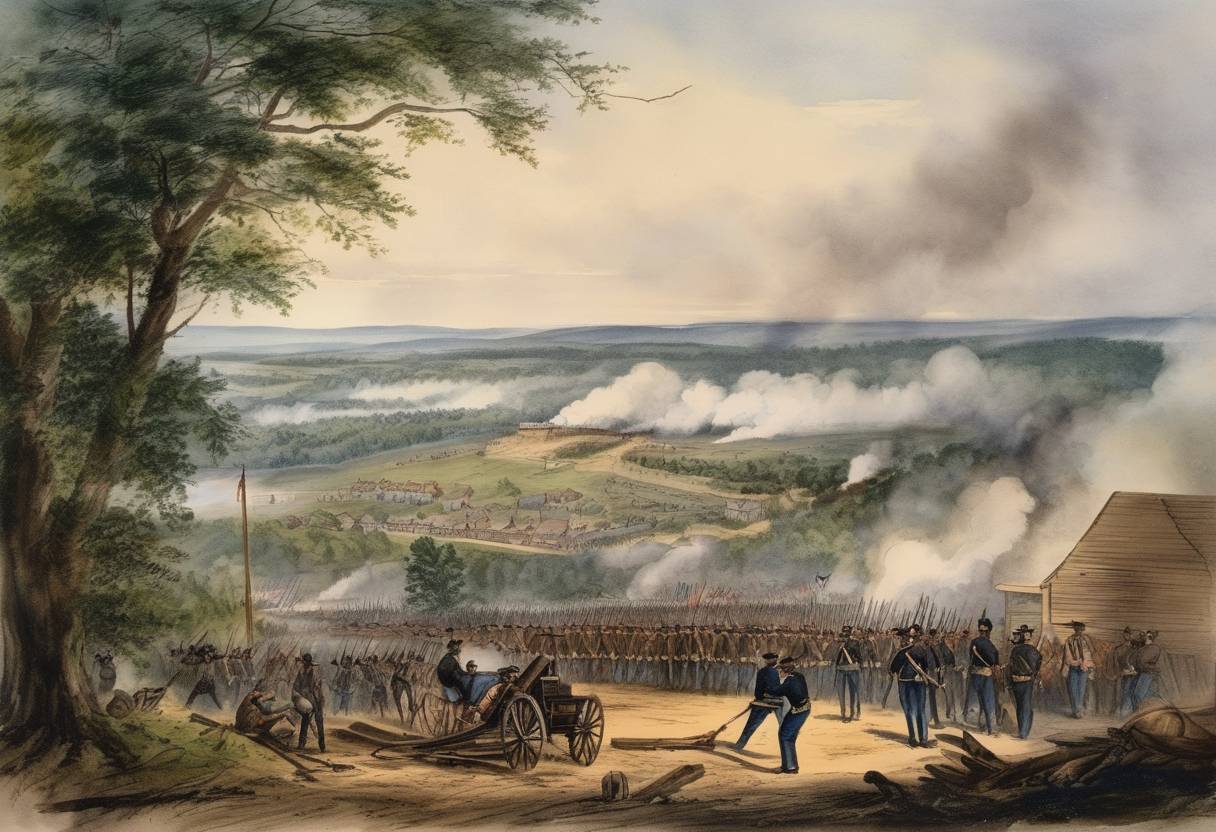
The Siege of Knoxville began on November 16, 1863, during the American Civil War. This military engagement involved Confederate forces under Lieutenant General James Longstreet and Union troops led by Major General Ambrose E. Burnside. This siege was a crucial part of the Eastern Theater of the war.
Prior to the siege, the Union had secured Knoxville, Tennessee, largely as a strategic move to control the East Tennessee area, which was vital for its railroad links and its pro-Union demographic. The Confederate high command sent Longstreet to the region with the aim of reclaiming this territory and disrupting Union supply lines.
Longstreet’s role also served as a diversionary tactic to draw Union forces away from their concentration at Chattanooga, where Confederate General Braxton Bragg was contending with Union forces. Longstreet’s corps, detached from the Army of Tennessee, was tasked with retaking Knoxville to support Confederate interests in the region.
On November 16, Longstreet’s forces arrived in Knoxville, positioning themselves to encircle the city and cut off supplies and reinforcements to Burnside’s garrison. The Union forces had fortified the city, constructing several defensive positions, including Fort Sanders, which was strategically positioned to defend the western approaches to Knoxville.
During the early stages of the siege, skirmishes and minor engagements were frequent as both sides sought to consolidate their positions. Longstreet, aware of the approaching winter and the need for a swift campaign, attempted to tighten his encirclement of Knoxville quickly. Despite this, Burnside’s preparations and Knoxville’s defenses posed an obstacle.
The siege of Knoxville continued for several weeks. While the actual combat on November 16 constituted the initial movements, this engagement set the stage for further actions, including the notable Battle of Fort Sanders on November 29, where Union forces defended against a major Confederate assault. Longstreet’s inability to capture the city ultimately resulted in his withdrawal in early December, marking a strategic failure for the Confederates in the theater.
This siege exemplified the tactical maneuverings during the war and highlighted the strategic importance of East Tennessee. It also reflected the larger picture of competing Union and Confederate strategies, with each side attempting to leverage territorial control for broader military objectives.
Source: en.wikipedia.org