Subdivision of the British Crown Colony of New York into Counties - November 1, 1683
1683 · New York, British America
The British crown colony of New York was subdivided into 12 counties, establishing much of the administrative structure used today.
June 24, 1664
The city of New Amsterdam was officially ceded to the British and renamed to New York, following the capture by the English fleet during the Anglo-Dutch War.
New York, United States | British Empire
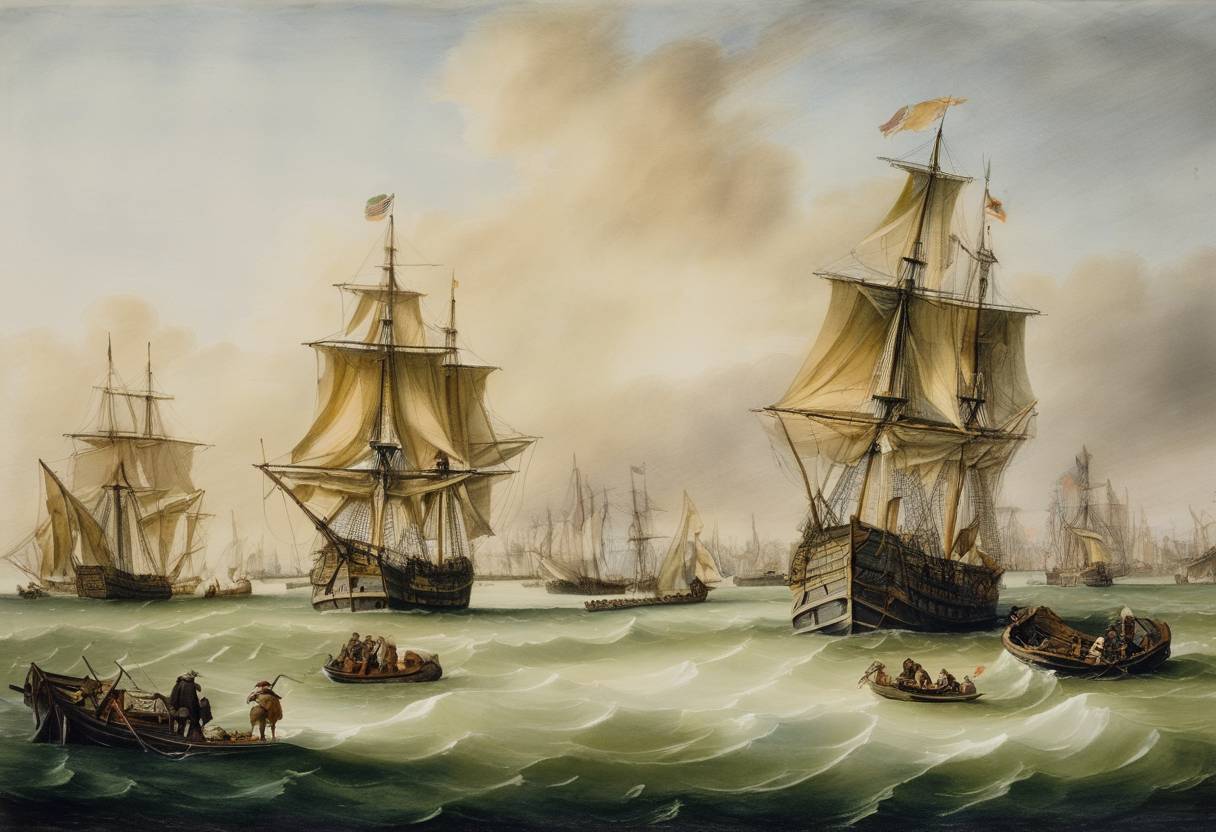
In the midst of the Anglo-Dutch Wars, a series of conflicts fought between the English and the Dutch in the mid-17th century, territorial control in the New World was a significant point of contention. The Dutch controlled a settlement known as New Amsterdam, strategically located at the southern tip of Manhattan Island. This site was the seat of the colonial government of New Netherland and an important trading hub.
On June 24, 1664, the city of New Amsterdam was ceded to the British as a consequence of ongoing military and diplomatic maneuvers. The English fleet, dispatched by King Charles II and led by Colonel Richard Nicolls, had captured the settlement without bloodshed in September 1664. The significance of the date June 24, 1664, relates to the formalization of this capture, marking the official transfer and renaming of the city.
The English takeover was facilitated by the declining power of the Dutch in the region and the resultant lack of military support for the isolated New Amsterdam. Governor Peter Stuyvesant, facing overwhelming opposition and with limited resources, negotiated terms of surrender that allowed for a peaceful transition of control.
Subsequent to its capture, New Amsterdam was renamed New York in honor of the Duke of York, the brother of King Charles II, who had been granted control of the area by the English crown. The transition marked a pivotal shift in colonial power in North America, as English influence expanded and solidified along the Atlantic coast.
The cession had broad implications for the development of colonial society and trade. It established a critical base for English maritime power and contributed significantly to the eventual creation of the Thirteen Colonies. The consolidation under English rule allowed for more cohesive policies and expansion strategies, ultimately leading to the growth of New York as a major political and cultural center in the New World.
The cession of New Amsterdam is noteworthy not only for its immediate power shifts but also for laying the groundwork for the diverse and dynamic metropolis that New York City would become. The peaceful transition of power set a precedent in colonial affairs and marked an important moment in the complex economic and geopolitical interactions of European powers in North America.
With the renaming and transformation, the legacy of New Amsterdam as a Dutch stronghold slowly transitioned to that of New York, an epicenter of American commerce, culture, and governance that persists to this day.
Source: en.wikipedia.org