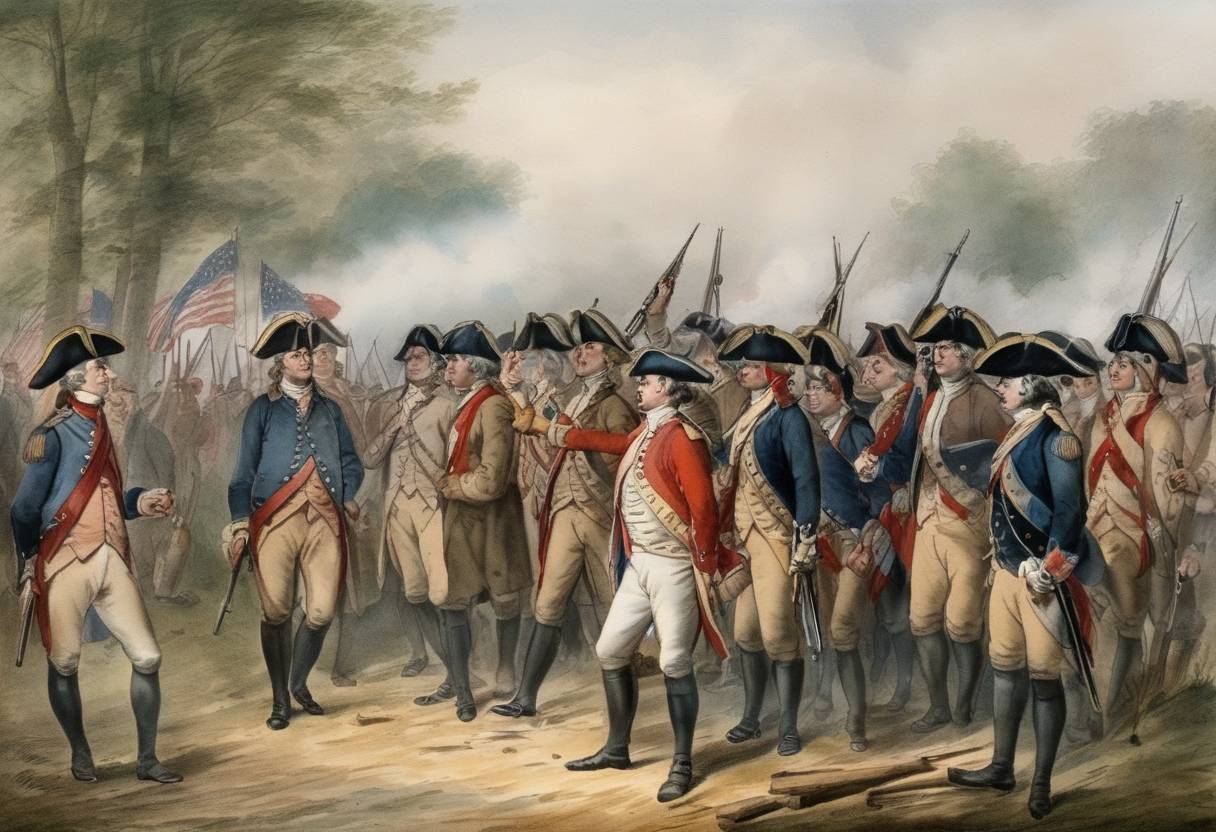
Battle of Vincennes: British Surrender - February 25, 1779
The Battle of Vincennes, a pivotal engagement of the American Revolutionary War, saw British forces surrender to American troops on February 25, 1779. This event took place at Fort Sackville, located in what is now Vincennes, Indiana, marking a crucial victory in the Illinois Campaign conducted by American forces aiming to secure the western frontier and influence territorial control in the region.
Context Leading to the Battle
The Illinois Campaign was orchestrated by George Rogers Clark, a Virginian militia officer, who sought to undermine and disable British power structures in the expansive western territories. Initially, Clark captured Kaskaskia and Cahokia in the summer of 1778, which were then British-controled settlements on the Mississippi River, dramatically altering the strategic landscape.
The British, under Lieutenant Governor Henry Hamilton, aimed to recapture these garrisons and strengthen their hold on the territory. In December 1778, Hamilton recognized the weakness of Fort Sackville’s defenses and returned to Vincennes, refurbishing and reinforcing the fort to maintain British territorial integrity.
The Battle
Clark, determined to prevent Hamilton from consolidating power in the west, planned a surprise winter expedition from Kaskaskia. He led a diverse force of roughly 170 men, consisting of American militia and French settlers from the region, on a grueling 18-day, 180-mile march fraught with cold, hunger, and the constant threat of British-allied Native American attacks.
On February 23, 1779, Clark’s forces reached Vincennes, launching a swift and audacious attack on Fort Sackville. Utilizing strategic bluffing tactics to appear more numerous, Clark’s men fired continuously upon the fort, maintaining significant pressure on the British forces inside.
Surrender and Aftermath
By February 25, with provisions depleted and a demoralized garrison, Henry Hamilton was compelled to surrender the fort to Clark and his men. This victory significantly disrupted British plans to control the West and curtailed their alliance with Native American tribes from expanding attacks into frontier settlements.
Clark’s capture of Fort Sackville was not only a tactical triumph but also a massive morale boost to the American cause. It paved the way for future western expansion and played a crucial role in the terms outlined in the Treaty of Paris (1783), which ended the Revolutionary War. The treaty saw Britain cede the Northwest Territory to the United States, largely due to successes such as the Battle of Vincennes, underscoring the operation’s strategic importance.
George Rogers Clark’s campaign significantly affected British control in the western territories, cementing his legacy as a cunning and resourceful military leader in the American Revolutionary era.