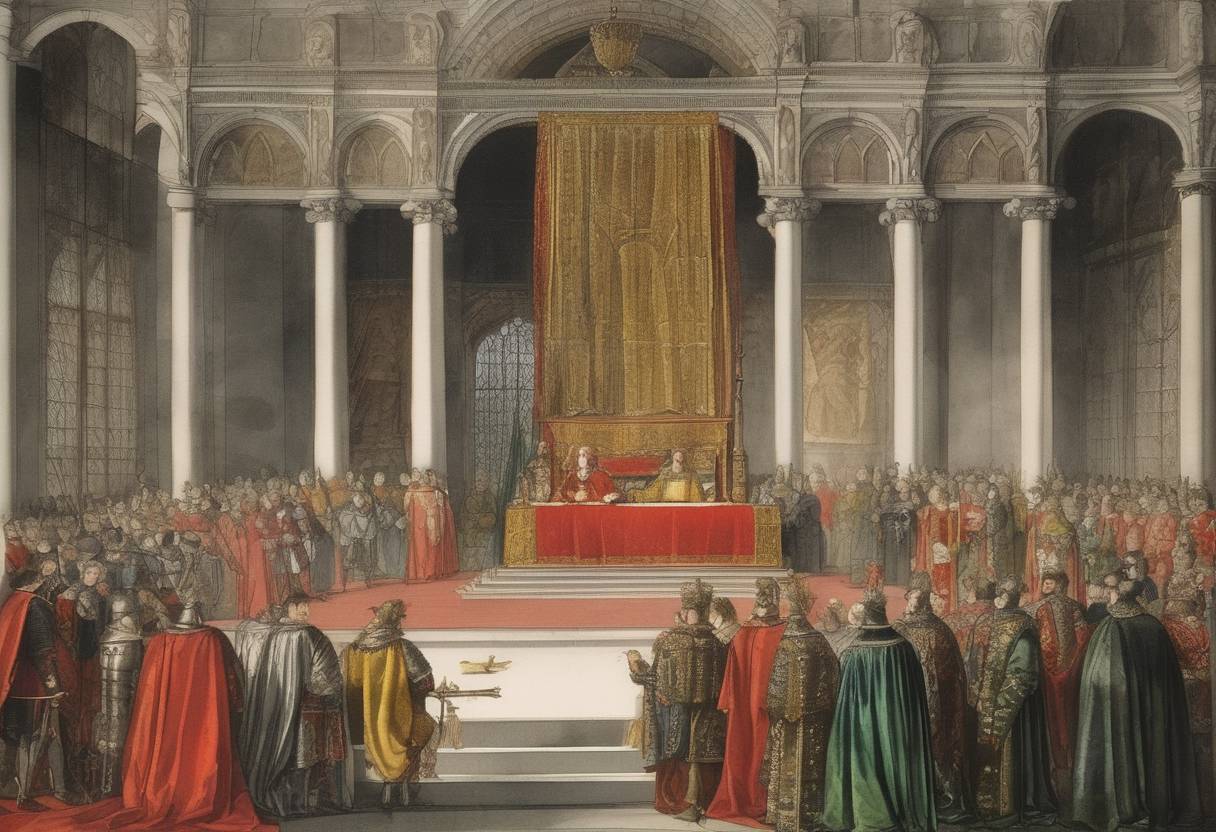
Public Announcement of Charles V as Holy Roman Emperor on July 16, 1519
On July 16, 1519, the public announcement of Charles of Spain’s election as the Holy Roman Emperor Charles V marked a significant moment in European history. Charles had been selected to succeed Maximilian I and became one of the most powerful monarchs of the time, overseeing an expansive domain that signified the height of European dynastic power.
Background
Charles was born in 1500 in Ghent, now part of modern-day Belgium, to Philip of Burgundy and Joanna of Castile. Upon his father’s death in 1506, Charles became Duke of Burgundy. He later inherited the Spanish crowns from his maternal grandparents, Ferdinand II of Aragon and Isabella I of Castile, in 1516. This dual inheritance laid the foundation for his vast empire.
The election as Holy Roman Emperor came at a time when the Holy Roman Empire comprised a large swath of central Europe. Following the death of Maximilian I in 1519, the position was highly coveted, with several candidates vying for the electors’ favor. Despite substantial competition from other European monarchs, including Francis I of France, Charles was eventually chosen due to his extensive lands and the influence of his family’s connections, combined with strategic financial incentives provided to the electors.
The Election Process
Charles’s election was not only a matter of inheritance but also a complex diplomatic exercise. The imperial electors, comprising seven influential princes and bishops within the empire, held significant power in determining the emperor. Charles’s team used diplomacy and sizeable bribes to secure the support of these electors.
On June 28, 1519, Charles was officially elected as Holy Roman Emperor. The public announcement of his election took place later, on July 16, marking his formal acceptance and signaling the beginning of his reign as emperor.
Reign and Significance
As Holy Roman Emperor, Charles V ruled over a vast empire that included territories in Europe, the Americas, and Asia. His reign was marked by numerous wars, including conflicts with France, the expansion of the Ottoman Empire, and the religious upheaval stemming from Martin Luther’s Protestant Reformation.
Charles V’s rule was pivotal in shaping the geopolitical landscape of 16th-century Europe. His vast territories demanded a delicate balance of diplomacy, military power, and governance, influencing the political and religious dynamics of the continent.
Aftermath
Charles V eventually abdicated in 1556, overwhelmed by the relentless challenges of ruling such an expansive empire. He divided his realms, giving the Holy Roman Empire to his brother Ferdinand I and the Spanish Empire to his son Philip II.
The legacy of Charles V’s time as Holy Roman Emperor is complex, marked by significant achievements and formidable challenges. His reign left a lasting imprint on the political landscape of Europe, with effects reverberating through subsequent generations.