Adolf Hitler's Secret Meeting with German Industrialists on February 20, 1933
1933 · Berlin, Germany
Adolf Hitler secretly met with German industrialists to secure funding for the Nazi Party's election campaign.
November 8, 1923
Adolf Hitler and the Nazi Party attempted a coup known as the Beer Hall Putsch in Munich, Germany, which was a failed effort to overthrow the Weimar Republic.
Munich, Germany | Nazi Party
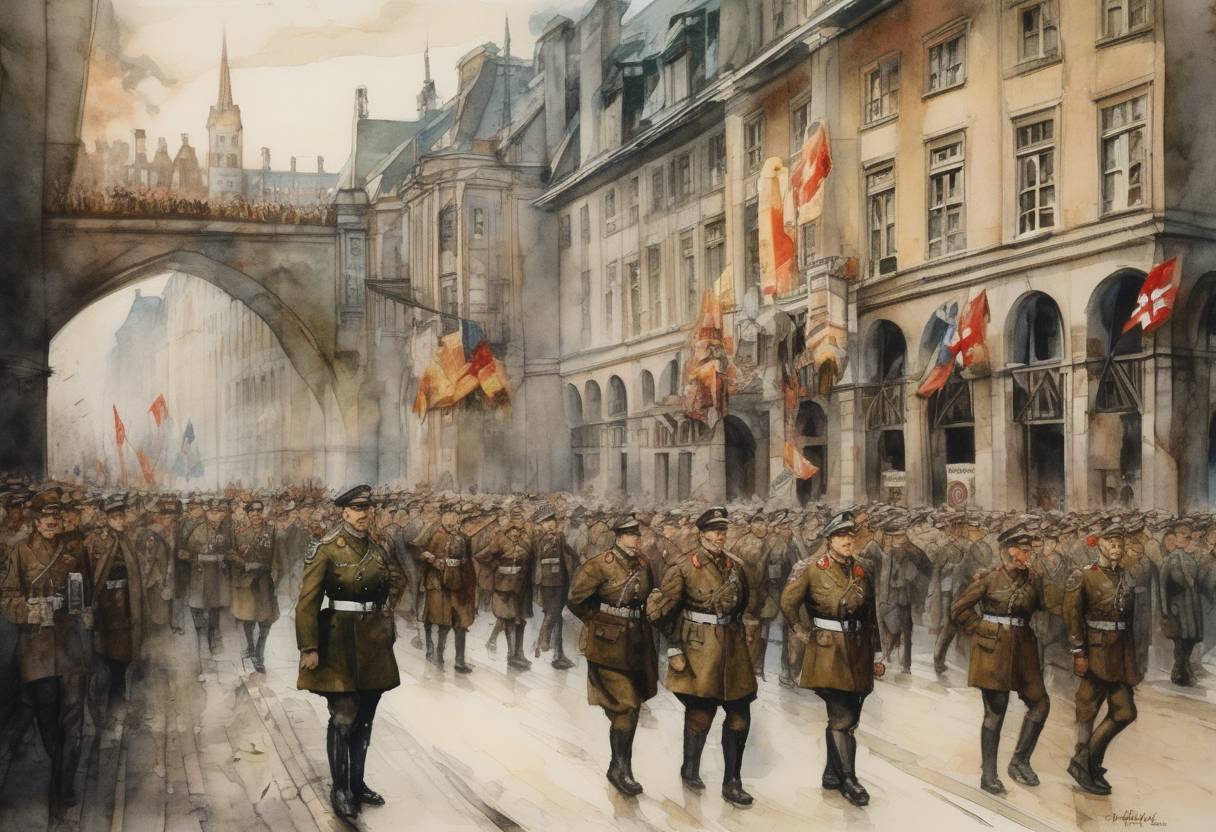
On November 8, 1923, Adolf Hitler and the National Socialist German Workers’ Party (NSDAP), commonly known as the Nazi Party, attempted a coup d’état in Munich, Germany. This event, known as the Beer Hall Putsch, was a failed effort to overthrow the Weimar Republic and seize control of the Bavarian government.
The early 1920s were a period of significant instability in Germany. The country was grappling with the aftermath of World War I, including severe economic hardship, hyperinflation, and political unrest. The Treaty of Versailles had imposed harsh reparations, leading to widespread dissatisfaction and a loss of national pride. This environment provided fertile ground for extremist political movements, including the Nazi Party, which capitalized on public discontent by promoting nationalist and anti-Semitic ideologies.
November 8, 1923: The putsch began at the Bürgerbräukeller, a large beer hall in Munich, where Gustav von Kahr, the State Commissioner of Bavaria, was addressing a crowd of about 3,000 people. Adolf Hitler, accompanied by armed stormtroopers (SA), stormed the hall and declared a national revolution. He announced the formation of a new government with himself as the leader.
Hostage Situation: Hitler took von Kahr and other key officials hostage, hoping to gain their support for the coup. Initially, they appeared to acquiesce, but it soon became clear that they were not genuinely supportive.
November 9, 1923: The following day, Hitler and his followers, including General Erich Ludendorff, marched through Munich in an attempt to rally public support and seize power. However, the Bavarian authorities had regrouped and were prepared to resist.
Confrontation and Arrest: The march ended in a confrontation with the police at the Odeonsplatz. Shots were fired, resulting in the deaths of 16 Nazi supporters and 4 police officers. The putsch was quickly suppressed, and Hitler was arrested two days later.
Trial and Imprisonment: Hitler was tried for treason in early 1924. The trial provided him with a national platform to spread his ideas, and he used it to gain publicity. He was sentenced to five years in prison but served only nine months in Landsberg Prison.
Mein Kampf: During his imprisonment, Hitler wrote “Mein Kampf” (“My Struggle”), which outlined his ideology and future plans for Germany. The book became a foundational text for the Nazi movement.
Reorganization of the Nazi Party: After his release, Hitler focused on reorganizing the Nazi Party, shifting from violent uprisings to gaining power through legal political means. This strategic change eventually led to the party’s rise to power in the early 1930s.
The Beer Hall Putsch was a pivotal moment in the history of the Nazi Party. Although it was a failure, it marked the beginning of Hitler’s rise to prominence in German politics. The event demonstrated the volatility of the Weimar Republic and highlighted the growing appeal of extremist ideologies during a time of national crisis. The lessons learned from the failed coup influenced Hitler’s future strategies, ultimately leading to his appointment as Chancellor of Germany in 1933 and the establishment of a totalitarian regime.
Source: www.britannica.com