Winter Quarters at Valley Forge: December 19, 1777
1777 · Valley Forge, United States
George Washington's Continental Army went into winter quarters at Valley Forge during the American Revolutionary War.
July 3, 1775
George Washington took command of the Continental Army during the American Revolutionary War.
Cambridge, United States | Continental Army
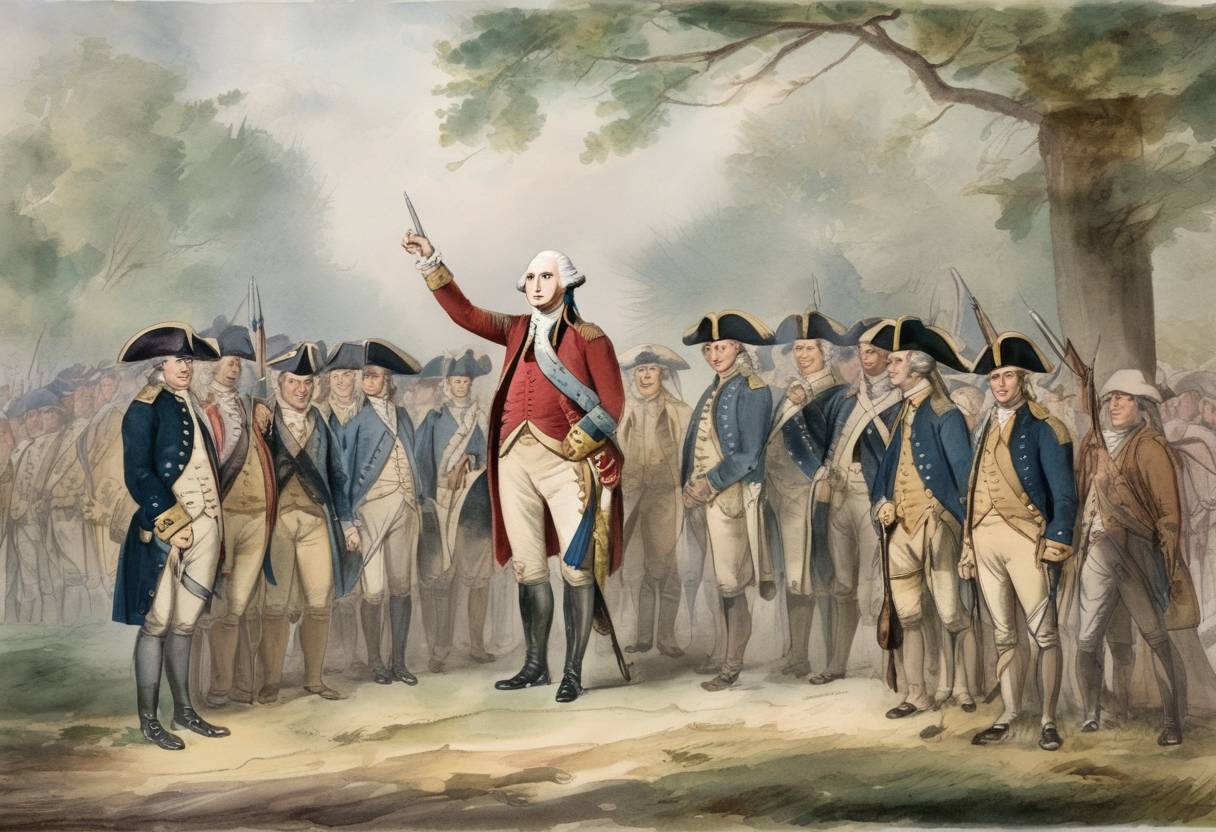
On July 3, 1775, George Washington formally took command of the Continental Army during the American Revolutionary War. This pivotal moment occurred in Cambridge, Massachusetts, marking a significant step in the colonies’ quest for independence from British rule.
The Outbreak of War: The American Revolutionary War had begun in April 1775 with the Battles of Lexington and Concord. These skirmishes marked the start of armed conflict between the Thirteen Colonies and Great Britain.
Second Continental Congress: In response to the escalating conflict, the Second Continental Congress convened in May 1775 in Philadelphia. The Congress faced the urgent task of organizing a unified colonial military effort.
Appointment of Washington: On June 15, 1775, the Congress appointed George Washington as the Commander-in-Chief of the Continental Army. Washington, a Virginian with military experience from the French and Indian War, was chosen for his leadership qualities and to help unify the colonies, particularly by appealing to the Southern colonies.
Assumption of Command: Washington arrived in Cambridge, where the colonial forces were encamped, and officially took command of the Continental Army. The army was then a collection of militia units from various colonies, lacking cohesion and adequate supplies.
Washington’s Address: In his first general order, Washington expressed confidence in the cause and the troops, emphasizing discipline and unity. He faced the daunting task of transforming the undisciplined militias into an effective fighting force.
Military Reorganization: Washington immediately began reorganizing the army, implementing stricter discipline, and addressing supply shortages. His leadership was crucial in maintaining morale and cohesion among the troops.
Strategic Challenges: Washington’s early command was marked by strategic challenges, including the Siege of Boston, which eventually led to the British evacuation in March 1776.
Legacy: Washington’s leadership during the Revolutionary War established him as a central figure in American history. His ability to maintain the army through difficult times was instrumental in the eventual success of the American cause.
Broader Impact: Washington’s command set the stage for the eventual independence of the United States, with his leadership style and strategic acumen becoming foundational elements of American military tradition.
In summary, George Washington’s assumption of command on July 3, 1775, was a defining moment in the American Revolution, symbolizing the colonies’ commitment to independence and setting the stage for the long struggle ahead.
Source: en.wikipedia.org