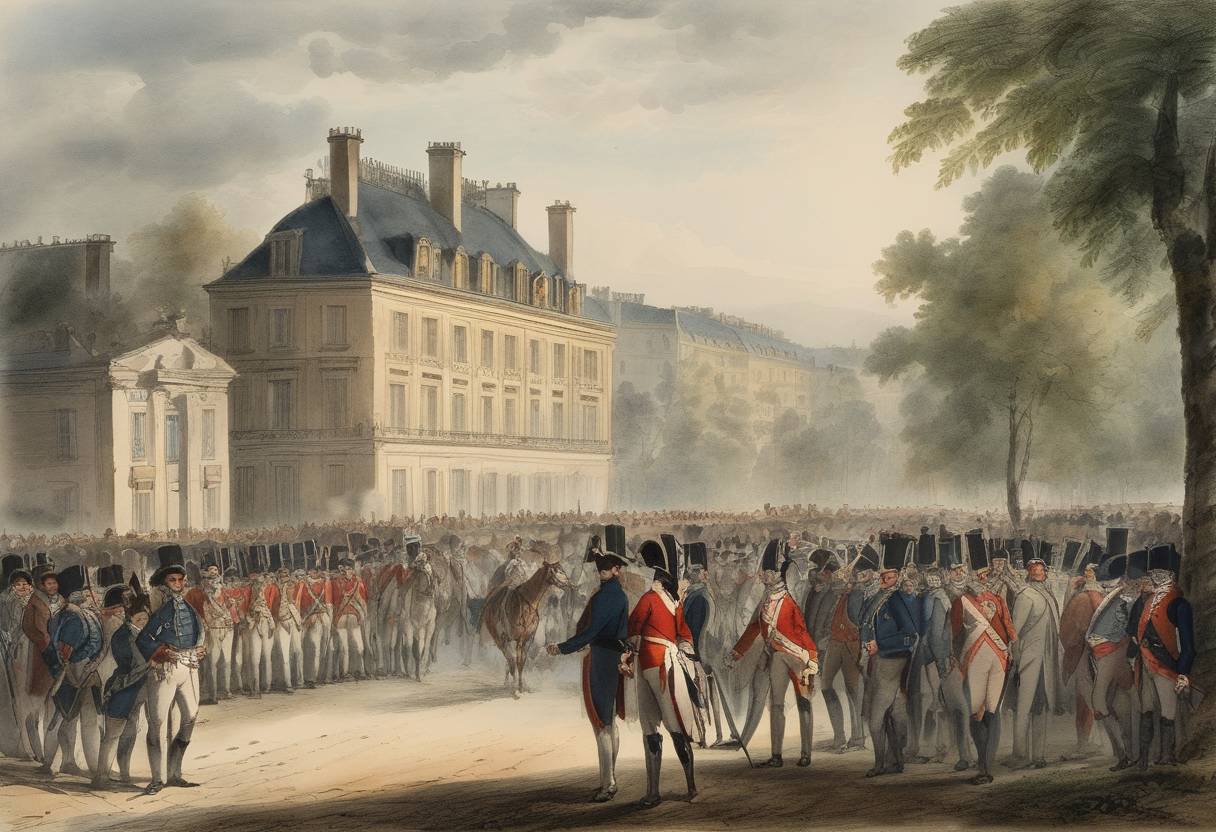
The Treaty of Lunéville Preliminary Agreements - December 24, 1800
On December 24, 1800, representatives from France and Austria reached a preliminary agreement in Lunéville, aimed at halting hostilities between the two nations during the protracted French Revolutionary Wars. This preliminary signing was a crucial step towards the formal Treaty of Lunéville, which would be signed on February 9, 1801. These discussions marked a significant diplomatic success for the First Consul of France, Napoleon Bonaparte, as it fortified his influence on the European continent.
Context and Background
The French Revolutionary Wars, which erupted after the revolutionary upheaval in France in 1789, saw France fending off various coalitions of European monarchies, including Austria, seeking to restore the old order. By the year 1800, France had been embroiled in the War of the Second Coalition against an alliance led by Britain, Austria, and Russia. The conflict was particularly burdensome and had both sides yearning for peace, given the exhaustive toll of years of warfare.
Key Events Leading to the Preliminary Agreement
Earlier in 1800, the French claimed a significant victory over Austrian forces at the Battle of Marengo in Italy on June 14. This battle not only reinforced Napoleon’s military prowess but also placed Austria in a disadvantageous position, weakening their negotiation stance. With Austria seeking to avoid further debilitating defeats, both parties turned towards diplomacy.
The preliminary agreements drafted on December 24 served as a ceasefire and outlined the basic terms of peace, ensuring cessation of hostilities while more detailed negotiations for the final treaty were underway.
Consequences and Aftermath
The preliminary accord paved the way for the comprehensive Treaty of Lunéville. The formal treaty, signed on February 9, 1801, affirmed French territorial gains, including retention of territories in Italy, Belgium, and beyond the Rhine. It effectively dissolved the Second Coalition, leaving Britain to stand alone against France for the remainder of the wars.
Napoleon’s consolidation of power through successful diplomacy and battlefield success enabled him to establish himself not only as a military leader but also as a formidable statesman. The agreements from the preliminary talks in Lunéville thus marked the decline of Austrian influence and contradictorily underscored the rise of Napoleon’s strategic command over Europe.