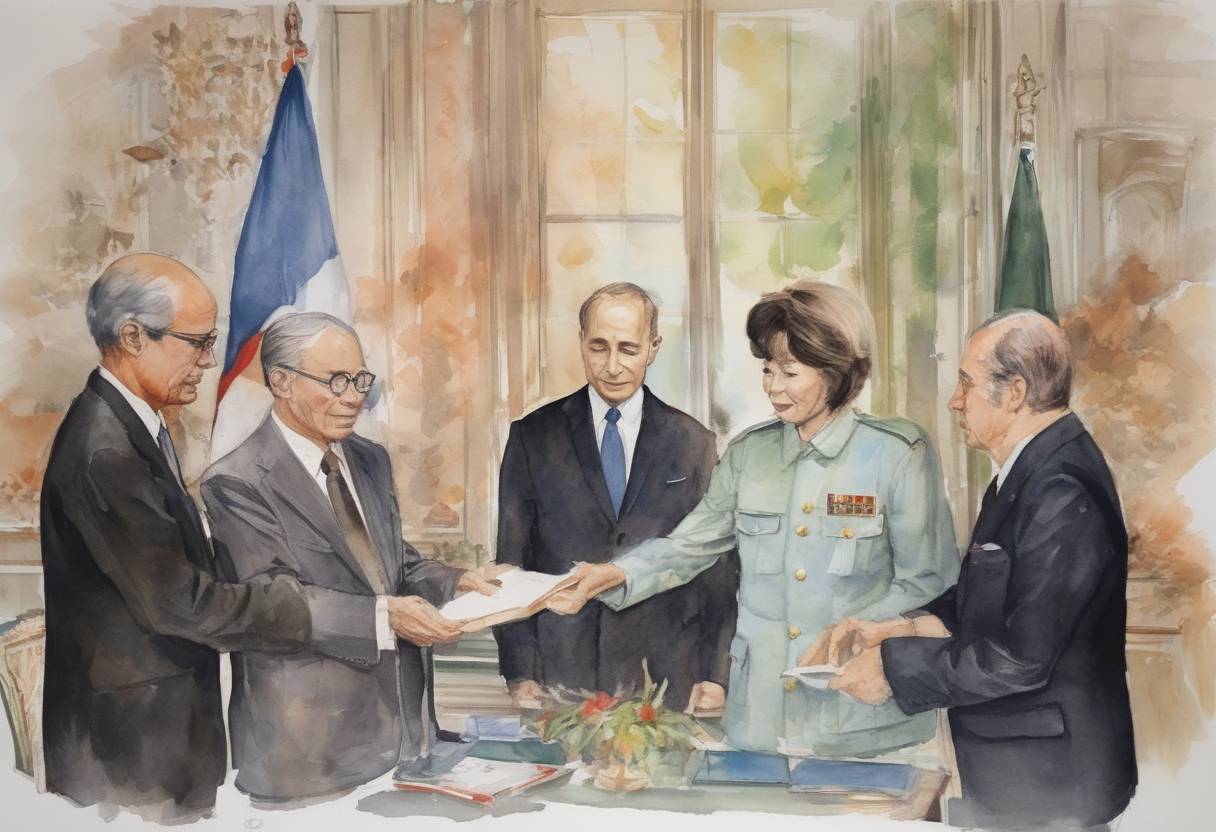
The Paris Peace Accords: Ending the Vietnam War
On January 27, 1973, the Paris Peace Accords were signed, marking a significant milestone in the effort to end the Vietnam War and restore peace in Vietnam. This agreement was the result of prolonged negotiations between the United States, North Vietnam, South Vietnam, and the Viet Cong, and it aimed to establish a ceasefire and outline the withdrawal of U.S. troops from Vietnam.
Background
The Vietnam War, which began in the late 1950s, was a protracted conflict that pitted the communist government of North Vietnam and its allies in South Vietnam, known as the Viet Cong, against the government of South Vietnam and its principal ally, the United States. The war was part of the larger context of the Cold War, with the U.S. seeking to prevent the spread of communism in Southeast Asia.
Negotiations to end the conflict had been ongoing for several years, with talks beginning in Paris in 1968. However, these discussions were often stalled by disagreements over key issues, such as the political future of South Vietnam and the presence of U.S. military forces.
Key Provisions of the Accords
The Paris Peace Accords included several crucial provisions:
Ceasefire: An immediate ceasefire was to be implemented, halting hostilities between the involved parties.
Withdrawal of U.S. Troops: The United States agreed to withdraw all its military forces from Vietnam within 60 days.
Return of Prisoners of War: Both sides agreed to release prisoners of war, with the U.S. focusing on the return of American POWs.
Political Settlement: The agreement called for a political settlement in South Vietnam, including free and democratic elections, although the specifics were left vague.
Territorial Integrity: The accords recognized the territorial integrity of Vietnam, effectively acknowledging the existence of both North and South Vietnam.
Aftermath and Consequences
Despite the signing of the Paris Peace Accords, peace in Vietnam was short-lived. The ceasefire quickly broke down, and fighting resumed between North and South Vietnam. The U.S. completed its military withdrawal by March 1973, but continued to provide economic and military aid to South Vietnam.
The conflict ultimately concluded with the fall of Saigon on April 30, 1975, when North Vietnamese forces captured the South Vietnamese capital, leading to the reunification of Vietnam under communist control.
Historical Significance
The Paris Peace Accords were significant as they marked the end of direct U.S. military involvement in Vietnam, a conflict that had deeply divided American society and resulted in significant loss of life. The accords also highlighted the complexities of achieving a lasting peace in a region marked by deep political and ideological divisions.
The Vietnam War and its conclusion had profound effects on U.S. foreign policy, leading to a more cautious approach in subsequent international conflicts and contributing to a period of détente in the Cold War.
In summary, the Paris Peace Accords were a pivotal moment in the history of the Vietnam War, representing both a hopeful step towards peace and a prelude to the eventual reunification of Vietnam under communist rule.