Siege of Fort Sumter - September 8, 1863
1863 · Charleston, United States
The Union forces began the siege of Fort Sumter as part of the American Civil War, following earlier attempts to recapture it.
April 12, 1861
The American Civil War began with the Confederate attack on Fort Sumter in South Carolina.
Charleston, United States | Confederate States of America
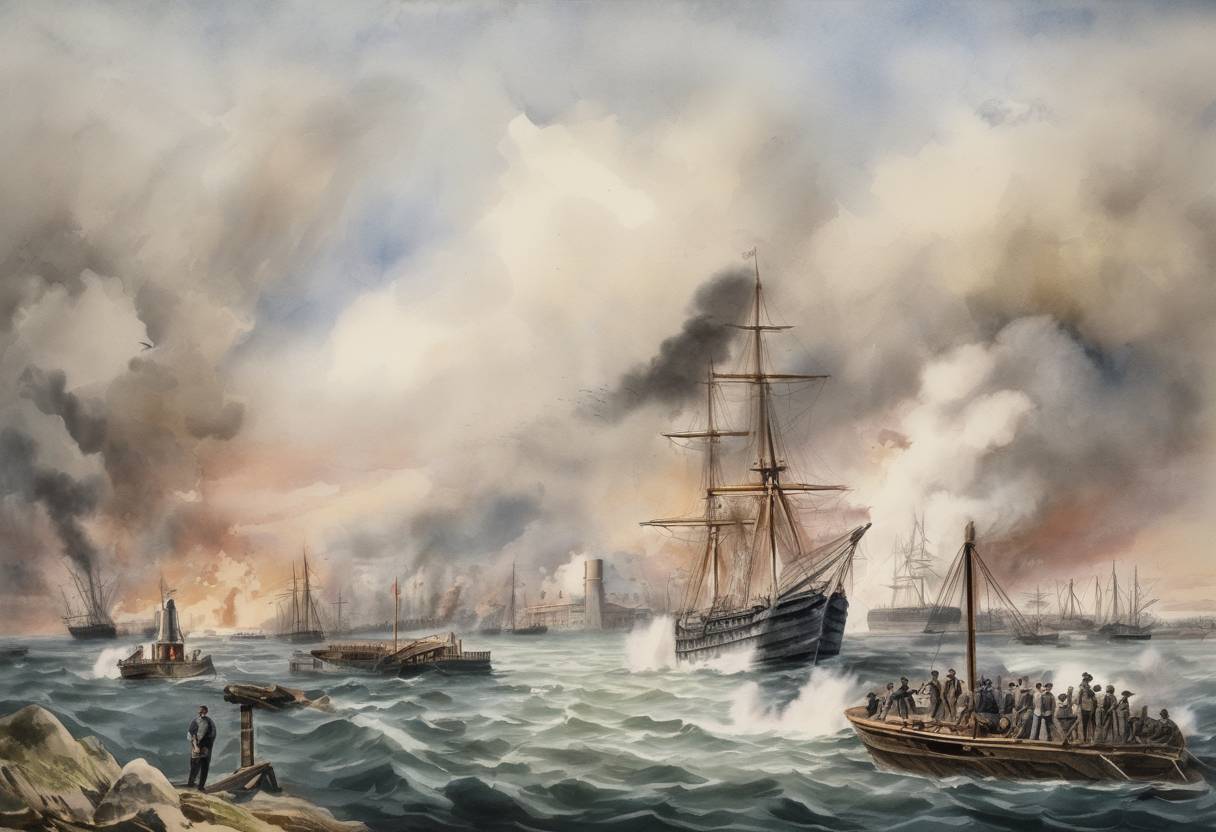
The American Civil War, a pivotal conflict in United States history, was primarily ignited by deep-seated tensions over slavery, states’ rights, and political power. By the early 1860s, these tensions had reached a boiling point. The election of Abraham Lincoln as President in November 1860, on a platform opposing the expansion of slavery, was unacceptable to many Southern states. As a result, South Carolina seceded from the Union on December 20, 1860, followed by several other Southern states, forming the Confederate States of America.
On April 12, 1861, the first shots of the Civil War were fired at Fort Sumter, a federal fort located in the harbor of Charleston, South Carolina. The fort was one of the last remaining federal strongholds in the seceded states. Major Robert Anderson, a Union officer, commanded the fort with a small garrison.
Preceding Tensions: In the months leading up to the attack, Confederate forces had been demanding the surrender of Fort Sumter. The situation was tense, as the fort was strategically important for control of the Charleston Harbor.
The Bombardment Begins: At 4:30 a.m. on April 12, Confederate forces, under the command of General P.G.T. Beauregard, opened fire on Fort Sumter. The bombardment lasted for 34 hours, with Confederate artillery relentlessly shelling the fort.
Union Surrender: Major Anderson and his men, outgunned and running low on supplies, surrendered the fort on April 13. Remarkably, there were no casualties during the bombardment itself, although one Union soldier died during a 100-gun salute after the surrender.
The attack on Fort Sumter marked the official start of the American Civil War. The fall of the fort galvanized the North, leading to a surge of enlistments in the Union Army. President Lincoln called for 75,000 volunteers to suppress the rebellion, prompting four more states—Virginia, Arkansas, Tennessee, and North Carolina—to join the Confederacy.
Mobilization for War: The attack unified the North in a determination to preserve the Union, while the South was equally resolved to defend its newly declared independence.
Long-term Conflict: The war that followed lasted four years, becoming one of the deadliest conflicts in American history, with significant social, economic, and political consequences.
The attack on Fort Sumter is often remembered as the spark that ignited a war that would ultimately reshape the United States, leading to the abolition of slavery and setting the stage for the country’s future development.
Source: en.wikipedia.org