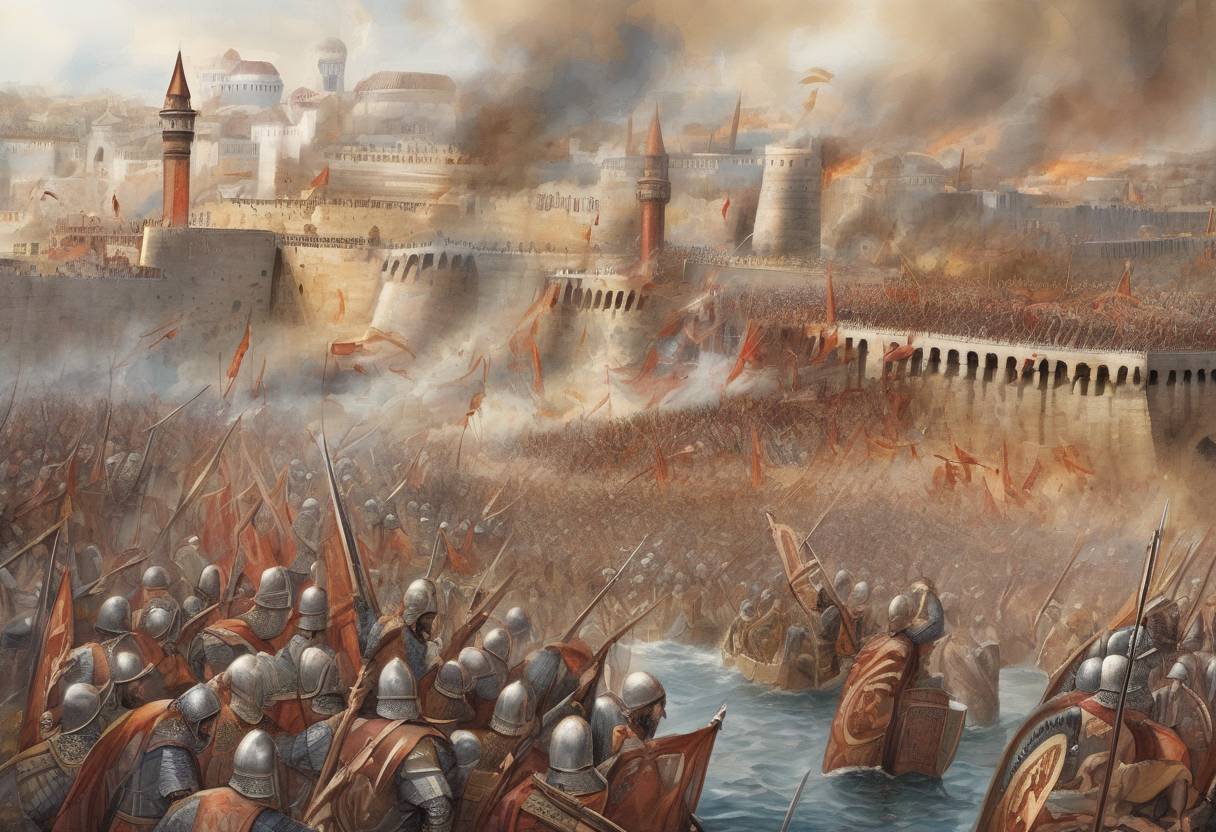
The Siege of Constantinople: August 7, 626
The Siege of Constantinople in 626 was a pivotal moment in the Byzantine Empire’s history, marking a significant victory against the combined forces of the Avars and the Sassanid Persians. This event took place during the reign of Emperor Heraclius and was a crucial turning point in the Byzantine-Sassanid War of 602–628.
Background
The early 7th century was a tumultuous period for the Byzantine Empire, with the Sassanid Empire under King Khosrow II launching aggressive campaigns that captured significant territories, including parts of the Levant and Egypt. The Byzantine Empire, weakened by internal strife and previous military defeats, faced a dire threat from the east.
In 626, the Sassanids formed an alliance with the Avars, a powerful nomadic group from the Eurasian steppes. The Avars, along with their Slavic allies, approached Constantinople from the west, while the Persians, led by General Shahrbaraz, threatened from the east, creating a pincer movement aimed at the Byzantine capital.
The Siege
The siege began in late June 626. Constantinople, protected by its formidable Theodosian Walls, was under the command of Patriarch Sergius and the patrician Bonus, as Emperor Heraclius was away on a campaign against the Persians in Anatolia. The city’s defenders, although outnumbered, were determined and well-prepared.
The Avars and their Slavic allies launched several assaults on the city, attempting to breach its defenses. Meanwhile, the Persian forces, stationed across the Bosporus, were unable to coordinate effectively with the Avars due to the Byzantine navy’s control of the strait, which prevented a direct crossing.
Key Events
Naval Engagements: The Byzantine navy played a crucial role in defending the city. They successfully repelled Slavic attempts to ferry Persian troops across the Bosporus, maintaining control of the sea routes and preventing a full-scale coordinated attack on the city.
Religious and Moral Support: Patriarch Sergius played a significant role in boosting the morale of the defenders. He organized religious processions and displayed the icon of the Virgin Mary, which was believed to have miraculous protective powers. This bolstered the defenders’ resolve and unity.
Failed Assaults: The Avars launched multiple assaults on the city’s walls, but each was repelled with heavy losses. The defenders’ use of Greek fire and other defensive tactics proved effective against the besiegers.
Conclusion and Aftermath
On August 7, 626, after weeks of failed attempts to breach the city’s defenses and suffering significant losses, the Avar and Persian forces withdrew. The failure of the siege was a major blow to the Avar-Persian alliance and a significant morale boost for the Byzantine Empire.
The successful defense of Constantinople allowed Emperor Heraclius to continue his campaigns against the Persians, eventually leading to a decisive Byzantine victory in the war. The siege’s failure also marked the beginning of the decline of Avar power in the region.
The victory at Constantinople reinforced the city’s reputation as an impregnable fortress and was celebrated as a divine intervention, strengthening the Byzantine Empire’s resolve and unity in the face of external threats.