Establishment of the U.S. Air Force as a Separate Branch
1947 · Washington, D.C., United States
The U.S. Air Force was established as a separate branch of the U.S. Armed Forces.
July 26, 1947
U.S. President Harry S. Truman signs The National Security Act of 1947, which creates the Central Intelligence Agency (CIA), Department of Defense, Air Force, and the National Security Council.
Washington, D.C., United States | United States government
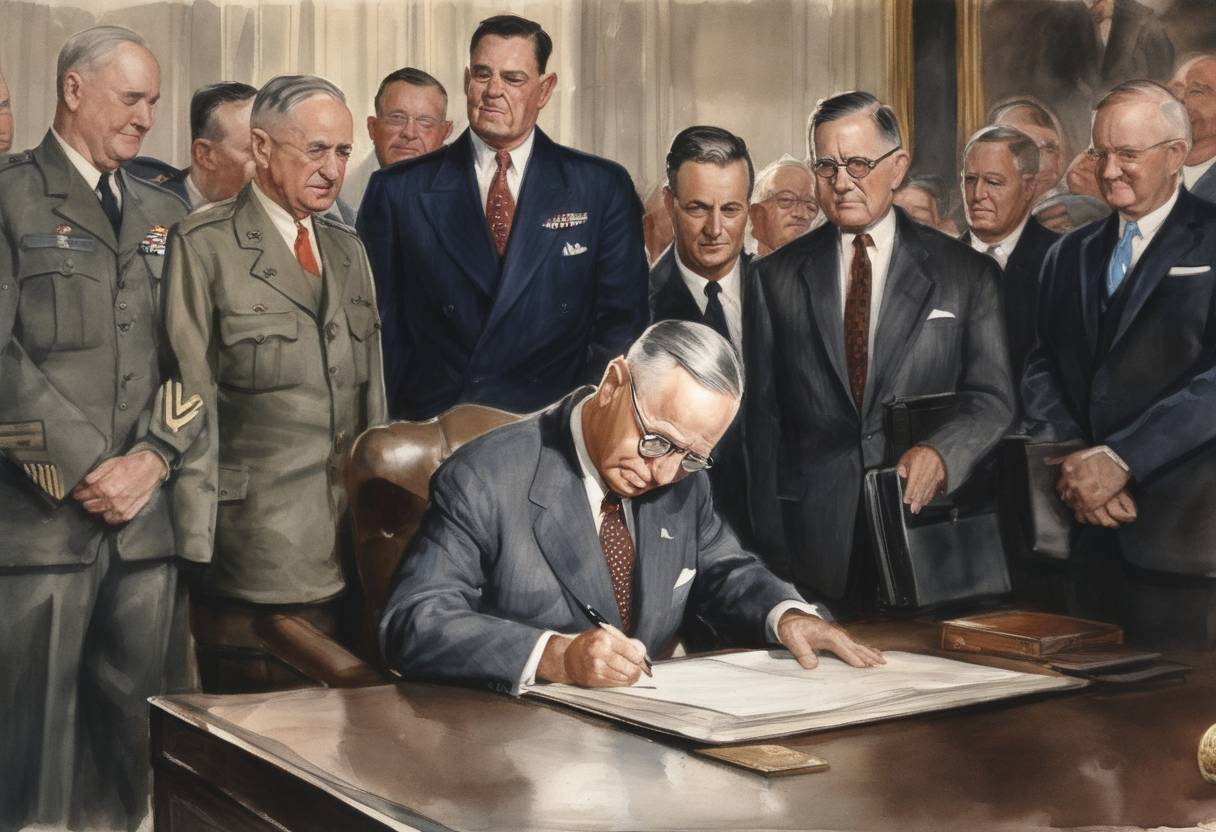
On July 26, 1947, U.S. President Harry S. Truman signed the National Security Act of 1947, a cornerstone legislation that restructured the United States’ military and intelligence apparatus following World War II. This comprehensive act was a response to the new geopolitical landscape, particularly the burgeoning Cold War tensions, and aimed to consolidate and coordinate military and foreign policy.
Department of Defense (DoD): The act merged the Department of War and the Department of the Navy into a single entity, the National Military Establishment. This was later renamed the Department of Defense in 1949. The DoD was intended to unify the Armed Forces under a single executive department, thus facilitating better coordination and efficiency.
United States Air Force: The act established the Air Force as a separate and co-equal branch of the U.S. military, reflecting the growing importance of air power. Previously, the Air Force had been part of the Army as the Army Air Forces.
Central Intelligence Agency (CIA): This was the first peacetime, civilian intelligence agency in the United States. The CIA was tasked with coordinating the nation’s intelligence activities and consulting with the National Security Council on intelligence matters relating to national security.
National Security Council (NSC): The NSC was created to advise the President on national security and foreign policies and to coordinate military and foreign policy among various government agencies. It was, and remains, an integral part of the executive branch’s decision-making process.
Cold War Urgency: The legislation was reflective of U.S. concerns about the Soviet Union’s expansionist policies and the need for a cohesive strategy to counter potential threats. By centralizing military and intelligence functions, the U.S. government improved its ability to respond to international challenges.
Reorganization for Efficiency: There was a pressing need for a more systematic and efficient administrative structure to prevent the kind of inter-service rivalries and bureaucratic inefficiencies that were evident during World War II.
Legacy: The National Security Act of 1947 set the foundation for how the U.S. government would structure its defense and intelligence capabilities throughout the Cold War and beyond. The structures it created have continued to evolve, but the framework it established remains central to the United States’ national security operations even today.
The initial implementation of the National Security Act faced challenges, particularly regarding inter-service rivalries and administrative integration. Adjustments were made in subsequent years, including amendments in 1949 that elevated the Secretary of Defense to a more powerful position. This act has remained one of the most significant legislative foundations for U.S. national security and serves as a testament to the foresight of post-World War II planners in adapting to a rapidly changing international context.
Source: www.archives.gov