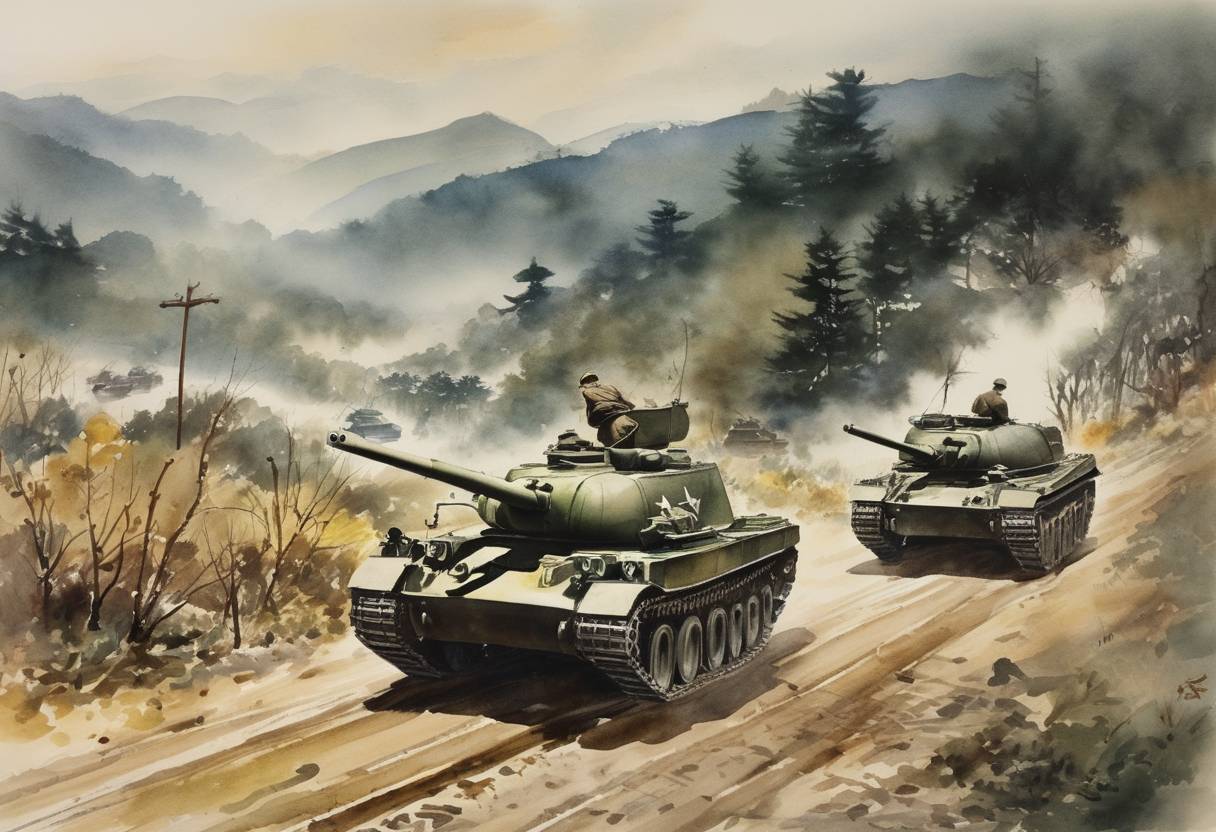
Deployment of U.S. Ground Forces in Korea: June 30, 1950
On June 30, 1950, President Harry S. Truman made a pivotal decision to order U.S. ground forces into Korea, marking a significant escalation in the Korean War. This action followed the North Korean invasion of South Korea on June 25, 1950, which had swiftly overwhelmed South Korean defenses and captured the capital, Seoul.
Context and Background
The Korean Peninsula had been divided at the 38th parallel after World War II, with the Soviet Union occupying the north and the United States occupying the south. The Democratic People’s Republic of Korea (North Korea) and the Republic of Korea (South Korea) were established in 1948, each claiming to be the legitimate government of the entire peninsula. Tensions between the two states, backed by the Soviet Union and U.S./UN respectively, had been mounting.
The invasion by North Korean forces, led by Kim Il-sung, was a direct challenge to the United Nations (UN) and the post-WWII order. On June 27, the UN Security Council passed Resolution 83, recommending member states assist South Korea in repelling the armed attack and restoring peace.
Truman’s Decision and Military Context
President Truman, facing the rapid advance of North Korean forces, sought to implement a response that would uphold UN principles and contain the spread of communism in accordance with the Truman Doctrine. This decision came amid fears of a broader conflict involving Soviet forces, which necessitated a measured but firm response.
Military deployments included the 24th Infantry Division, which was sent as part of the United Nations Command established under General Douglas MacArthur. The move from air and naval support to the deployment of ground troops signaled a substantial commitment from the U.S., as it became clear that a more robust effort was needed to stabilize the situation in Korea.
Aftermath and Significance
The deployment marked the beginning of a major U.S. military engagement, which saw American and UN forces participating directly in combat operations alongside the Republic of Korea (South Korea) army. This event heralded a period of intense military activity, characterized by significant battles such as the Pusan Perimeter defense and the Inchon Landing.
Truman’s decision underscored the U.S.’s commitment to containing communism in Asia and signaled the beginning of a larger Cold War engagement in Asia. It set the stage for U.S. involvement in Korea for the ensuing three years, significantly impacting U.S. military and foreign policy in the decades to follow.