Galileo's Observation of the Galilean Moons
1610 · Padua, Italy
Galileo Galilei made his first observation of the four largest moons of Jupiter: Ganymede, Callisto, Io, and Europa, which are now known as the Galilean moons.
August 25, 1609
Galileo Galilei demonstrates his first telescope to Venetian lawmakers.
Venice, Italy | Republic of Venice
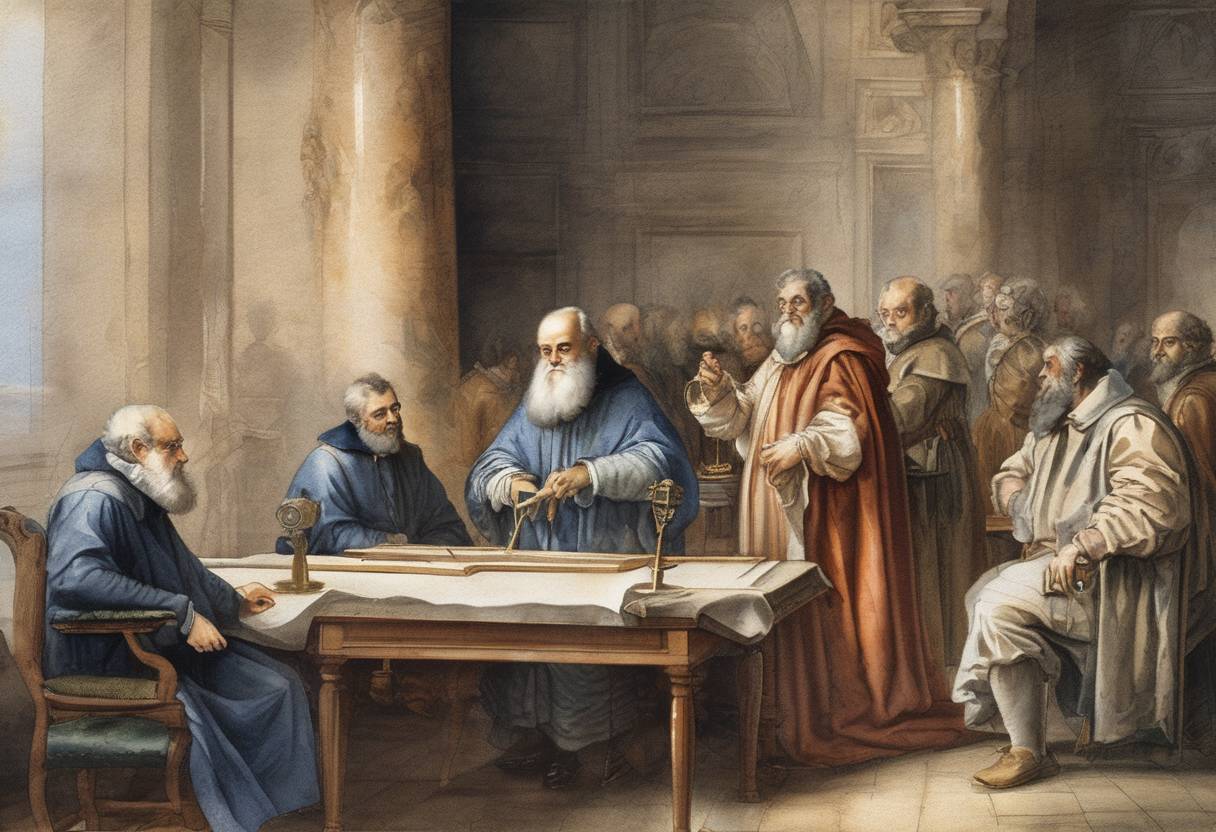
On August 25, 1609, the renowned Italian astronomer and physicist Galileo Galilei presented his first telescope to the lawmakers of Venice. This event marked a pivotal moment in the history of astronomy and science, as it showcased the potential of telescopic technology to expand human understanding of the universe.
Galileo Galilei, born in 1564 in Pisa, Italy, was a key figure in the Scientific Revolution. By the early 17th century, he had already established himself as a prominent mathematician and scientist. The invention of the telescope, originally developed in the Netherlands in 1608, quickly caught Galileo’s attention. Although he was not the original inventor, Galileo improved upon the design significantly, enhancing its magnification capabilities.
Galileo’s demonstration to the Venetian lawmakers took place on the bell tower of St. Mark’s Basilica in Venice. He presented an 8x magnification telescope, which was a significant improvement over the initial Dutch designs that offered only 3x magnification. This demonstration was not only a scientific milestone but also a strategic move by Galileo to gain favor and patronage from the Venetian government.
The demonstration was a success, impressing the Venetian lawmakers with its potential military applications, such as spotting distant ships. As a result, Galileo was rewarded with a lifetime lectureship at the University of Padua and a significant salary increase.
Galileo’s demonstration of his telescope to the Venetian lawmakers on August 25, 1609, was a landmark event that not only advanced the field of astronomy but also highlighted the intersection of science, technology, and politics. It underscored the transformative power of scientific innovation and its ability to reshape human understanding of the natural world.
Source: en.wikipedia.org