The United Kingdom’s First Atomic Bomb Test: Operation Hurricane
On October 3, 1952, the United Kingdom successfully conducted its first atomic bomb test, codenamed “Operation Hurricane,” off the coast of the Montebello Islands in Western Australia. This event marked the UK as the third nation to develop and possess nuclear weapons, following the United States and the Soviet Union.
Context and Background
Post-WWII Nuclear Race: After World War II, the geopolitical landscape was dominated by the Cold War tensions between the United States and the Soviet Union. The development of nuclear weapons became a crucial element of national security and international influence.
British Nuclear Program: The UK initiated its nuclear weapons program in the late 1940s, driven by the need to maintain its status as a global power and to ensure national security. The program was spearheaded by the British government under Prime Minister Clement Attlee and continued under Winston Churchill.
Collaboration and Independence: Initially, the UK collaborated with the United States under the Quebec Agreement during WWII. However, post-war, the U.S. passed the Atomic Energy Act of 1946 (McMahon Act), restricting nuclear information sharing, prompting the UK to pursue an independent nuclear capability.
The Test: Operation Hurricane
Location: The test was conducted in the remote Montebello Islands, chosen for their isolation and the ability to minimize risk to populated areas.
The Device: The bomb was a plutonium implosion device, similar in design to the “Fat Man” bomb dropped on Nagasaki. It was detonated aboard the frigate HMS Plym, which was anchored in the lagoon.
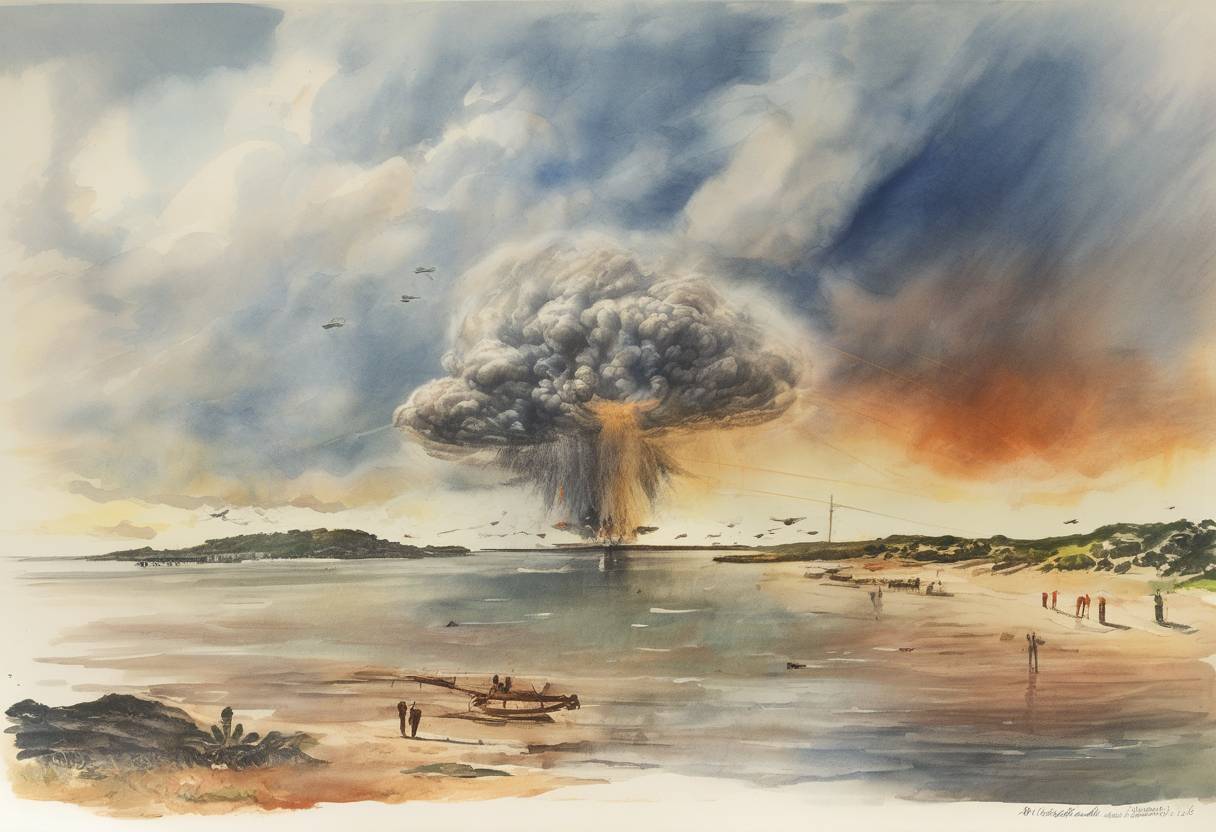
Detonation: At 8:00 AM local time, the device was detonated, producing an explosion equivalent to 25 kilotons of TNT. The blast created a significant mushroom cloud and caused extensive damage to the surrounding area.
Aftermath and Significance
International Standing: The successful test solidified the UK’s position as a leading military power and a key player in the Cold War dynamics. It also reinforced the UK’s role as a principal ally of the United States within NATO.
Nuclear Policy: The test led to the establishment of the UK as a nuclear state, influencing its defense policy and international relations. It also contributed to the ongoing nuclear arms race, prompting further developments in nuclear technology and strategy.
Environmental and Health Concerns: The test, like others of its time, raised concerns about environmental damage and the health impacts of radioactive fallout, issues that would become more prominent in later decades.
Conclusion
Operation Hurricane was a pivotal moment in British history, marking the nation’s entry into the exclusive club of nuclear powers. It underscored the complexities of nuclear diplomacy and the balance of power during the Cold War era. The test also highlighted the broader implications of nuclear weapons development, including ethical, environmental, and geopolitical considerations.