The Battle of Dunbar - April 27, 1296
1296 · Dunbar, Scotland
The Battle of Dunbar took place during the First War of Scottish Independence. English forces under King Edward I defeated the Scots, leading to his occupation of Scotland.
August 7, 1106
The Battle of Tinchebray was fought between Henry I of England and his brother Robert Curthose, Duke of Normandy, resulting in an important victory for Henry and the capture of Robert, bringing Normandy under English control.
Tinchebray, Duchy of Normandy (now France) | Kingdom of England
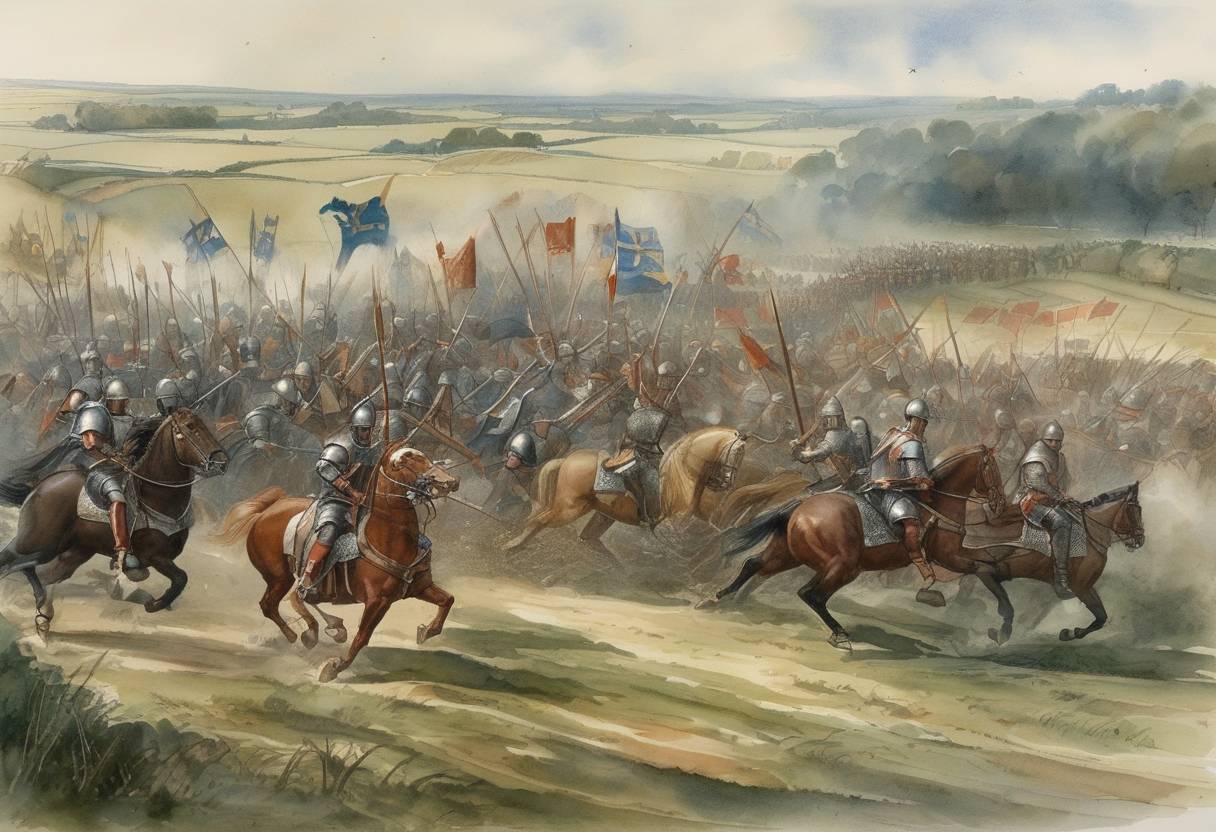
The Battle of Tinchebray was a decisive conflict fought on September 28, 1106, between King Henry I of England and his older brother, Robert Curthose, the Duke of Normandy. This battle was part of the larger struggle over control of Normandy, a region both held personal claims to due to their lineage as sons of William the Conqueror.
After the death of William the Conqueror in 1087, Henry and Robert’s rivalry intensified. The Norman lands were divided between the two brothers, with Robert receiving the Duchy of Normandy, while William II, their other brother, retained the English crown. Following William II’s death in 1100, Henry seized the English throne. This move escalated tensions, as Henry sought to reunite England and Normandy, leading to a series of conflicts over the control of these territories.
The confrontation took place at Tinchebray, a strategic location in Normandy. Henry’s forces consisted of English, Norman, and local allies, organized into units of cavalry and infantry. Commanding a force of reportedly about 3,000 knights and soldiers, Henry I approached with a mix of strategic discipline and tactical planning, effectively employing both cavalry and infantry.
Robert’s army, somewhat similar in size, fought under his personal command alongside his younger brother, William Clito. The battle commenced with a swift and aggressive assault by Henry’s forces. Utilizing superior field tactics, Henry’s men managed to break Robert’s lines. A key maneuver involved attacking the center of Robert’s army, creating a breach and ultimately leading to their encirclement.
The battle resulted in a decisive victory for Henry I. Robert Curthose was captured along with several of his key commanders and was taken prisoner. Subsequently, Robert spent the rest of his life in captivity, dying in 1134.
Henry’s victory at Tinchebray effectively brought Normandy under his control, unifying the realm across the English Channel and consolidating his authority. This unification of Normandy and England under Henry helped to stabilize his reign, laying the groundwork for stronger centralized governance. It marked a significant shift in the balance of power in Western Europe and had lasting implications for the relationship between England and France.
Henry’s rule continued to reinforce the Angevin domain, setting the stage for future English aspirations and expansions on the continent. The integration of Normandy into the English crown established a foundation for the Plantagenet dynasty’s future claims and conflicts in France, notably impacting the Angevin Empire’s formation.
Source: en.wikipedia.org