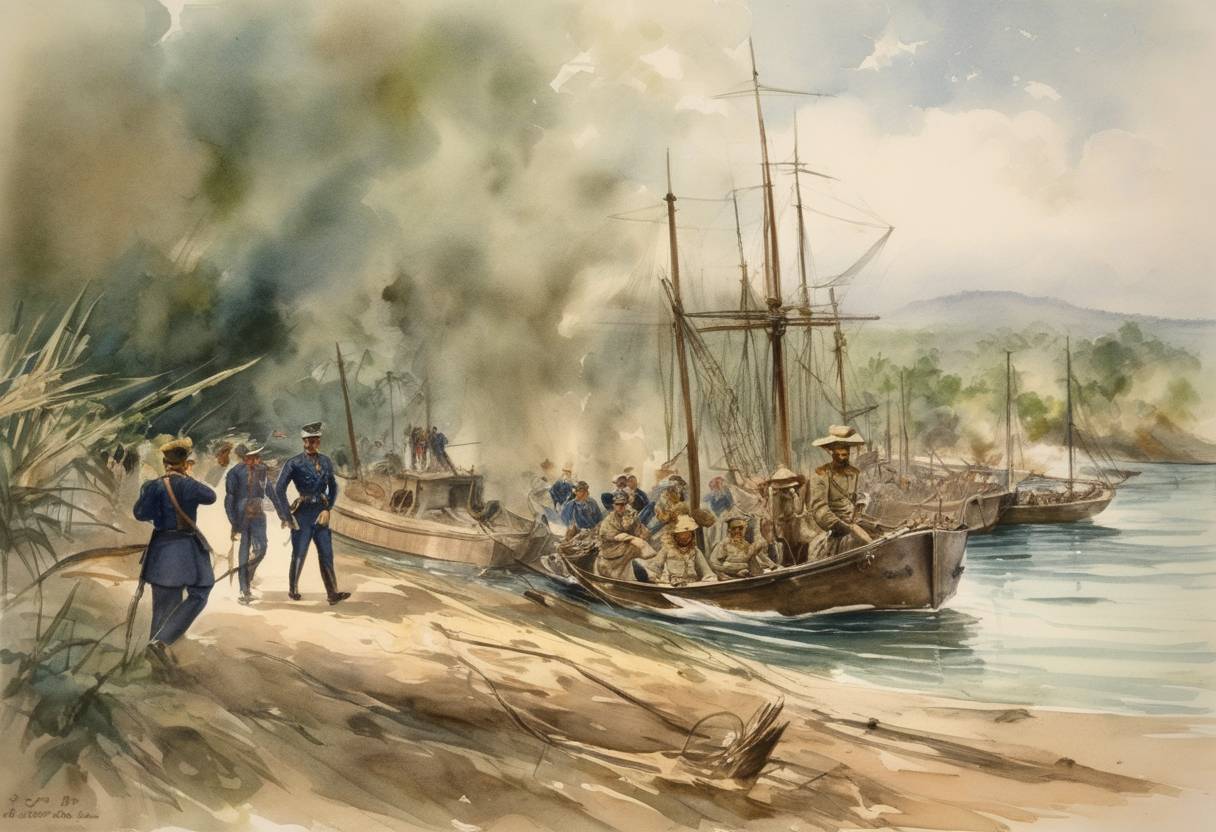
United States Forces Land in Cuba - June 22, 1898
On June 22, 1898, during the Spanish-American War, the United States launched a critical military maneuver by landing forces on the southern coast of Cuba, near the town of Daiquiri. This strategic move was part of the larger campaign to seize control of Cuba from Spanish colonial rule. The operation marked a turning point in the conflict, highlighting the tactical evolution and coordination of American forces.
Context and Prelude
The Spanish-American War erupted in April 1898, following months of escalating tension between the United States and Spain, primarily over the latter’s harsh colonial rule in Cuba. The explosion of the USS Maine in Havana Harbor galvanized U.S. public opinion toward intervention. Following a series of naval victories in the Pacific at Manila Bay, U.S. strategic focus shifted towards engagements in the Caribbean.
The Landing
The U.S. expeditionary forces, composed predominantly of infantry units, embarked from Tampa, Florida, as part of the Fifth Army Corps led by Major General William Rufus Shafter. The landing at Daiquiri involved intricate planning and coordination with naval escorts. The American troops were tasked with establishing a foothold on the island to begin a direct assault against Spanish forces stationed inland.
On the morning of June 22, approximately 16,000 soldiers began disembarking onto Cuban soil. The operation was characterized by logistical challenges, including rough seas and a lack of proper landing infrastructure, which delayed deployment. Nevertheless, the landing proceeded with minimal Spanish resistance, as the naval bombardment had successfully secured the area.
Impact and Significance
The successful landing at Daiquiri allowed U.S. forces to swiftly advance towards the Cuban interior, putting pressure on Santiago de Cuba, a pivotal target for the campaign. The subsequent victories in battles such as the Battle of San Juan Hill further underscored the strategic advantage gained by securing a Cuban beachhead.
This amphibious operation was one of the earliest examples of a coordinated joint forces endeavor by the U.S. military and set a precedent for future military undertakings involving army and naval cooperation. The victory in Cuba significantly contributed to the U.S. emerging as a consequential power on the world stage and marked the beginning of American imperial expansion into the Caribbean and the Pacific.