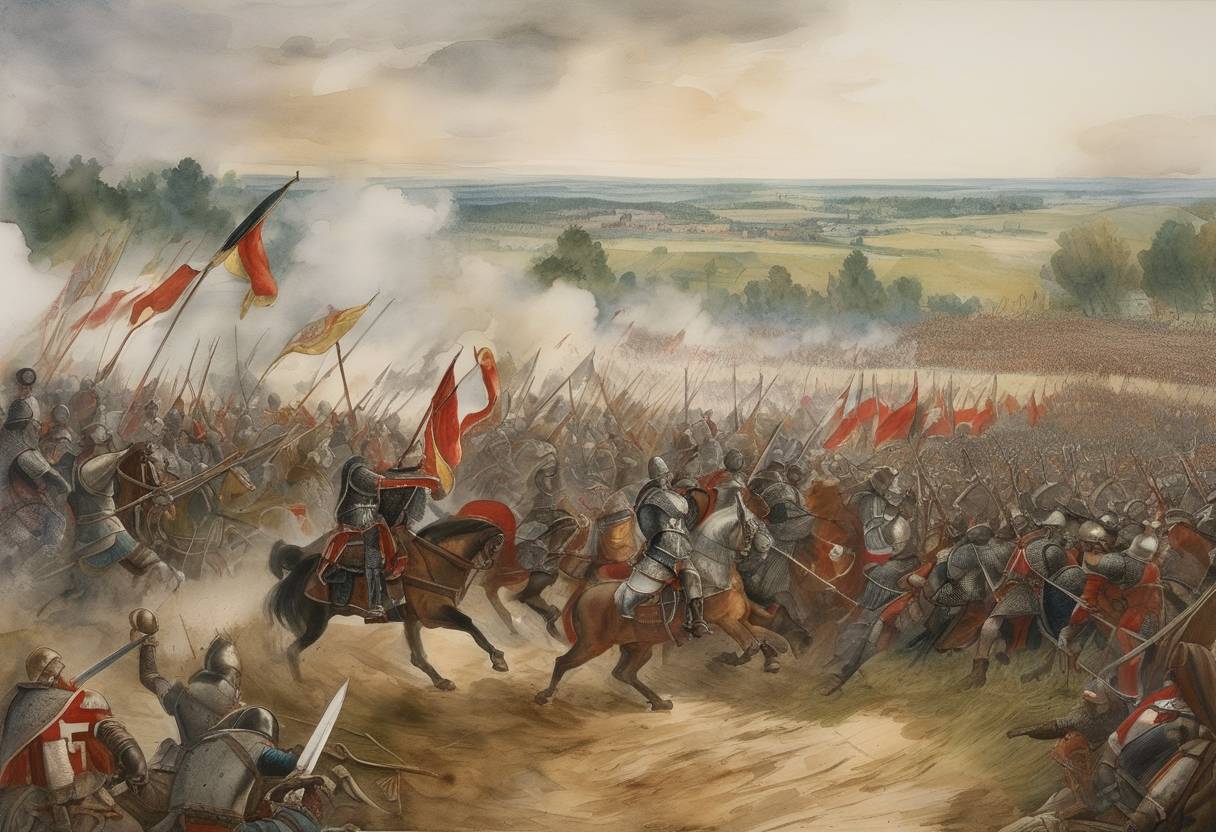
The Battle of Göllheim: July 2, 1298
The Battle of Göllheim, fought on July 2, 1298, was a pivotal conflict in the struggle for power within the Holy Roman Empire. This battle determined the fate of the imperial throne contested between Adolf of Nassau and Albert of Habsburg.
Background
In the late 13th century, the Holy Roman Empire was a fractious entity with numerous claimants to power. Adolf of Nassau was elected King of the Romans in 1292, but his rule soon faced significant opposition. His financial strains, failures in military ventures, and unpopular policies led to a rise in dissent among the German princes. A key rival emerged in the form of Albert I of Habsburg, who claimed the throne after Adolf’s election was increasingly seen as invalid due to his inability to maintain the support of influential nobles.
The Battle
The decisive encounter took place near the village of Göllheim in what is now Rhineland-Palatinate, Germany. Adolf’s forces, having initially tried to regroup and defend his reign, met Albert’s army in battle. Albert had managed to garner significant support, and this backing proved crucial. Despite Adolf’s efforts to muster a formidable defense, his forces were ultimately overwhelmed by the superior numbers and strategy of the Habsburg host.
Adolf of Nassau was killed during the fighting, allegedly receiving a fatal blow while still on the battlefield. This effectively brought an end to his tenure as King of the Romans and positioned Albert of Habsburg as the uncontested claimant.
Aftermath
The victory at Göllheim allowed Albert of Habsburg to solidify his claim to the throne, and he was officially recognized as King of the Romans the following year. Albert’s triumph marked a significant turning point, consolidating the power of the Habsburg family, which would come to dominate Central European politics for centuries.
The site of Adolf’s death was marked by the erection of a memorial called the “King’s Cross” (Königskreuz) by Albert, symbolizing the Habsburg ascendancy and issuing a stark reminder of the battle’s outcome.
Albert’s reign as king featured efforts to strengthen royal authority, although inter-family rivalries and external challenges persisted throughout his tenure. The events at Göllheim set the stage for future disputes within the empire but signaled a momentary stabilization of power amidst the competing interests that characterized the medieval Holy Roman Empire.
Historical Significance
The Battle of Göllheim remains a critical event in medieval European history as it underscored the volatile nature of imperial elections and the influence noble support held in determining leadership within the Holy Roman Empire. Moreover, it laid the groundwork for the enduring legacy of the Habsburg dynasty, whose influence would shape European politics and history in the following centuries.