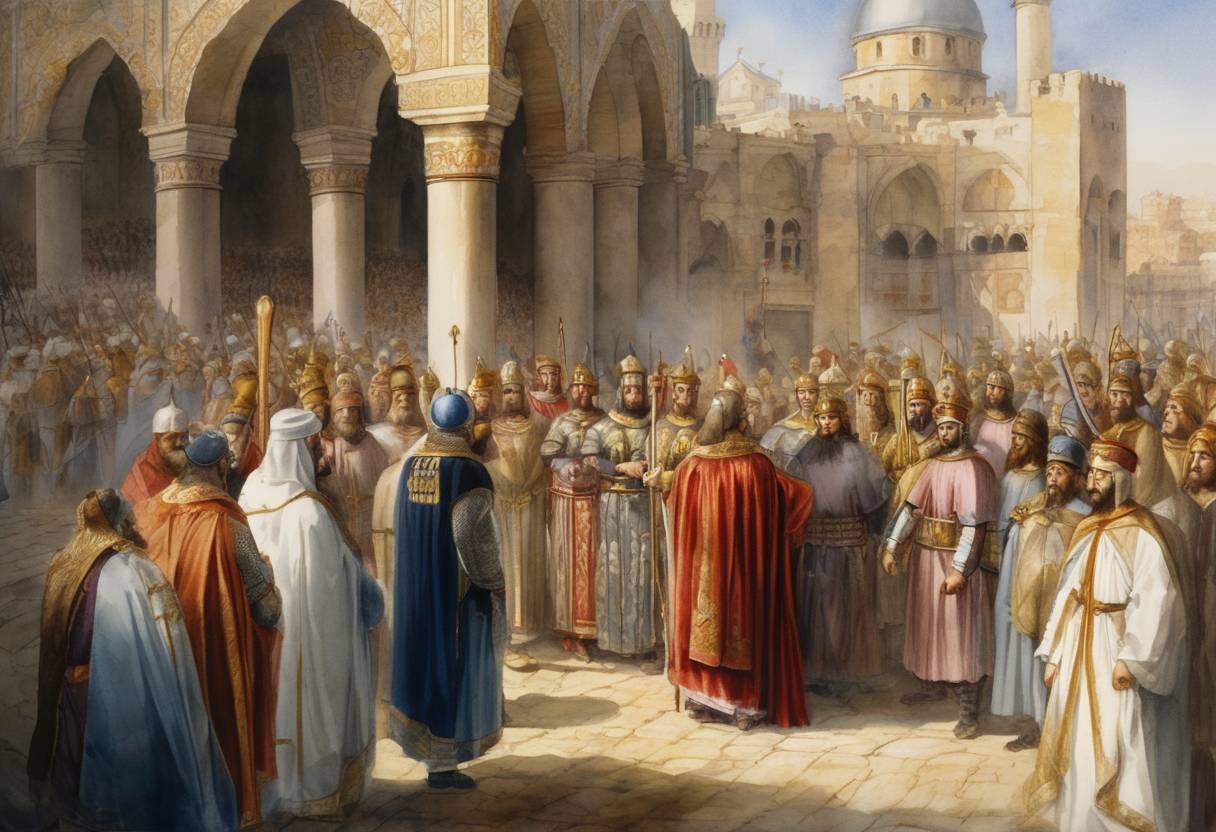
Alexios V Doukas Declared Byzantine Emperor
On February 5, 1204, Alexios V Doukas was declared the Byzantine Emperor amid the chaos of the Fourth Crusade. This event unfolded during a tumultuous period in Byzantine history when internal strife and external pressures culminated in a dramatic shift of power within the empire.
Background
The Fourth Crusade, initially intended to conquer Muslim-controlled Jerusalem by means of an invasion through Egypt, was drastically diverted. By 1203, the Crusaders had reached Constantinople, driven by debts and promises made by the deposed Byzantine prince Alexios IV Angelos. Alexios IV, who sought to reclaim the throne from his uncle, Emperor Alexios III, had promised the Crusaders substantial financial rewards and the unification of the Western and Eastern Christian churches in return for their support.
Rise to Power
After the initial success in restoring Alexios IV to power in 1203 alongside his blind father, Isaac II Angelos, the duo proved unable to fulfill their financial promises to the Crusaders. This failure, combined with rising tensions and dissatisfaction within Constantinople, led to civil unrest.
In this climate of instability, Alexios V Doukas, known by the nickname Mourtzouphlos, gained prominence. A member of a notable Byzantine family, Doukas seized the opportunity presented by the public’s growing discontent. On February 5, 1204, he was proclaimed emperor after engineering a coup that ultimately led to the imprisonment and execution of Alexios IV. Doukas’ ascension was supported by factions within the capital eager to rid themselves of the Latin presence and the influence of the Crusaders.
Reign and Fall
As emperor, Alexios V sought to fortify Constantinople’s defenses against the Crusader threat and attempted to consolidate his power. However, his rule was short-lived. By April 1204, the Crusaders, frustrated by their lack of payment and seeing a weakened Byzantine leadership, resolved to attack the city.
Despite attempts to defend the city and rally Byzantine forces, Alexios V’s reign ended when he fled Constantinople as the Crusaders successfully breached its walls during the infamous Sack of Constantinople. This event marked the de facto end of the Byzantine Empire’s dominance in the region, as it was replaced by the Latin Empire, fundamentally altering the course of Eastern Orthodox and Byzantine history.
Historical Significance
The proclamation of Alexios V Doukas as Byzantine Emperor on February 5, 1204, underscored the volatility and factionalism of late Byzantine politics during the Fourth Crusade. His short-lived reign and subsequent events directly contributed to one of the most significant and transformative episodes in the history of the Byzantine Empire, illustrating the interplay of internal political dynamics and external military pressures.