Battle of Princeton: January 3, 1777
1777 · Princeton, United States
American Revolutionary War: American forces under General George Washington defeated British forces at the Battle of Princeton.
January 1, 1776
During the American Revolutionary War, General George Washington hoists the Grand Union Flag, the first national flag of the United States, at Prospect Hill.
Somerville, United States | Continental Army
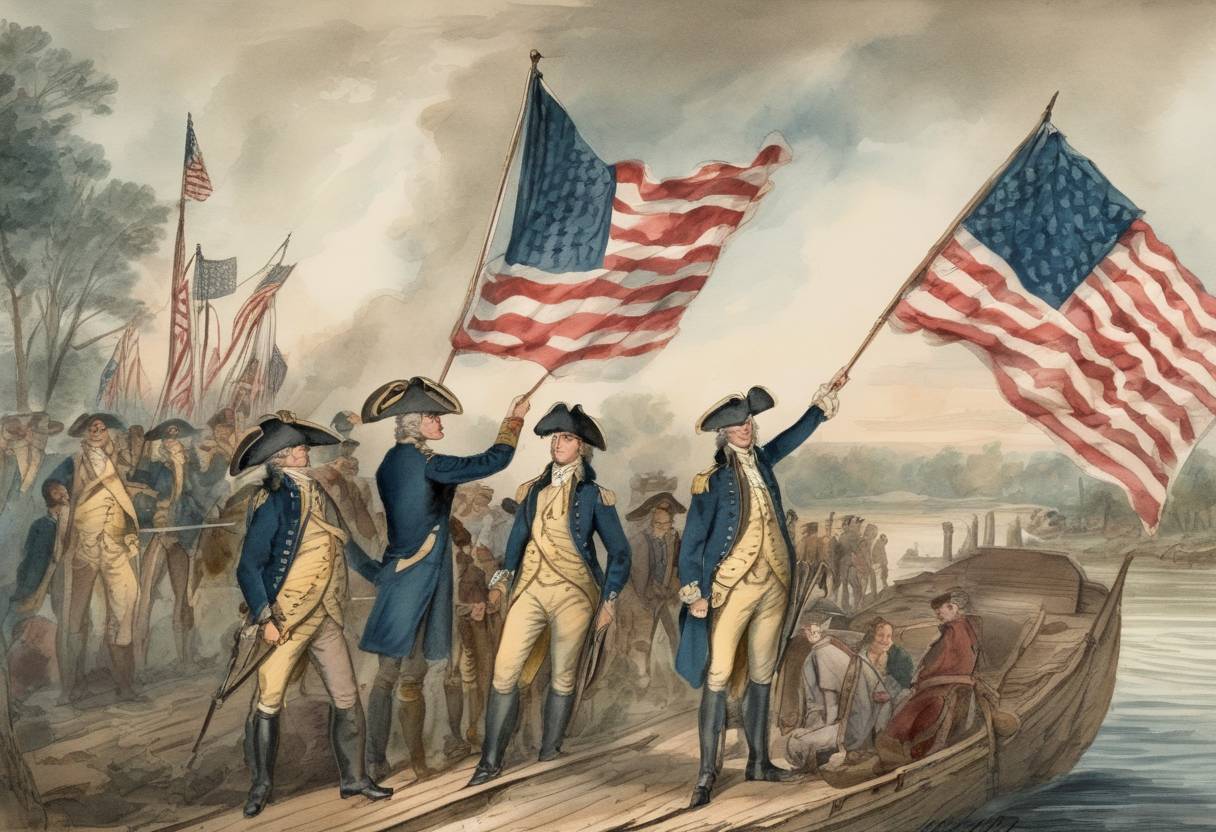
On January 1, 1776, during the American Revolutionary War, General George Washington hoisted the Grand Union Flag at Prospect Hill, near his headquarters in Cambridge, Massachusetts. This event marked a significant moment in American history as it was the first time a national flag was raised to represent the united colonies.
The American Revolutionary War: The conflict between the Thirteen American Colonies and Great Britain had begun in April 1775 with the battles of Lexington and Concord. By the end of 1775, the Continental Army, led by General George Washington, was engaged in the Siege of Boston, attempting to expel British forces from the city.
Need for a Unified Symbol: As the colonies sought independence, there was a growing need for a symbol that represented their unity and collective resolve. Prior to the Grand Union Flag, various colonial and regimental flags were used, but none symbolized the colonies as a whole.
Design: The Grand Union Flag, also known as the Continental Colors, combined elements of the British Union Jack with the thirteen stripes representing the colonies. The flag featured the Union Jack in the canton (upper left corner) and thirteen alternating red and white stripes.
Symbolism: The Union Jack in the flag’s design acknowledged the colonies’ historical ties to Britain, while the stripes symbolized their unity and determination to stand together against British rule.
Location: Prospect Hill, located in present-day Somerville, Massachusetts, was a strategic high ground used by the Continental Army during the Siege of Boston.
Significance: The raising of the Grand Union Flag was a morale booster for the Continental Army and the colonial populace. It signified a new phase in the struggle for independence, emphasizing the colonies’ unity and resolve.
Evolution of the Flag: The Grand Union Flag served as the de facto national flag until June 14, 1777, when the Continental Congress adopted the Stars and Stripes as the official flag of the United States.
Legacy: The hoisting of the Grand Union Flag is remembered as a pivotal moment in American history, symbolizing the transition from disparate colonial entities to a unified nation striving for independence.
In summary, the raising of the Grand Union Flag by General George Washington on January 1, 1776, was a key event in the American Revolutionary War, representing the unity and determination of the Thirteen Colonies in their quest for independence from British rule.
Source: en.wikipedia.org