Execution of Atahualpa: The Last Inca Emperor
1533 · Cajamarca, Peru
Atahualpa, the last Inca Emperor, was executed by Spanish conquistadors under Francisco Pizarro's command, marking a significant event in the Spanish conquest of the Inca Empire.
November 20, 1541
After its capture by Spanish conquistadors, King Dauphin of the Inca Empire and his court were executed by Francisco Pizarro in Jaén, Peru.
Jaén, Peru | Spanish Conquistadors
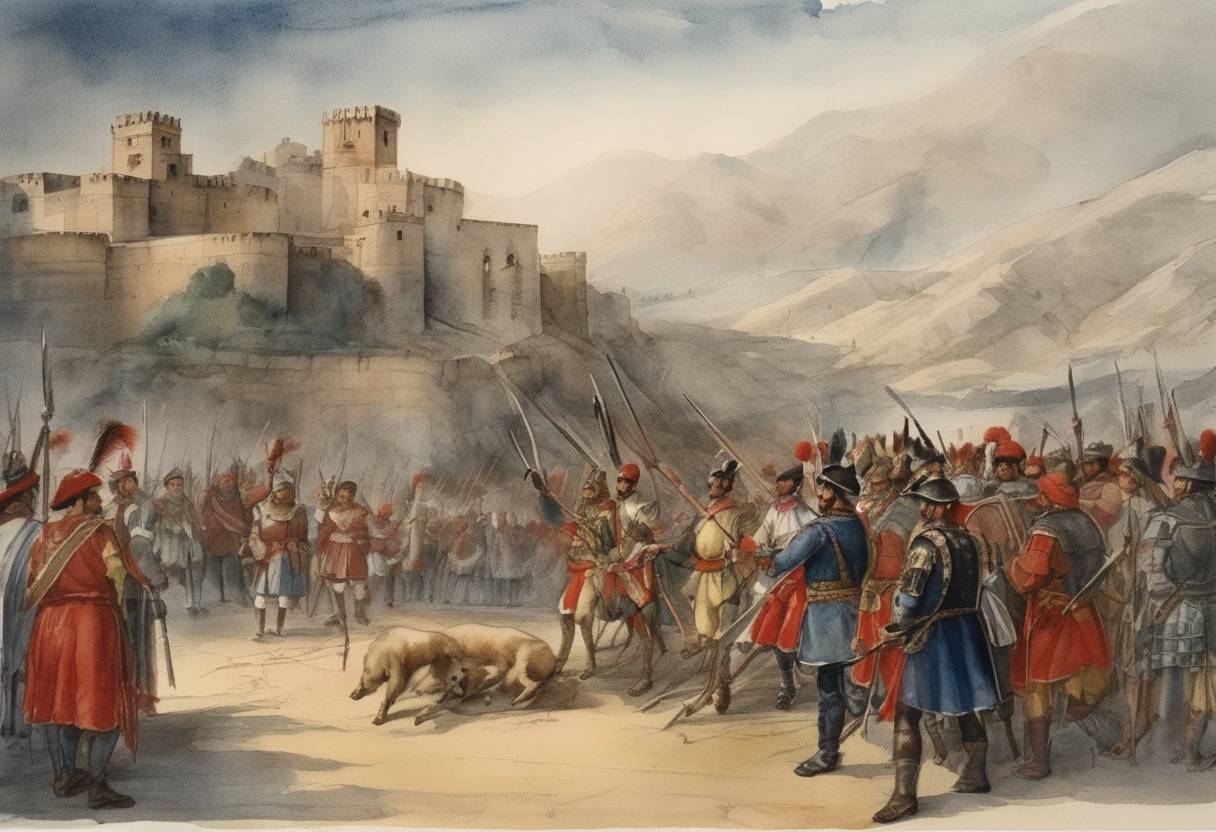
On November 20, 1541, a significant yet often lesser-known event in the conquest of the Inca Empire by the Spanish conquistadors took place. Francisco Pizarro, the Spanish conquistador renowned for his role in the conquest of the Incan civilization, ordered the execution of an Incan king referred to as “King Dauphin” and members of his court in Jaén, Peru.
By 1541, the Spanish conquest of the Inca Empire was well underway. Their advance, led by figures like Francisco Pizarro and Diego de Almagro, was characterized by strategic military campaigns, political manipulations, and often ruthless elimination of opposition. The capture and execution of Incan leaders were a part of their efforts to dismantle the local power structures and consolidate Spanish control over the region.
The individual referred to as “King Dauphin” in historical records is somewhat obscure, leading to speculation that this title might have been an interpretation or miscommunication of an indigenous title into European terms by chroniclers. During the Spanish conquest, it was common for various local leaders and potential claimants to the throne to be captured and executed as a means to prevent rebellion and secure territorial gains.
On this date, Pizarro ordered the execution of King Dauphin and his court, reinforcing the conquistadors’ dominance. This act was emblematic of the harsh measures employed by the Spanish to quell any form of resistance and to integrate the vast and culturally rich Incan domain into the Spanish Crown.
The execution of King Dauphin and his court served to demonstrate the absolute power the Spanish exerted over the local population. It contributed to the further destabilization of the remaining Inca resistance forces and highlighted the technological and tactical superiority possessed by the Spanish invaders, which they leveraged decisively in their favor.
The news of these executions would have rippled through the remaining Incan lands, serving as a deterrent against further resistance and encouraging submission to Spanish rule. This continued pattern of capture, trial, and execution of indigenous leaders played a key role in the eventual full subjugation of the Inca territory under the Spanish colonial rule.
While Francisco Pizarro’s conquest is more commonly associated with the capture and execution of Emperor Atahualpa, the death of leaders such as King Dauphin underscores the broader strategy employed by the conquistadors: subjugation through fear, the elimination of leadership, and assimilation. These events form an integral part of the narrative of the destruction of one of the most sophisticated pre-Columbian civilizations in the Americas.
Source: en.wikipedia.org