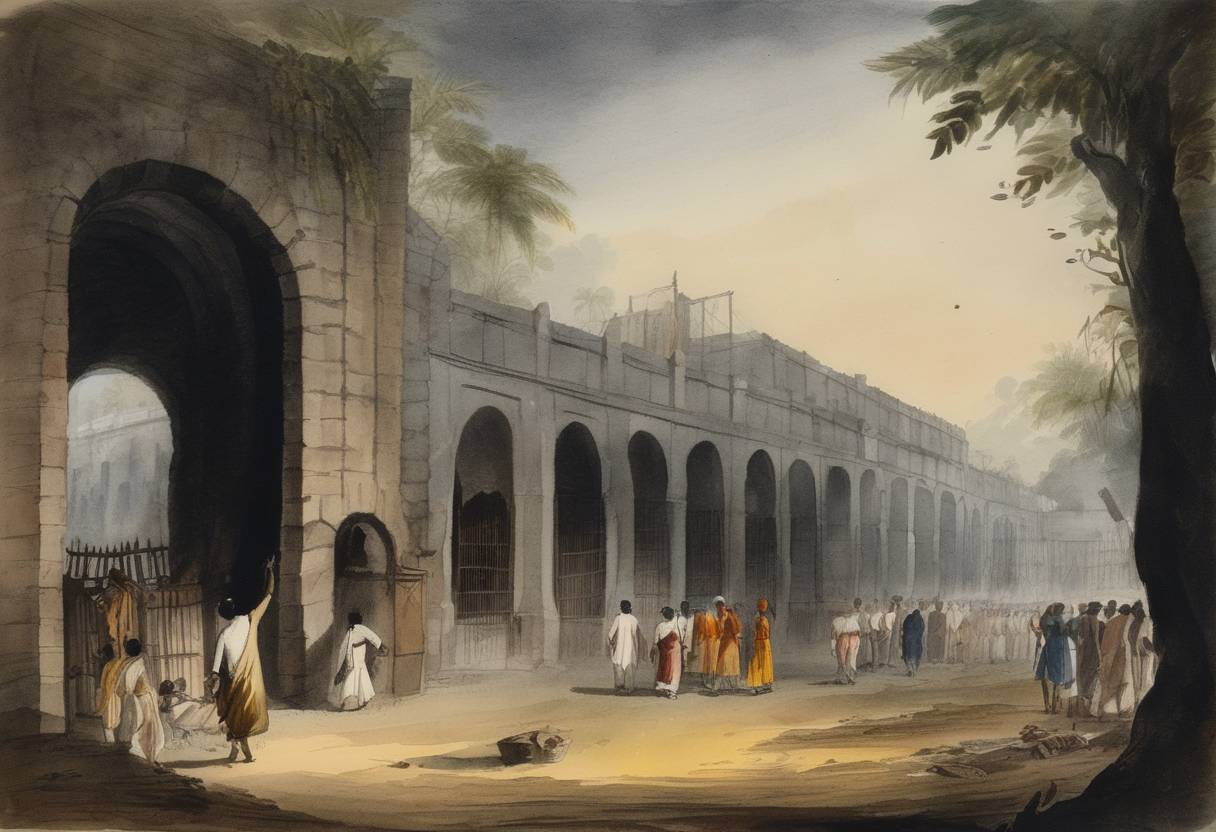
The Black Hole of Calcutta Incident - June 20, 1756
The Black Hole of Calcutta incident is a notorious episode that occurred on June 20, 1756, in the Indian city of Calcutta (now Kolkata). This incident is often cited as a dark moment in the history of British colonialism in India, illustrating the violent tensions between the British East India Company and local Indian rulers.
Background
The era was marked by growing tensions between the British East India Company, which was expanding its trading operations and influence in India, and the Nawab of Bengal, Siraj ud-Daulah. Siraj ud-Daulah was wary of the increasing fortifications at Fort William, the British stronghold in Calcutta, viewing them as threats to his authority.
The Event
On June 20, 1756, following a series of escalations, Siraj ud-Daulah’s forces captured Fort William after a brief siege. Following the capture, a large group of British and Anglo-Indian soldiers and civilians were reportedly imprisoned overnight in a small and poorly ventilated dungeon known as the “Black Hole.”
According to accounts, the cell measured about 14 feet by 18 feet and held an estimated 64 to 146 people. The cramped conditions led to a catastrophic lack of air and resulted in numerous deaths from suffocation and heat exhaustion as the night progressed. The exact number of deaths is disputed, but contemporary accounts often cite 123 fatalities.
Aftermath and Significance
The Black Hole incident became a rallying cry in Britain and was used to justify subsequent military actions against Siraj ud-Daulah. This eventually led to the Battle of Plassey in 1757, where British forces under Robert Clive decisively defeated the Nawab and secured British supremacy in the region.
The story of the Black Hole of Calcutta was heavily propagated by British officials, contributing to its infamy in colonial history. Modern historians debate the accuracy of the episode’s details, particularly regarding the number of prisoners and fatalities, recognizing that the narratives were potentially exaggerated to serve colonial narratives.
Nonetheless, the incident remains significant as it exemplified the perilous interactions between imperial forces and indigenous powers during a pivotal period in India’s colonial history, paving the way for significant political changes in Bengal and beyond.