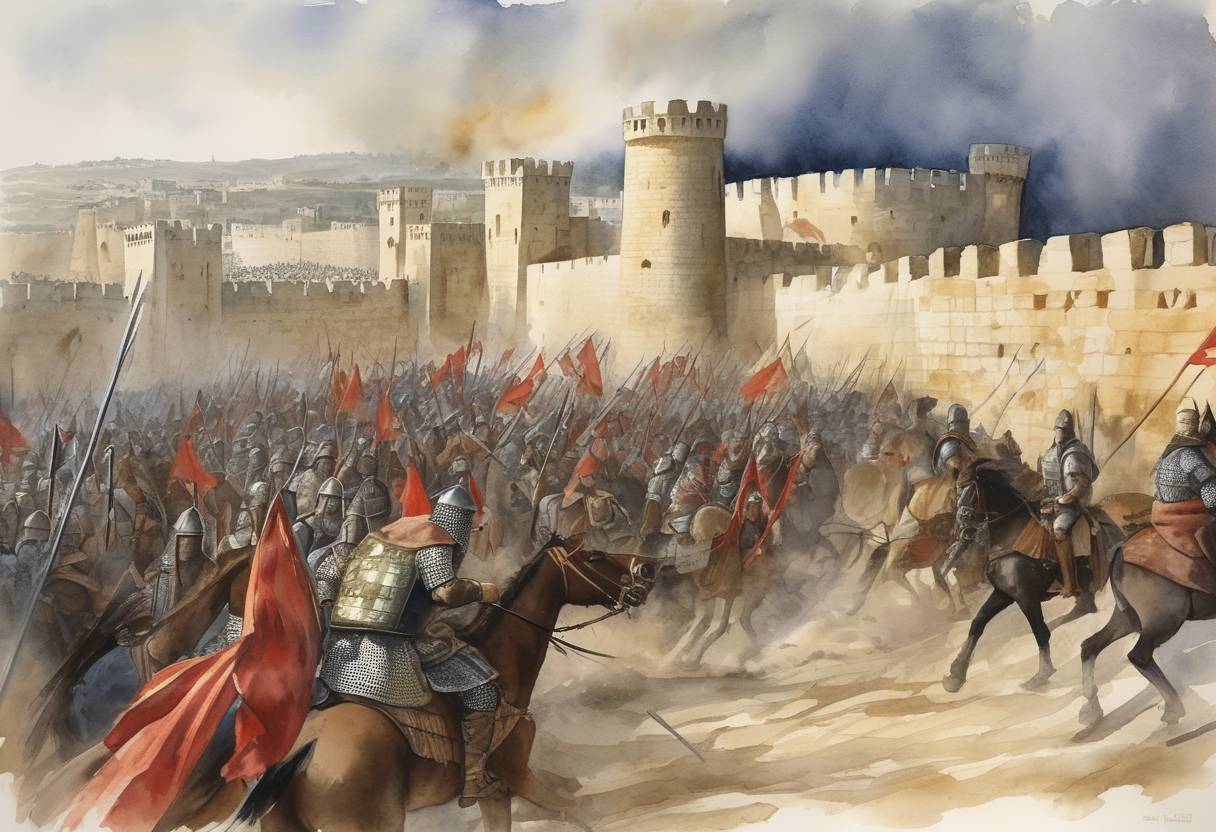
The Siege of Jerusalem Begins - June 6, 1099
On June 6, 1099, the Crusaders commenced the Siege of Jerusalem, marking a crucial phase in the First Crusade, which was a concerted effort by Christians to capture the Holy City from Muslim control. The First Crusade began in 1096 as a response to Pope Urban II’s call to aid the Byzantine Empire against Muslim Seljuk advances and to reclaim the Holy Land for Christendom.
Context and Prelude
Background: The First Crusade was initiated after Pope Urban II’s sermon at the Council of Clermont in 1095, urging Western Christian warriors to take up arms for a cause deemed both spiritual and sanctified.
The Route: The Crusaders, comprising knights, foot soldiers, and non-combatants, embarked on a perilous journey spanning thousands of miles from Europe to the Middle East. They traversed through what are now France, Italy, and the Byzantine-controlled areas, enduring hardships including starvation, disease, and skirmishes.
Key Battles: Before reaching Jerusalem, the Crusaders engaged in significant battles such as the Siege of Antioch in 1098, which was a major turning point bolstered by fervent belief in religious providence.
The Siege
Forces: The Crusader army ranged from 12,000 to 15,000 knights and infantry, a fraction of the original contingent due to attrition along the way. Their opponents in Jerusalem were a determined Muslim garrison defending the fatimid-controlled city.
Strategy: As the Crusaders arrived, they faced considerable challenges. The city’s formidable fortifications and the summer heat compounded difficulties in maintaining a siege.
Preparation: Various leaders divided their forces to encircle the city. Without adequate supplies and facing diseases such as dysentery, the Crusaders relied on their tenacity and the logistics provided by local Christian communities and merchants.
Significance and Aftermath
Impact: The June 6th siege marked the beginning of an intense campaign that would culminate in the capture of Jerusalem on July 15, 1099. The victory had far-reaching theological and geopolitical consequences for both the Christian and Islamic worlds.
Legacy: The capture of Jerusalem established several Crusader states, including the Kingdom of Jerusalem, altering the landscape of medieval geopolitics in favor of Christian powers, albeit temporarily.
Aftereffects: The aftermath saw brutal violence against the city’s inhabitants, a tragic historical footnote reflecting the era’s brutal inter-religious conflicts. The capture of Jerusalem underlined the religious fervor that characterized much of the First Crusade.
By achieving their primary objective of capturing the Holy City, the Crusaders set in motion centuries of conflict over the religious and strategic holdings in the Eastern Mediterranean, underscoring the deep interreligious tensions existent throughout medieval history.