The Death of Emperor Titus and the Succession of Domitian
81 · Rome, Roman Empire
The Roman Emperor Titus dies, and his brother Domitian succeeds him as Emperor of Rome.
December 22, 0069
Vitellius, the Roman emperor, was captured and killed in Rome by Vespasian's forces, effectively ending his rule and the Year of the Four Emperors.
Rome, Roman Empire | Roman Empire
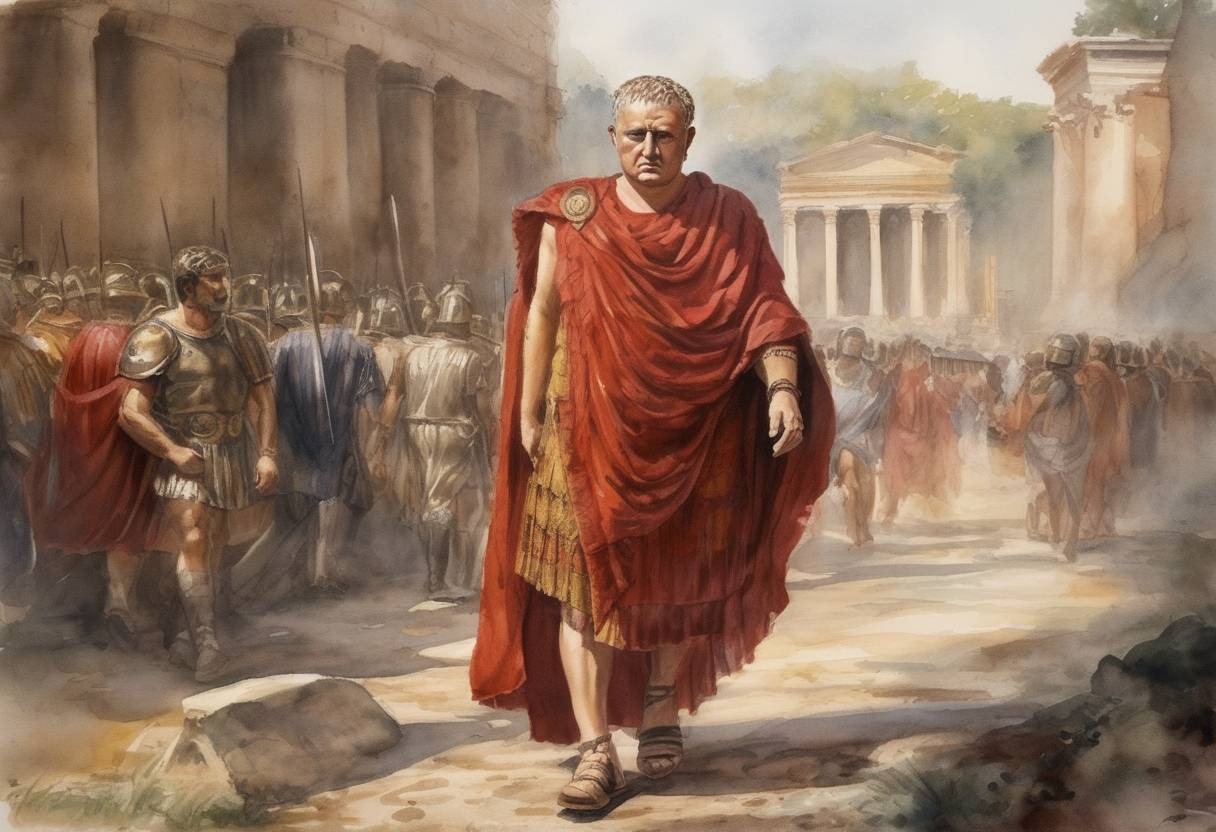
On December 22, 69 AD, the brief and tumultuous reign of the Roman Emperor Vitellius came to a violent end when he was captured and executed by forces loyal to his successor, Vespasian. This event not only marked the conclusion of Vitellius’s rule but also effectively ended the chaotic period known as the Year of the Four Emperors.
The Roman Empire was plunged into turmoil following the suicide of Emperor Nero in 68 AD. Over the next year, the empire saw a rapid succession of rulers, with emperors Galba, Otho, Vitellius, and eventually Vespasian all seizing power at different points. This period was characterized by civil war, political machinations, and shifting allegiances among the legions.
Vitellius, initially appointed as governor of the province of Germania Inferior by Emperor Galba, found himself propelled to power when his legions declared him emperor in early 69 AD. Vitellius managed to seize control after defeating Otho in the Battle of Bedriacum. His reign, however, was marked by excess and a lack of political acumen, which quickly led to dissatisfaction among the Roman populace and elite.
As Vitellius struggled to maintain his hold on the throne, Titus Flavius Vespasianus (commonly known as Vespasian), a celebrated military commander stationed in the Eastern provinces, was declared emperor by the Roman legions of the eastern provinces. Moving westwards, Vespasian’s forces sought to claim Rome for their commander. The decisive confrontation came when Vespasian’s strategists, led by commanders such as Marcus Antonius Primus, advanced into Italy and won a significant victory near Cremona.
By December 69 AD, Vespasian’s forces had entered Rome. Vitellius’s attempts to abdicate in favor of preserving his and his family’s lives failed as chaos consumed the city. On December 22, despite efforts to disguise himself and hide in a door-to-door search, Vitellius was captured by soldiers. He was dragged through the streets of Rome, publicly humiliated, and eventually executed, with his body cast into the Tiber River.
Vitellius’s death and the accession of Vespasian to the throne marked the end of the Year of the Four Emperors. Vespasian would go on to found the Flavian dynasty, bringing relative stability to the Roman Empire after a period marked by rapid upheaval. Vespasian’s reign saw significant administrative reforms and the commencement of ambitious construction projects, including the beginning of the Colosseum.
This dramatic sequence of events underscored the volatility of the Roman imperial system in the absence of a clear succession plan and highlighted the power wielded by the Roman legions in determining the fate of emperors.
Source: en.wikipedia.org