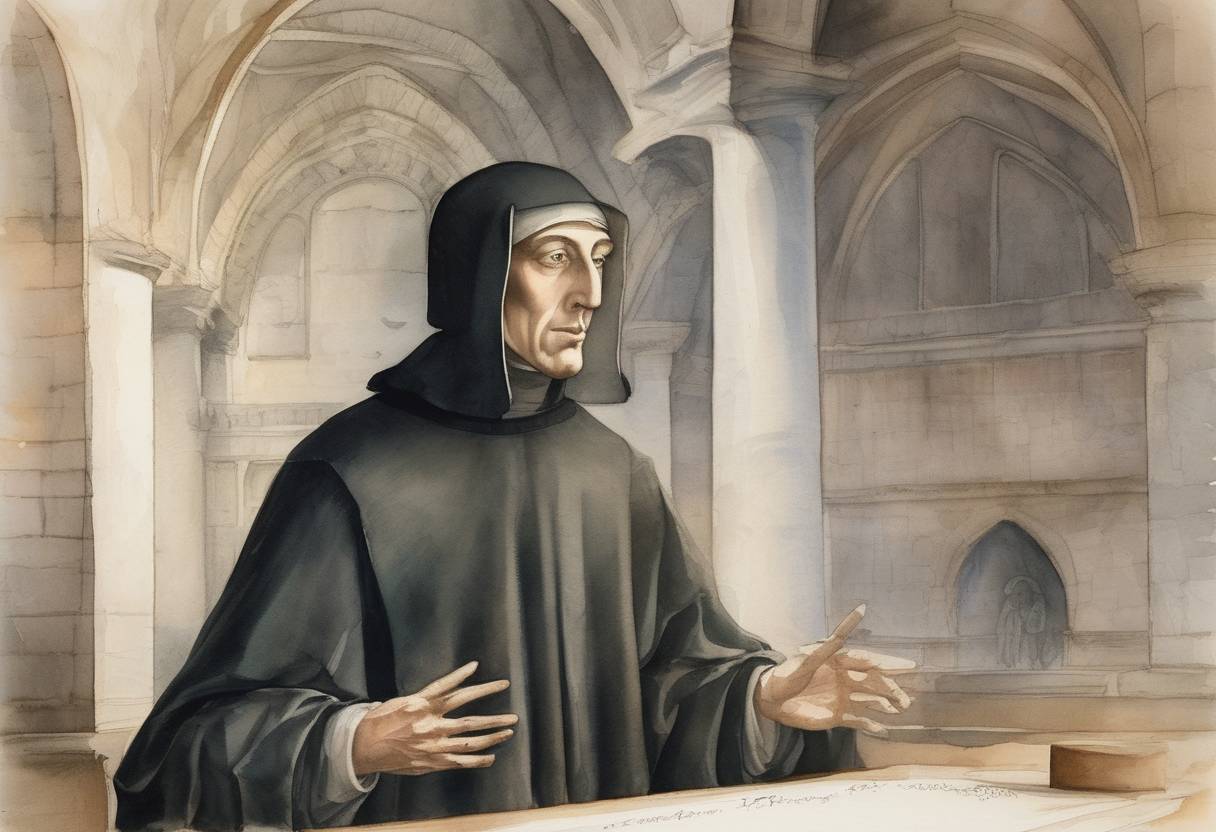
Execution of Girolamo Savonarola - May 23, 1498
Girolamo Savonarola was an influential Italian Dominican friar and preacher known for his vehement denunciations of secularism, moral corruption, and the excesses of the Renaissance culture in Florence. His execution on May 23, 1498, marked the end of a tumultuous period in Florentine history.
Background
Early Life and Rise to Power: Savonarola was born on September 21, 1452, in Ferrara, Italy. He joined the Dominican Order in Bologna in 1475 and became known for his passionate sermons. In 1490, he was invited to Florence by Lorenzo de’ Medici, where he quickly gained a reputation as a fiery preacher.
Preaching and Influence: Savonarola’s sermons focused on the need for religious reform and the denunciation of the moral decay he perceived in the church and society. He prophesied apocalyptic visions and called for a return to Christian values. His influence grew, and he became a central figure in Florentine politics, especially after the death of Lorenzo de’ Medici in 1492.
The Bonfire of the Vanities: In 1497, Savonarola organized the infamous “Bonfire of the Vanities,” where citizens of Florence were encouraged to burn objects associated with vanity, such as cosmetics, art, and books, in a massive public pyre.
Events Leading to Execution
Conflict with the Papacy: Savonarola’s growing power and his criticisms of the church eventually led to conflict with Pope Alexander VI. In 1495, he defied the pope by refusing to join the Holy League against France, which led to his excommunication in 1497.
Political Downfall: His influence began to wane as political and economic conditions in Florence deteriorated. The failure of his prophecies and increasing opposition from the Medici supporters and other factions led to his arrest.
Trial and Execution: Savonarola was tried for heresy, sedition, and other charges. Under torture, he confessed to being a false prophet. On May 23, 1498, he was executed by hanging and burning in the Piazza della Signoria in Florence, alongside two of his closest followers.
Aftermath and Historical Significance
Legacy: Savonarola’s execution did not immediately end his influence. His followers, known as the “Piagnoni,” continued to promote his ideas. Over time, he became a symbol of religious reform and moral integrity.
Impact on Florence: His death marked the end of a radical period in Florence’s history. The Medici family eventually returned to power, and the city resumed its role as a center of Renaissance culture.
Historical Perspective: Savonarola is remembered as a complex figure—both a reformer who challenged corruption and a zealot whose methods and visions were often extreme. His life and execution highlight the tensions between religious authority and secular power during the Renaissance.
Savonarola’s story is a poignant reminder of the challenges faced by those who seek to reform entrenched systems and the often harsh consequences of standing against powerful institutions.