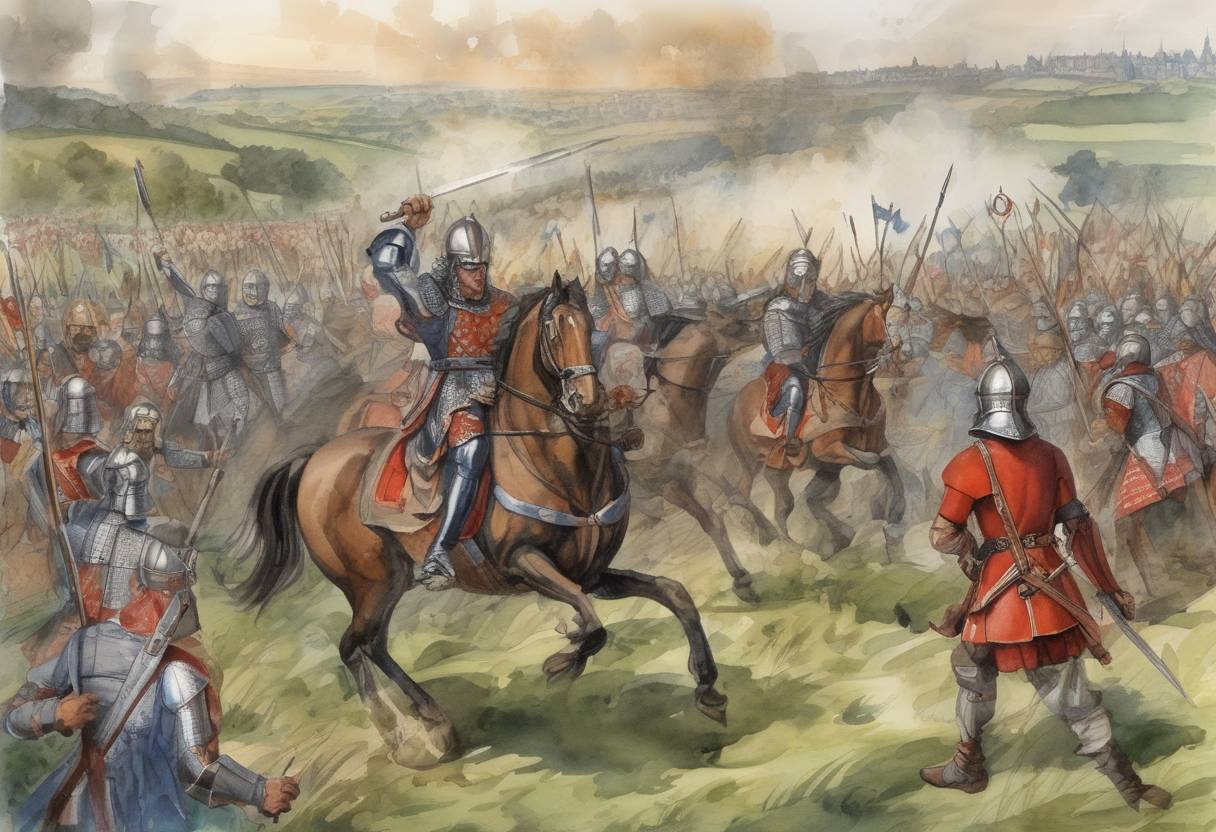
The Battle of Lewes: May 14, 1264
The Battle of Lewes, fought on May 14, 1264, was a pivotal conflict during the Second Barons’ War in England. This battle marked a significant moment in the struggle between the monarchy and the baronial forces seeking to limit royal authority.
Background
The Second Barons’ War (1264–1267) was rooted in the dissatisfaction of English barons with King Henry III’s rule. The king’s financial mismanagement, favoritism towards foreign advisors, and failure to uphold the Provisions of Oxford—a set of reforms agreed upon in 1258 to limit royal power—fueled the rebellion. Simon de Montfort, Earl of Leicester, emerged as the leader of the baronial opposition.
The Battle
- Location: The battle took place near the town of Lewes in Sussex, England.
- Forces: Simon de Montfort led the rebel barons, while King Henry III commanded the royal forces, supported by his son, Prince Edward (later King Edward I).
- Tactics: De Montfort’s forces, although outnumbered, utilized the element of surprise and the advantageous terrain of the South Downs to their benefit. The battle began with a dawn attack on the royalist camp.
Key Events
- Initial Assault: De Montfort’s forces launched a surprise attack, catching the royal army off guard.
- Prince Edward’s Charge: Prince Edward initially led a successful cavalry charge against the rebel forces, but his pursuit of fleeing soldiers left the royalist infantry vulnerable.
- Rebel Victory: De Montfort capitalized on this vulnerability, leading to a decisive victory for the barons. The royal forces were overwhelmed, and many were captured or killed.
Aftermath
- Capture of the King: King Henry III and Prince Edward were captured, effectively placing the monarchy under the control of the barons.
- Mise of Lewes: Following the battle, the “Mise of Lewes” was agreed upon, which temporarily established a government led by de Montfort and his allies, significantly curtailing the king’s power.
- Significance: The battle and its aftermath marked a critical point in the struggle for constitutional governance in England. It set the stage for the development of parliamentary democracy, as de Montfort summoned a parliament in 1265 that included commoners, a precursor to the modern British Parliament.
Conclusion
The Battle of Lewes was a turning point in English history, highlighting the tensions between royal authority and baronial power. Although de Montfort’s control was short-lived—he was killed at the Battle of Evesham in 1265—the principles of governance and representation he championed had lasting impacts on the English political system.