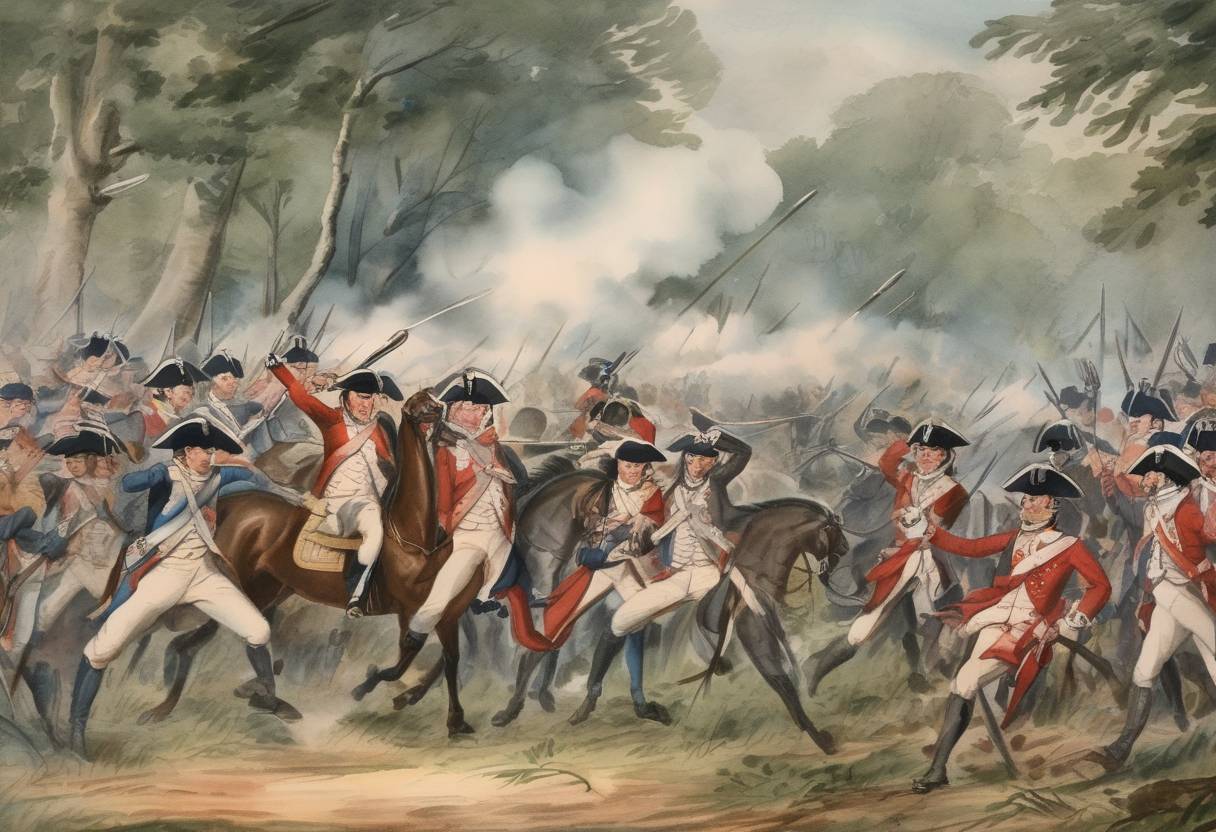
The Battle of Cowpens: January 17, 1781
The Battle of Cowpens, fought on January 17, 1781, was a pivotal engagement during the American Revolutionary War. This battle marked a decisive victory for the American forces under Brigadier General Daniel Morgan against the British forces led by Lieutenant Colonel Banastre Tarleton. The battle took place in the South Carolina backcountry and played a crucial role in the Southern campaign of the war.
Context and Prelude
Southern Campaign: By late 1780, the British had shifted their focus to the Southern colonies, hoping to rally Loyalist support and regain control. The Southern campaign was critical for both sides, with the British aiming to isolate the Southern states from the rest of the colonies.
American Strategy: General Nathanael Greene, commander of the Southern Department of the Continental Army, divided his forces to stretch the British supply lines and force them into smaller engagements. He dispatched General Daniel Morgan to the western part of South Carolina to disrupt British operations.
British Pursuit: In response, British General Charles Cornwallis sent Tarleton, known for his aggressive tactics, to pursue Morgan and neutralize his threat.
The Battle
Location: The battle occurred near Cowpens, a grazing area in present-day Cherokee County, South Carolina. The terrain was strategically chosen by Morgan, who was familiar with the area.
American Forces: Morgan commanded approximately 1,000 men, including Continental regulars, militia, and cavalry. His forces were strategically arranged in three lines to maximize their effectiveness.
British Forces: Tarleton led a force of about 1,100 troops, consisting of British regulars, Loyalists, and dragoons.
Tactics and Execution: Morgan employed a double envelopment tactic, a rare and sophisticated maneuver. He positioned sharpshooters in the front to harass the British, followed by militia who were instructed to fire two volleys before retreating. This feigned retreat lured the British into a trap, where they were enveloped by the Continental regulars and cavalry.
Outcome and Significance
Decisive Victory: The battle resulted in a significant American victory. Tarleton’s force was nearly annihilated, with heavy British casualties and many captured, including 200 wounded and 600 prisoners. Tarleton himself narrowly escaped.
Strategic Impact: The victory at Cowpens was a turning point in the Southern campaign. It boosted American morale and disrupted British plans in the South. The defeat forced Cornwallis to abandon his pursuit of Morgan and rethink his strategy, eventually leading to his fateful decision to march into Virginia.
Legacy: The Battle of Cowpens is celebrated for its brilliant tactical execution and is often cited as a classic example of effective military strategy. It demonstrated the potential of the Continental Army and militia working in concert and contributed to the eventual American victory in the Revolutionary War.
The Battle of Cowpens remains a testament to the strategic ingenuity and resilience of the American forces during the Revolutionary War, underscoring the importance of leadership and tactical innovation in achieving victory against formidable odds.