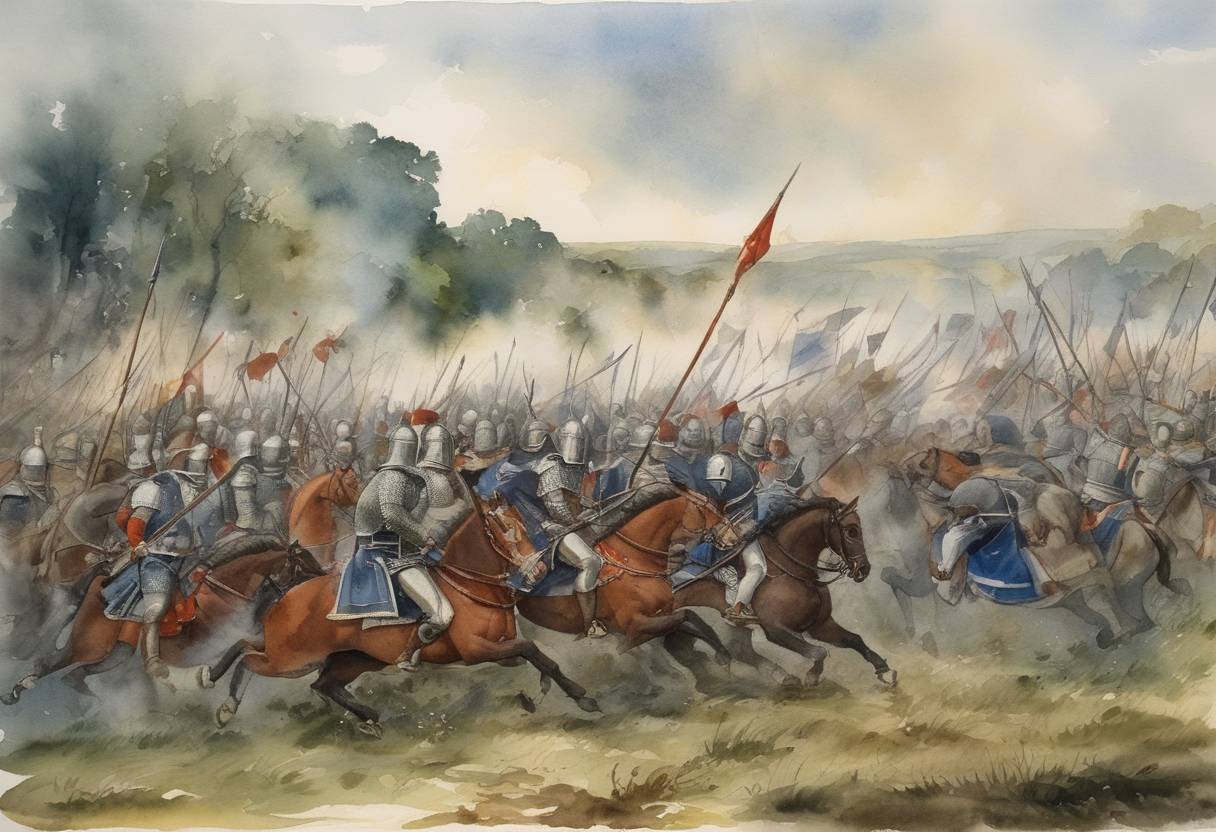
The Battle of the Thirty: March 26, 1351
The Battle of the Thirty, a notable event during the Breton War of Succession, occurred on March 26, 1351. This staged combat took place in Brittany and featured a highly unusual challenge combat between thirty knights and squires representing opposing factions in the conflict over the Duchy of Brittany. The war itself was a part of the broader context of the Hundred Years’ War and revolved around a succession dispute following the death of Duke John III of Brittany.
Context and Background
- Breton War of Succession: Following the death of Duke John III in 1341, a power struggle emerged between two claimants: Charles of Blois, married to John III’s niece and supported by the French crown, and John of Montfort, half-brother to John III with backing from the English.
- The Stalemate: By the early 1350s, the conflict had reached a stalemate, with neither side able to claim decisive military victories, which prompted smaller scale engagements like The Battle of the Thirty.
The Event
- The Combatants: The challenge was set between a contingent of thirty knights and squires from each faction. The French side, led by Jean de Beaumanoir, supported Charles of Blois, while the English-backed side was led by Robert Bemborough on behalf of John de Montfort.
- The Challenge: The duel was initiated as a formal chivalric contest, not as a traditional open battle. This engagement was intended to showcase the valor and prowess of the warriors and to potentially negotiate an end to ongoing hostilities through a less destructive contest.
- The Location: The fight took place on a field along the road between Josselin and Ploërmel, regions associated with the de Blois faction.
The Battle
- The Engagement: The combat lasted several hours, with both sides demonstrating remarkable endurance and skill. The clash was characterized by hand-to-hand combat with swords, axes, and spears, highlighting the chivalric code and martial expectations of the period.
- Outcome: The French faction under Jean de Beaumanoir emerged victorious after a hard-fought contest. This was reputedly due to the death of Bemborough and the exhaustion and surrender of several English combatants.
Aftermath and Significance
- Peaceful Resolution: Despite its brutality, the battle was hailed as an honorable engagement and a testament to knightly virtues. It temporarily alleviated direct hostilities, if only briefly, by resolving a portion of the contest through personal prowess rather than full-scale battles.
- Cultural Legacy: The Battle of the Thirty became a celebrated event in chivalric tradition, lauded in both French and Breton literature as an exemplary display of knightly honor.
- Long-term Impact: While the battle did not significantly alter the course of the Breton War of Succession, it contributed to the romantic narrative surrounding chivalric warfare during the Middle Ages, influencing the perception of knightly conduct in medieval Europe.
This engagement remains a unique instance of warfare resolved by an orchestrated contest rather than open-field combat, reflective of both the period’s chivalric ideals and the complex political landscape of the Hundred Years’ War.