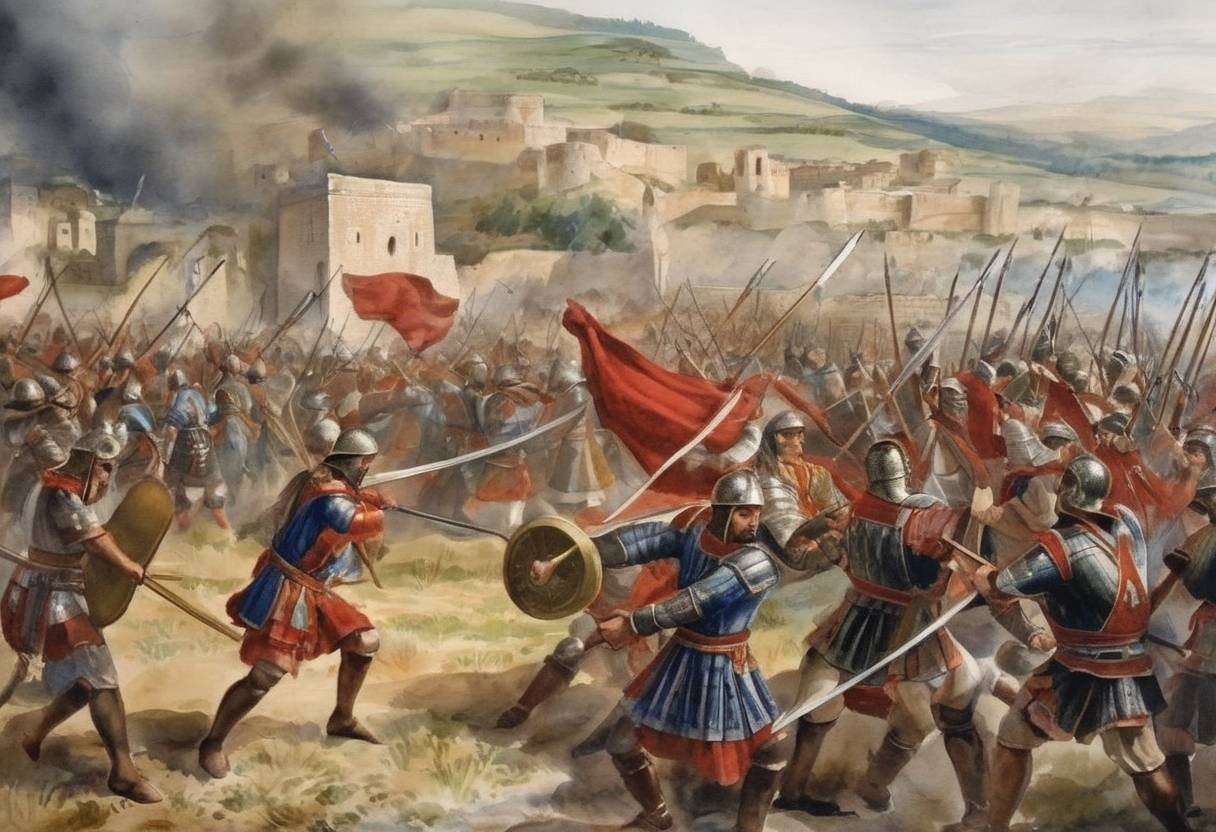
The Battle of Picotin: March 22, 1316
On March 22, 1316, in the region of Picotin on the Peloponnese peninsula, a significant military engagement unfolded as part of the larger context of the Byzantine civil wars. This conflict saw the forces of the Latin Principality of Achaea decisively defeat those of the Byzantine Empire.
Context
The early 14th century was a tumultuous period for the Byzantine Empire, marked by internal strife and challenges from external forces. The Latin Principality of Achaea, established in the aftermath of the Fourth Crusade, emerged as a potent Western European feudal state on Byzantine territory. This era was also characterized by the Byzantine attempts to reclaim territories lost to Latin states, spearheaded by various rulers intent on restoring Byzantine dominance in the region.
The Battle
The battle itself was strategically decisive. The Principality of Achaea, under the leadership of Matilda of Hainaut and her principal general, Louis of Burgundy, faced the Byzantine forces. The Latins, wielding the tactics and chivalric military prowess characteristic of Western European knights, managed to outmaneuver and overwhelm the Byzantine troops, who were caught in a period of strategic and logistical challenges amid the ongoing civil wars.
Aftermath and Significance
The victory for the Principality of Achaea had profound implications. It reaffirmed Latin control over parts of the Peloponnese, temporarily halting Byzantine efforts to reclaim this territory. The battle also underscored the continued fragmentation and decline of Byzantine power, which struggled with both internal and external pressures.
Strategically, the Battle of Picotin weakened Byzantine influence in the region and solidified the position of the Latin principalities that persisted despite the waning crusader enthusiasm and resources in Europe. For the Latin Principality of Achaea, it marked a moment of strengthened autonomy and military prowess.
Broader Historical Impact
While it was a significant conflict, the victory at Picotin for the Latins was not long-lasting in the grand scheme of history. The Byzantine Empire, despite being under constant pressure, would continue to be an influential entity in the region until its ultimate fall in 1453. Nonetheless, events such as the Battle of Picotin exemplify the complex and fragmented nature of political and military power in the medieval Balkans and the shifting tides between Latin and Byzantine dominance.