Germany's Admission to the League of Nations
1925 · Geneva, Switzerland
Germany was admitted to the League of Nations.
November 15, 1920
The League of Nations holds its first assembly in Geneva, Switzerland, marking the first international organization aimed at maintaining world peace.
Geneva, Switzerland | League of Nations
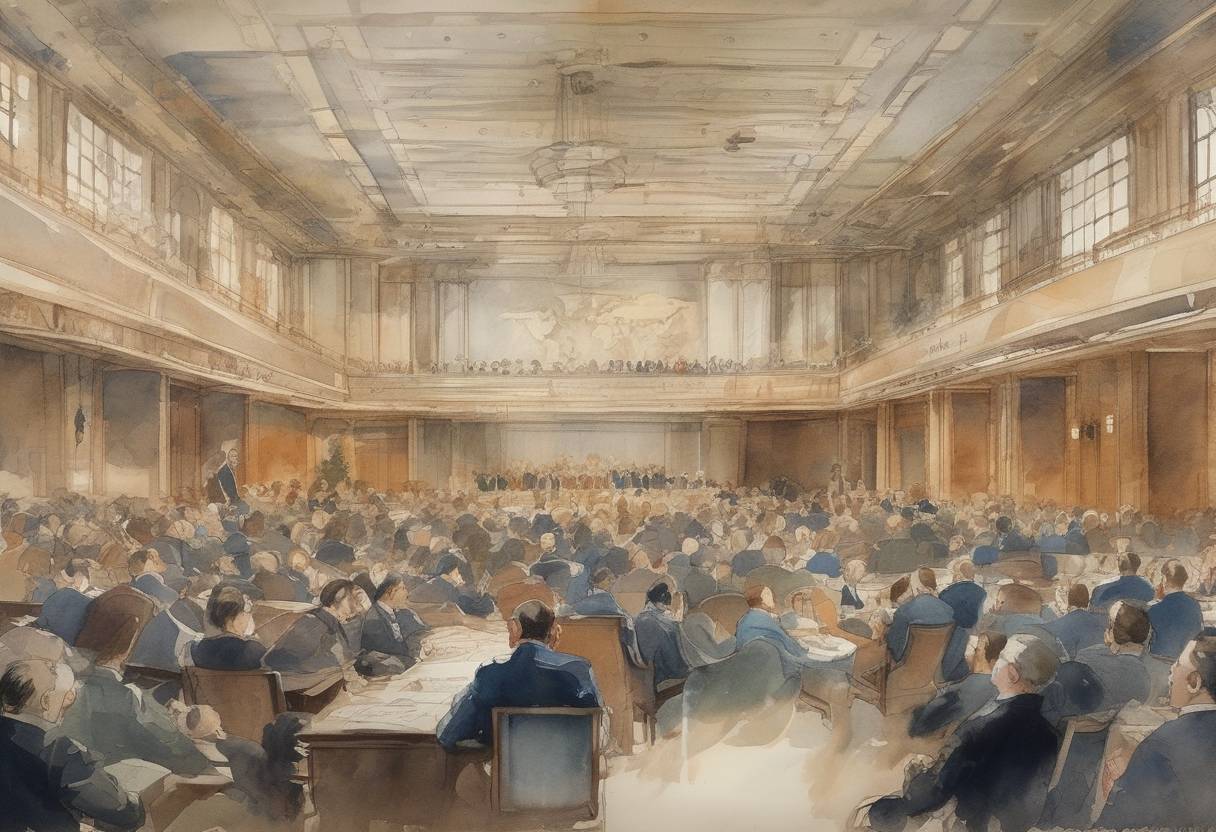
On November 15, 1920, the League of Nations held its inaugural assembly in Geneva, Switzerland. This event marked a significant milestone in international diplomacy as it was the first time an organization was established with the primary aim of maintaining world peace and preventing future conflicts.
The League of Nations was conceived during the Paris Peace Conference in 1919, following the devastation of World War I. The idea was championed by U.S. President Woodrow Wilson, who included it as the 14th point in his famous Fourteen Points speech. The League was intended to provide a platform for resolving international disputes through dialogue and negotiation rather than warfare.
Treaty of Versailles (1919): The League of Nations was formally established by the Treaty of Versailles, which ended World War I. The treaty outlined the League’s structure and functions.
Covenant of the League of Nations: This was the founding charter of the League, included in the Treaty of Versailles. It detailed the League’s mission, organizational structure, and the obligations of member states.
Initial Membership: The League began with 42 member countries, including major powers like the United Kingdom, France, Italy, and Japan. Notably, the United States never joined, as the U.S. Senate refused to ratify the Treaty of Versailles.
Location: The assembly took place in Geneva, chosen for its neutral status and tradition of hosting international diplomacy.
Participants: Delegates from 41 member countries attended the assembly. The United States was absent due to its non-membership.
Agenda: The assembly focused on establishing the League’s operational framework, including the election of its first Secretary-General, Sir Eric Drummond. Discussions also included disarmament, the prevention of war, and the promotion of international cooperation.
International Cooperation: The League’s first assembly set a precedent for international cooperation and dialogue, laying the groundwork for future international organizations, most notably the United Nations.
Challenges: Despite its noble goals, the League faced significant challenges, including the absence of key global powers like the United States and the inability to prevent aggression by member states, which eventually led to its ineffectiveness in stopping the outbreak of World War II.
Legacy: While the League of Nations ultimately failed to prevent another world war, it represented an early attempt at collective security and international governance, influencing the creation of the United Nations in 1945.
The first assembly of the League of Nations in 1920 was a pioneering effort in the realm of international relations, setting the stage for future endeavors in global peacekeeping and cooperation.
Source: www.un.org