Bill Clinton's Re-Election on November 5, 1996
1996 · Washington, D.C., United States
Bill Clinton was re-elected as President of the United States, defeating Republican challenger Bob Dole.
November 5, 1968
Richard Nixon was elected as the 37th President of the United States, defeating incumbent Vice President Hubert Humphrey.
Washington, D.C., United States | Republican Party
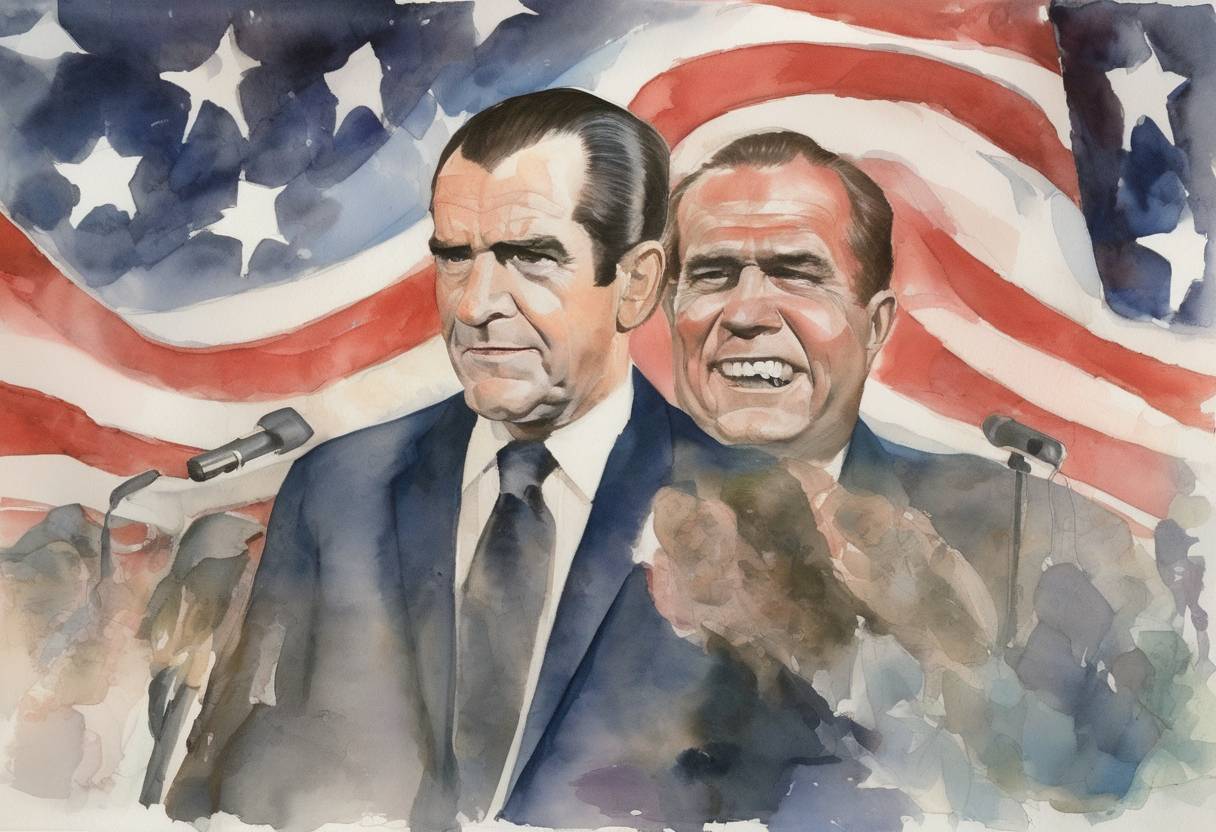
On November 5, 1968, Richard Nixon was elected as the 37th President of the United States, defeating the incumbent Vice President Hubert Humphrey and third-party candidate George Wallace. This election marked a significant moment in American political history, characterized by a tumultuous social and political climate.
The 1968 presidential election occurred during a period of considerable upheaval in the United States. The country was deeply divided over the Vietnam War, civil rights issues, and widespread social unrest. The assassination of key figures such as Martin Luther King Jr. and Robert F. Kennedy earlier that year further intensified the national mood.
Richard Nixon (Republican Party): Nixon, who had previously served as Vice President under Dwight D. Eisenhower, campaigned on a platform of “law and order” and promised to bring peace and honor to the United States amidst the Vietnam War. He appealed to what he termed the “silent majority” of Americans who were disenchanted with the social changes and protests of the 1960s.
Hubert Humphrey (Democratic Party): As the sitting Vice President under Lyndon B. Johnson, Humphrey faced the challenge of distancing himself from the unpopular Vietnam War policies of the Johnson administration. Despite gaining momentum in the final weeks of the campaign, he struggled to overcome the divisions within the Democratic Party.
George Wallace (American Independent Party): The former Governor of Alabama ran on a segregationist platform, appealing to voters in the South and those disaffected by the civil rights movement. His candidacy further complicated the electoral landscape by drawing votes away from both major parties.
Richard Nixon won the presidency with 301 electoral votes, while Hubert Humphrey secured 191 electoral votes. George Wallace captured 46 electoral votes, primarily from Southern states. In terms of the popular vote, Nixon received approximately 43.4%, Humphrey 42.7%, and Wallace 13.5%.
Nixon’s victory signaled a shift in American politics, with the Republican Party beginning to gain strength in the South, a region that had traditionally supported Democrats. His presidency would later be marked by significant events such as the continuation and eventual winding down of the Vietnam War, the opening of diplomatic relations with China, and the Watergate scandal, which ultimately led to his resignation in 1974.
The 1968 election is often seen as a pivotal moment in American history, reflecting the deep divisions within the country and setting the stage for the political realignments that would shape future decades.
Source: en.wikipedia.org