Death of Martin of Tours - November 11, 397
397 · Candes, Roman Empire (modern-day France)
Death of Martin of Tours, a prominent Christian bishop and saint, known for his role in spreading Christianity in Gaul.
April 4, 0397
St. Ambrose, the Bishop of Milan, died. He was a significant figure in the early Christian Church, known for his influence on Western Christianity and his role in the conversion of St. Augustine.
Milan, Italy | Christian Church
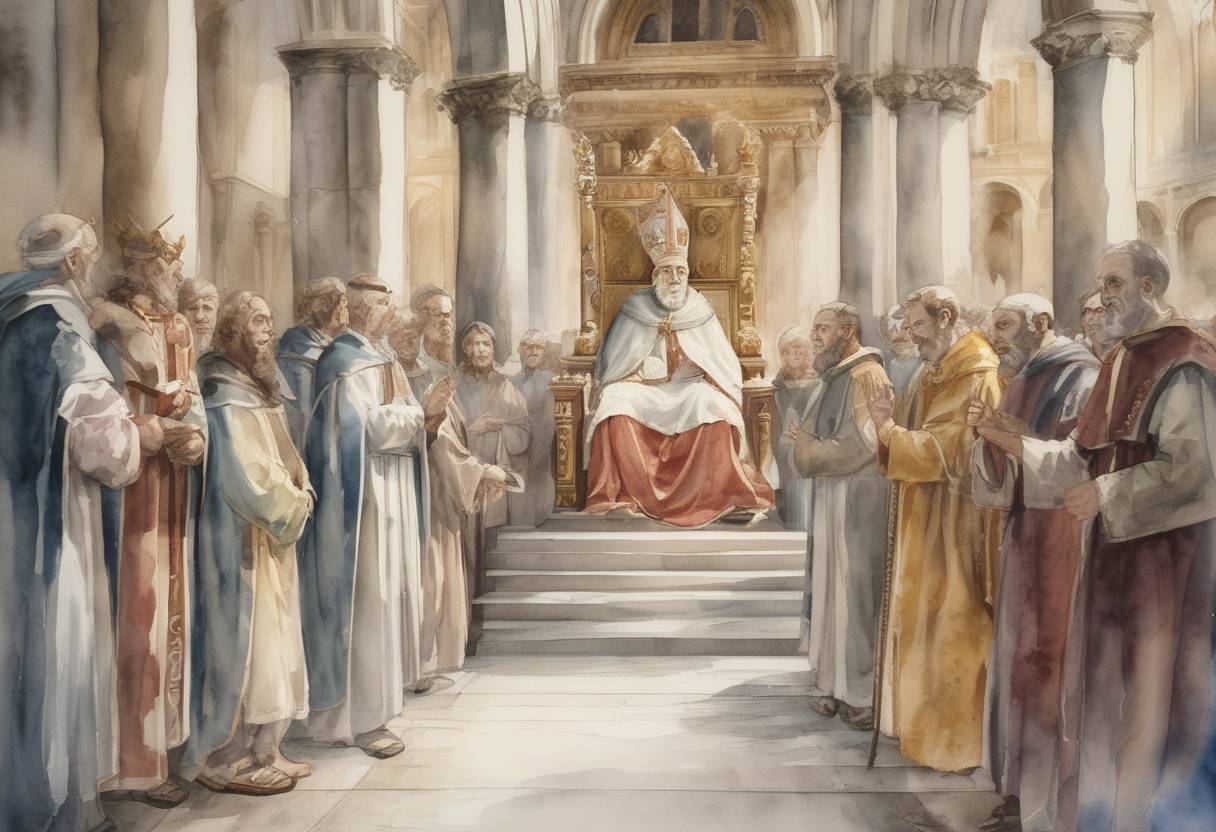
On April 4, 397, St. Ambrose, the Bishop of Milan, passed away, leaving behind a profound legacy in the early Christian Church. His life and work significantly influenced Western Christianity, and he played a pivotal role in the conversion of St. Augustine, one of Christianity’s most important theologians.
Ambrose was born around 340 AD in Trier, a city in present-day Germany. He came from a Roman Christian family and was well-educated, studying literature, law, and rhetoric. His career began in the Roman administration, where he served as a governor in Northern Italy.
In 374 AD, Ambrose’s life took a dramatic turn when he was unexpectedly appointed as the Bishop of Milan. At the time, Milan was a crucial center of political and religious activity in the Western Roman Empire. Ambrose’s appointment was unusual because he was not yet baptized, but his reputation for fairness and integrity made him a popular choice among both the clergy and the laity.
As bishop, Ambrose became a staunch defender of Nicene Christianity during a period of intense theological conflict with Arianism, a doctrine that questioned the divinity of Jesus Christ. He was known for his eloquent sermons and writings, which helped to articulate and spread orthodox Christian beliefs.
Ambrose’s influence extended beyond theology. He was a skilled diplomat and played a key role in the political sphere, often mediating between the church and the Roman emperors. His assertive stance in defending the church’s autonomy set important precedents for the relationship between church and state.
One of Ambrose’s most enduring legacies is his influence on St. Augustine. Augustine, who initially led a life of philosophical exploration and moral ambiguity, was deeply moved by Ambrose’s preaching and intellectual rigor. Ambrose’s ability to interpret Scripture allegorically and his personal piety impressed Augustine, ultimately leading to his conversion to Christianity in 386 AD. Augustine would go on to become one of the most influential theologians in Christian history, largely due to Ambrose’s mentorship.
St. Ambrose died on April 4, 397, in Milan. His death marked the end of a significant era in the early church, but his impact continued to resonate through his writings and the leaders he inspired. Ambrose’s works, including hymns, theological treatises, and letters, contributed to the development of Christian doctrine and liturgy.
Ambrose is venerated as a saint in both the Eastern Orthodox and Roman Catholic traditions, and his feast day is celebrated on December 7. His life exemplifies the power of faith and intellect in shaping the course of religious history, and his legacy endures in the teachings and traditions of the Christian Church.
Source: en.wikipedia.org