Fall of Baghdad: April 7, 2003
2003 · Baghdad, Iraq
U.S. troops captured Baghdad, leading to the fall of Saddam Hussein's regime in Iraq.
April 9, 2003
The statue of Saddam Hussein in Baghdad's Firdos Square is toppled by Iraqi civilians and U.S. military forces, symbolizing the fall of Baghdad during the Iraq War.
Baghdad, Iraq | United States Armed Forces
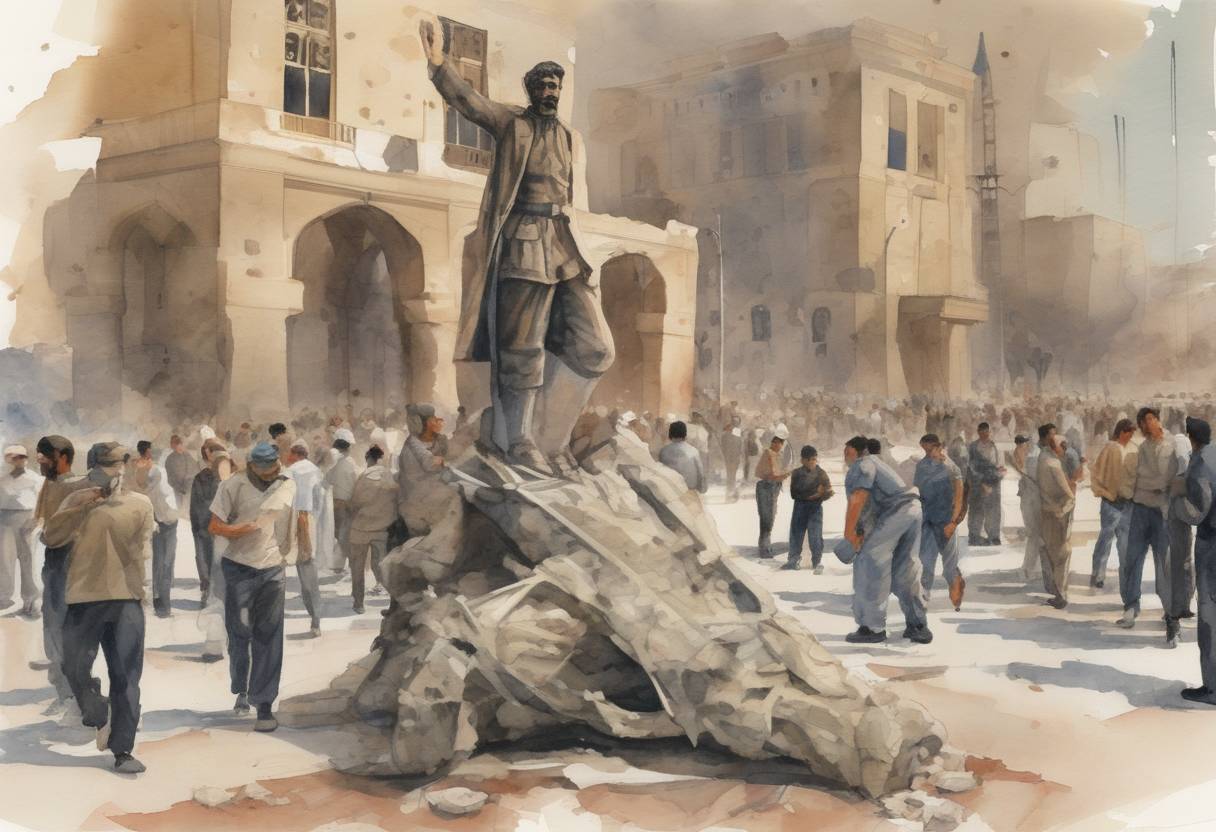
On April 9, 2003, a significant event unfolded in Baghdad, Iraq, marking a symbolic moment in the Iraq War: the toppling of Saddam Hussein’s statue in Firdos Square. This event became an iconic representation of the fall of Baghdad and the collapse of Saddam Hussein’s regime.
The Iraq War began on March 20, 2003, when a coalition led by the United States and the United Kingdom launched a military invasion of Iraq. The primary justification for the invasion was the alleged presence of weapons of mass destruction (WMDs) in Iraq, along with the aim to end Saddam Hussein’s authoritarian rule and promote democracy in the region.
By early April, coalition forces had rapidly advanced through Iraq, facing varying degrees of resistance. The capture of Baghdad was a critical objective, as it was the political and symbolic heart of Saddam’s regime.
On April 9, as U.S. forces entered Baghdad, they encountered minimal organized resistance. In the heart of the city, at Firdos Square, stood a towering statue of Saddam Hussein, erected in 2002 to commemorate his 65th birthday. The statue had become a symbol of his oppressive rule.
The toppling of the statue was a joint effort between Iraqi civilians and U.S. Marines. Initially, a group of Iraqis attempted to bring down the statue using ropes and sledgehammers, but their efforts were largely ineffective. U.S. Marines then intervened, using an M88 armored recovery vehicle to pull down the statue. The image of the statue being pulled down, with Iraqis cheering and striking it with shoes—a gesture of contempt in Arab culture—was broadcast worldwide.
The fall of the statue was widely interpreted as a symbol of the end of Saddam Hussein’s rule and the liberation of Iraq from decades of dictatorship. It was a moment of jubilation for many Iraqis who had suffered under his regime.
However, the toppling of the statue also foreshadowed the complex and tumultuous period that would follow. The initial euphoria was soon overshadowed by the challenges of post-war reconstruction, sectarian violence, and the absence of the anticipated WMDs, which led to widespread criticism of the war’s justification.
The event remains a powerful image in the narrative of the Iraq War, encapsulating both the hope for a new beginning and the subsequent difficulties that Iraq faced in the years following the invasion.
Source: www.britannica.com