Battle of Wagram: July 6, 1809
1809 · Wagram, Austria
A combined Franco-Polish army, led by Napoleon, won the Battle of Wagram against the Austrian Empire near Vienna, ending in a significant French victory.
December 26, 1805
The Treaty of Pressburg was signed between France and Austria following France's victory at the Battle of Austerlitz. The treaty resulted in significant territorial losses for Austria and marked the end of the War of the Third Coalition.
Pressburg, Austria | Napoleonic France
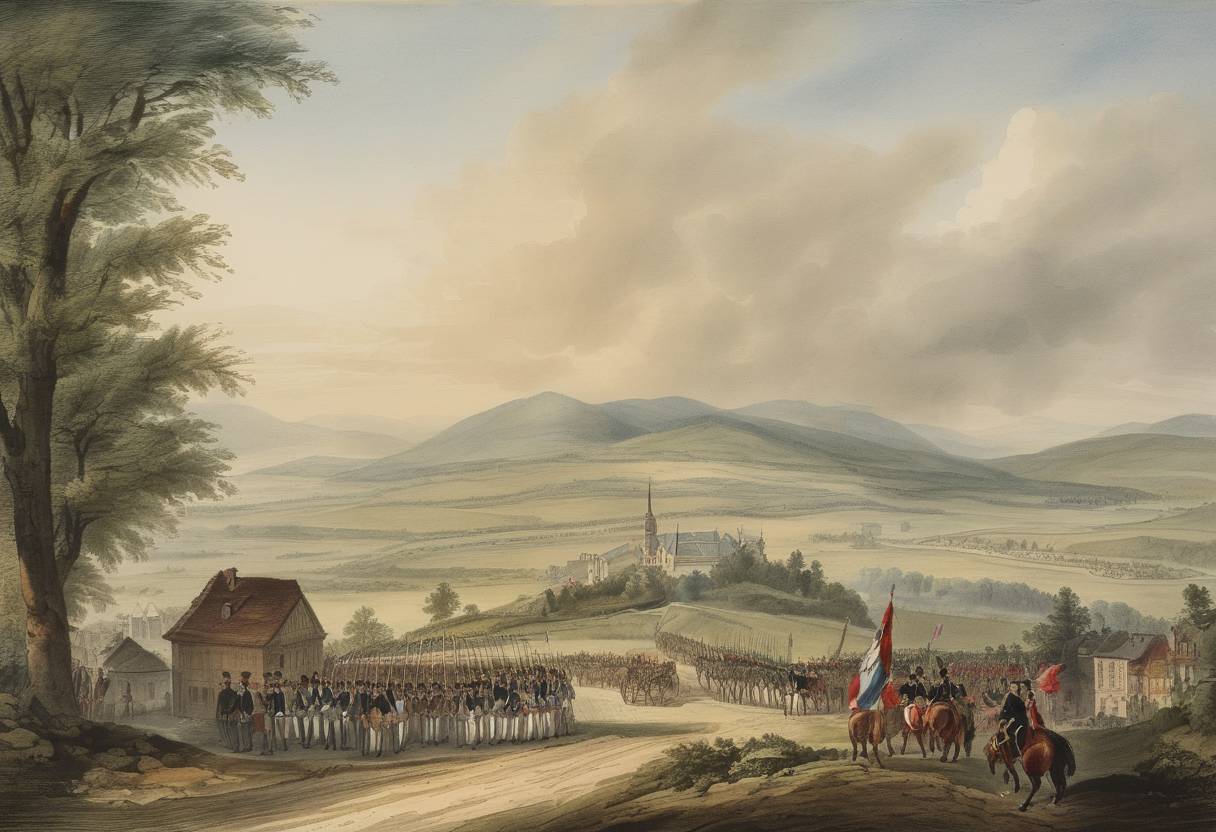
The Treaty of Pressburg was a pivotal moment in European history, marking the conclusion of the War of the Third Coalition amidst the Napoleonic Wars. This treaty was signed in the aftermath of Napoleon Bonaparte’s decisive victory over the Austrian and Russian forces at the Battle of Austerlitz on December 2, 1805.
The War of the Third Coalition (1805) was an alliance led by Britain, Russia, Austria, and others against the expansionist policies of Napoleonic France. The Coalition’s primary aim was to curtail French dominance in Europe. Despite initial optimism, the coalition forces suffered a crushing defeat at Austerlitz, often referred to as the “Battle of the Three Emperors” due to the presence of the French Emperor Napoleon, Russian Emperor Alexander I, and Austrian Emperor Francis II.
The Treaty of Pressburg, signed in the city of Pressburg (modern-day Bratislava, Slovakia), resulted in significant territorial and political changes, primarily detrimental to Austria:
Territorial Losses for Austria: Austria ceded several territories, including the Tirol and Vorarlberg, to Bavaria and parts of Venetia to the Kingdom of Italy, which was under Napoleon’s influence. Additionally, Austria had to relinquish control of Istria and Dalmatia to the French Empire.
Recognition of French Titles: Austria recognized Napoleon’s reorganization of the Holy Roman Empire into the Confederation of the Rhine, which effectively meant the dissolution of the Holy Roman Empire and significantly increased Napoleon’s influence over German states.
Monetary Indemnities: Austria was required to pay a substantial financial indemnity to France, further weakening its economy.
Diplomatic Shifts: The treaty also realigned several German and Italian states, ensuring they were under Napoleon’s dominion, directly or indirectly.
The Treaty of Pressburg largely diminished Austria’s standing as a central European power and contributed to the restructuring of the political landscape in Europe. It exemplified Napoleon’s strategic mastery and military prowess, further consolidating his control in Central Europe. Additionally, it led to the eventual abolition of the Holy Roman Empire in 1806, as the establishment of the Confederation of the Rhine under French protectorate effectively made the traditional empire obsolete.
This treaty set the scene for Napoleon’s dominance on the European continent, although it sowed the seeds for future conflicts as powers like Austria sought to regain their lost influence, culminating in the subsequent formation of the Fourth Coalition against France.
Source: en.wikipedia.org