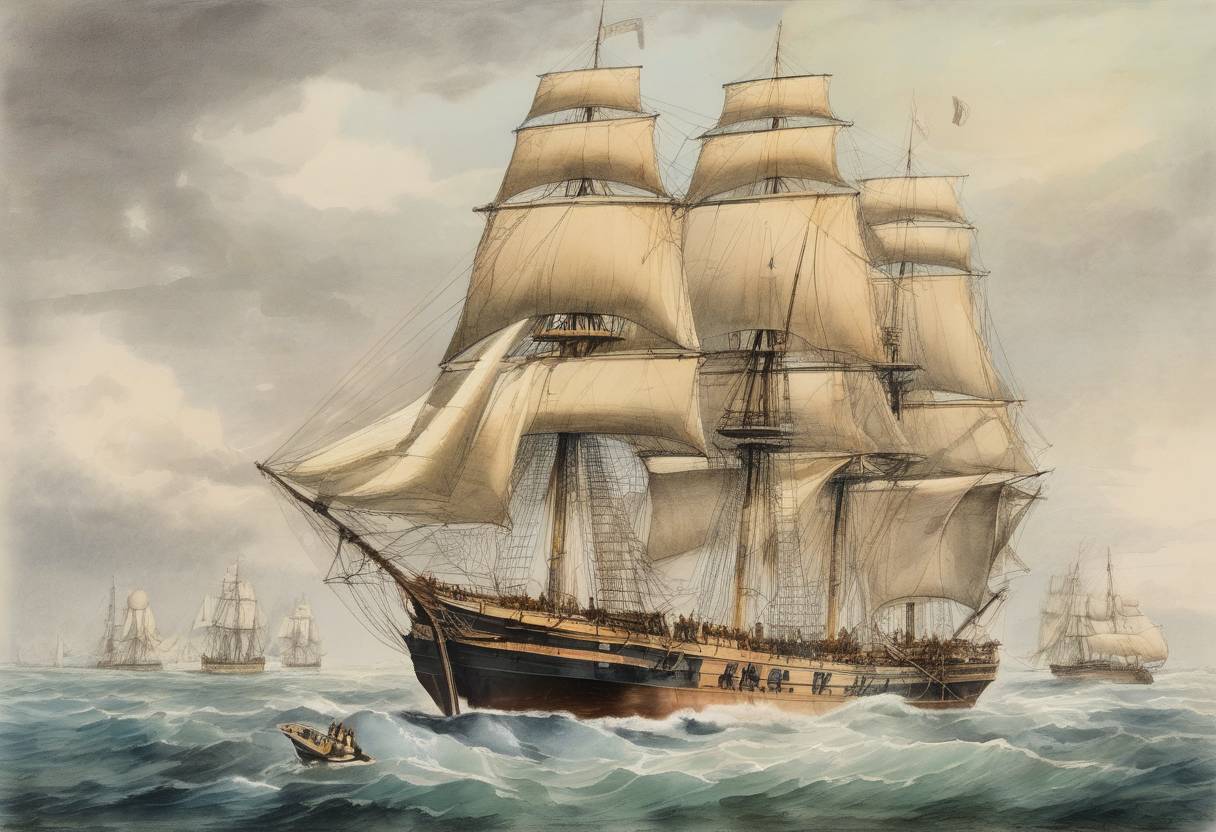
The Challenger Expedition: A Milestone in Oceanography
Overview
On December 21, 1872, the HMS Challenger set sail from Portsmouth, England, marking the beginning of the first major scientific expedition dedicated to the study of the world’s oceans. This groundbreaking voyage laid the foundation for the field of oceanography, transforming our understanding of marine science.
Background
Before the Challenger Expedition, knowledge of the ocean was limited and largely speculative. The expedition was conceived by the Royal Society of London and the British Admiralty, who recognized the need for systematic scientific exploration of the seas. The HMS Challenger, a converted British naval corvette, was equipped with state-of-the-art scientific instruments and a team of distinguished scientists led by Charles Wyville Thomson, a professor of natural history.
Objectives
The primary goals of the Challenger Expedition were to:
- Investigate the physical and chemical properties of seawater.
- Study marine life at various depths.
- Map the ocean floor and measure its depth.
- Collect samples of marine organisms, sediments, and water.
The Voyage
The Challenger embarked on a nearly four-year journey, covering approximately 68,000 nautical miles. The expedition traversed the Atlantic, Indian, and Pacific Oceans, making stops at numerous locations, including the Caribbean, South America, Australia, and the Antarctic Circle. The crew conducted systematic sampling and measurements at over 360 stations worldwide.
Key Discoveries
- Marine Biodiversity: The expedition discovered over 4,700 new species of marine life, significantly expanding the known diversity of oceanic organisms.
- Ocean Depths: The Challenger made the first systematic measurements of ocean depths, including the discovery of the Mariana Trench, the deepest known part of the world’s oceans.
- Ocean Currents and Temperature: The expedition provided valuable data on ocean currents and temperature variations, contributing to the understanding of global climate patterns.
- Seafloor Composition: The collection of sediment samples revealed the composition and distribution of the ocean floor, challenging previous assumptions about its uniformity.
Impact and Legacy
The Challenger Expedition’s findings were published in a comprehensive 50-volume report, which took over 20 years to complete. This monumental work provided a wealth of data that became the cornerstone of modern oceanography. The expedition demonstrated the importance of interdisciplinary scientific research and inspired future generations of oceanographers.
The Challenger Expedition is celebrated as a pivotal moment in the history of science, highlighting the vastness and complexity of the oceans and setting a precedent for future oceanographic exploration.