Establishment of St. Augustine: August 28, 1565
1565 · St. Augustine, United States
Pedro Menéndez de Avilés establishes the first permanent European settlement in what is now the continental United States, founding St. Augustine in Florida.
September 8, 1565
The Spanish establish the first permanent European settlement in the continental United States at St. Augustine, Florida.
St. Augustine, United States | Spanish Empire
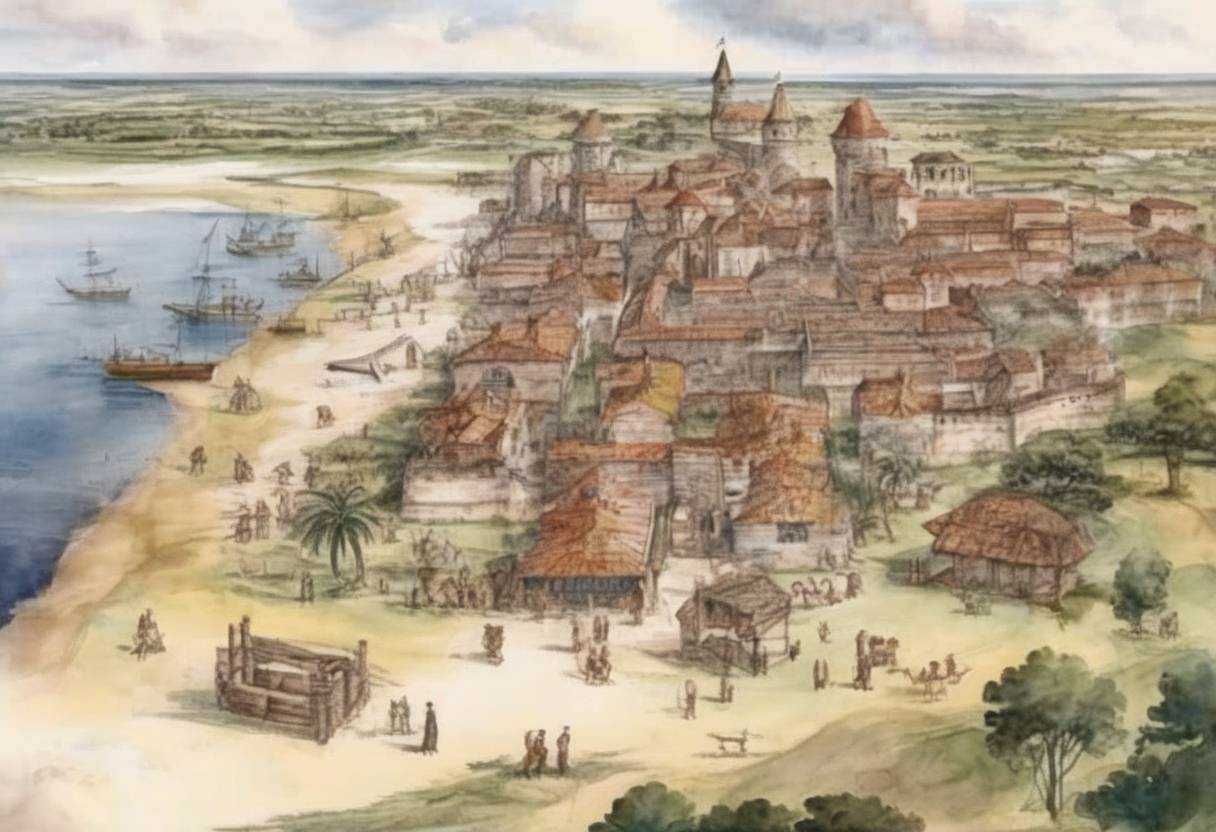
On September 8, 1565, the Spanish established St. Augustine in present-day Florida, marking the creation of the first permanent European settlement in what is now the continental United States. This event was a significant milestone in the history of European colonization in the Americas.
Spanish Exploration and Colonization: By the mid-16th century, Spain had already established a strong presence in the Caribbean and parts of Central and South America. The Spanish Crown was eager to expand its influence and secure its claims in North America against other European powers, particularly France and England.
French Threat: The French had established a settlement at Fort Caroline, near present-day Jacksonville, Florida, in 1564. This posed a direct threat to Spanish interests in the region, prompting Spain to act decisively to eliminate the French presence and assert its dominance.
Pedro Menéndez de Avilés: Appointed by King Philip II of Spain, Pedro Menéndez de Avilés was tasked with establishing a Spanish foothold in Florida and removing the French settlers. Menéndez was a seasoned naval officer and explorer, well-suited for the mission.
Arrival and Founding: Menéndez and his fleet arrived off the coast of Florida in late August 1565. On September 8, he officially founded St. Augustine, naming it after Saint Augustine of Hippo, whose feast day was celebrated on August 28, the day Menéndez first sighted land.
Strategic Location: St. Augustine was strategically located to serve as a base for further exploration and defense against other European powers. Its position allowed Spain to control the important sea routes along the Atlantic coast.
Construction and Defense: The settlers quickly began constructing fortifications and buildings to establish a permanent presence. The Castillo de San Marcos, a stone fortress built later in the 17th century, became a symbol of Spanish strength and resilience.
Endurance and Legacy: Despite challenges such as attacks by pirates, conflicts with indigenous peoples, and rival European powers, St. Augustine endured as a Spanish stronghold for over two centuries. It remained under Spanish control until 1763 when it was ceded to Britain, only to be returned to Spain in 1783, and finally becoming part of the United States in 1821.
Cultural Impact: St. Augustine’s establishment marked the beginning of a lasting Spanish cultural and architectural influence in the region, evident in the city’s historic district today.
Historical Importance: As the oldest continuously inhabited European-established settlement in the continental United States, St. Augustine represents a crucial chapter in the history of European colonization and the complex interactions between European settlers and indigenous populations.
The founding of St. Augustine set the stage for further Spanish exploration and colonization efforts in North America, shaping the cultural and historical landscape of the region for centuries to come.
Source: en.wikipedia.org