The Siege of Yorktown: British Surrender on October 19, 1781
1781 · Yorktown, United States
The Siege of Yorktown ends with the British Army's surrender to American and French forces, effectively ending the American Revolutionary War.
October 17, 1777
British General John Burgoyne surrendered to American forces at Saratoga, marking a turning point in the American Revolutionary War.
Saratoga, United States | Continental Army
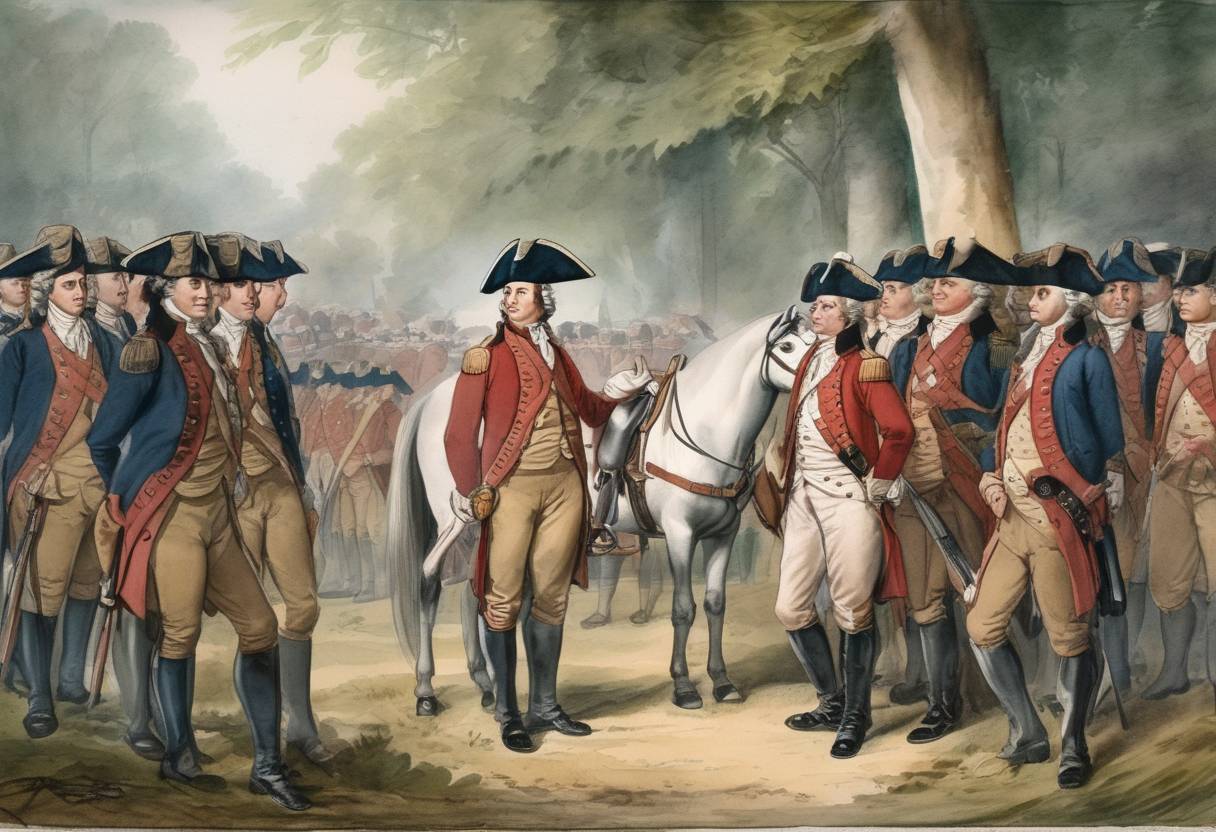
On October 17, 1777, British General John Burgoyne surrendered to American forces at Saratoga, New York, marking a pivotal moment in the American Revolutionary War. This event is often regarded as the turning point of the war, as it significantly boosted American morale and helped secure crucial international support.
The Saratoga campaign was part of a British strategy to divide the rebellious American colonies by gaining control of the Hudson River Valley. General Burgoyne led a large force southward from Canada in the summer of 1777, intending to rendezvous with other British forces moving north from New York City. However, the plan was fraught with logistical challenges and miscommunications.
Burgoyne’s progress was slow, hampered by difficult terrain and the need to transport heavy artillery. Additionally, the expected reinforcements from the south, led by General Howe, never materialized, as Howe chose to capture Philadelphia instead. This left Burgoyne isolated and vulnerable.
The campaign culminated in two significant battles near Saratoga. The first battle, known as the Battle of Freeman’s Farm, occurred on September 19, 1777. Although technically a British victory, it came at a high cost in casualties and did not significantly alter the strategic situation.
The second battle, the Battle of Bemis Heights, took place on October 7, 1777. American forces, commanded by General Horatio Gates and bolstered by the tactical acumen of Benedict Arnold, decisively defeated the British. This defeat forced Burgoyne to retreat to Saratoga, where he found himself surrounded by a growing American army.
With dwindling supplies and no hope of reinforcements, Burgoyne was left with no choice but to surrender. On October 17, 1777, he formally capitulated to General Gates. The terms of the surrender, known as the Convention of Saratoga, allowed Burgoyne’s troops to return to Britain on the condition that they would not serve again in North America during the war.
The surrender at Saratoga had profound implications for the American Revolutionary War. It was a major morale booster for the American cause and demonstrated the viability of the Continental Army. Perhaps most importantly, it convinced France to enter the war as an ally of the United States, providing essential military support and resources that would prove crucial in the eventual American victory.
The Saratoga campaign underscored the importance of strategic planning and coordination in military operations. It also highlighted the potential for American forces to effectively challenge and defeat a major British army, setting the stage for future successes in the war for independence.
Source: en.wikipedia.org