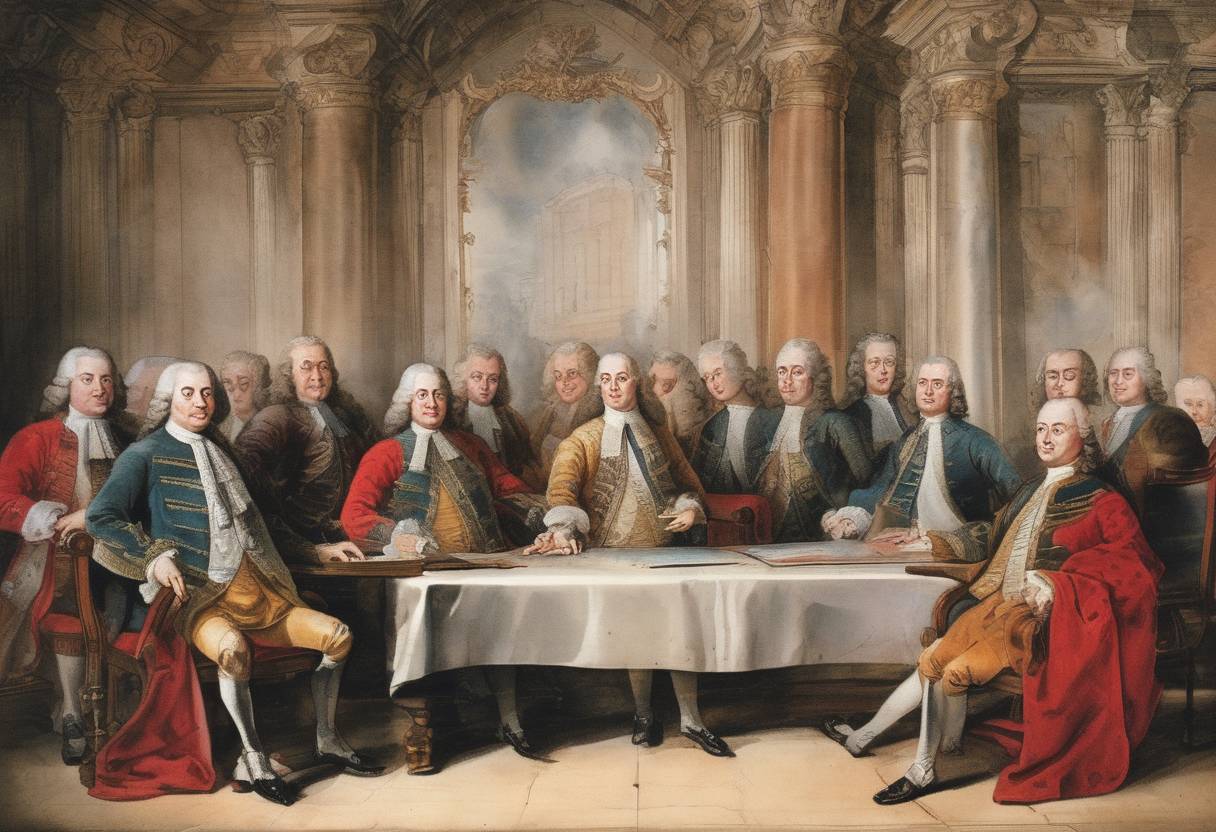
The Treaty of Utrecht: April 11, 1713
The Treaty of Utrecht, signed on April 11, 1713, was a series of agreements between various European powers that concluded the War of the Spanish Succession (1701-1714). This war was primarily fought over who should succeed to the Spanish throne after the death of the childless Charles II of Spain. The treaties were pivotal in reshaping the political landscape of Europe and establishing a new balance of power.
Background
- War of the Spanish Succession: The conflict began when Charles II of Spain died in 1700, leaving his throne to Philip of Anjou, a grandson of Louis XIV of France. This alarmed other European powers, particularly England, the Dutch Republic, and the Holy Roman Empire, who feared the unification of the French and Spanish thrones under a single Bourbon monarch.
- Grand Alliance: To counter this potential hegemony, England, the Dutch Republic, and the Holy Roman Empire formed the Grand Alliance, aiming to prevent the Bourbon family from dominating Europe.
Key Provisions of the Treaty
- Spain and France: Philip V was recognized as the King of Spain, but he had to renounce any claim to the French throne, ensuring that the two crowns would remain separate.
- Territorial Adjustments:
- Spain ceded Gibraltar and Minorca to Great Britain, enhancing British naval power in the Mediterranean.
- The Spanish Netherlands, Naples, Milan, and Sardinia were ceded to the Austrian Habsburgs.
- Sicily was given to the Duchy of Savoy, which later exchanged it for Sardinia.
- British Gains:
- Great Britain gained control of Newfoundland, Nova Scotia, and the Hudson Bay territory from France, marking significant colonial expansion.
- The Asiento de Negros, a contract granting Britain the exclusive right to supply enslaved Africans to Spanish colonies in the Americas, was also secured.
Consequences and Significance
- Balance of Power: The Treaty of Utrecht is often credited with establishing the principle of the balance of power in Europe, a concept that would dominate European diplomacy for the next century.
- Rise of the British Empire: The territorial gains and commercial rights acquired by Britain laid the groundwork for its emergence as a dominant global power.
- Decline of Spanish Influence: The treaty marked the beginning of the decline of Spanish influence in Europe, as its vast empire was significantly reduced.
- End of French Expansion: The treaty curtailed Louis XIV’s ambitions and marked the end of French expansionist policies that had characterized his reign.
The Treaty of Utrecht was a landmark in diplomatic history, setting a precedent for future peace negotiations and altering the course of European and global history.