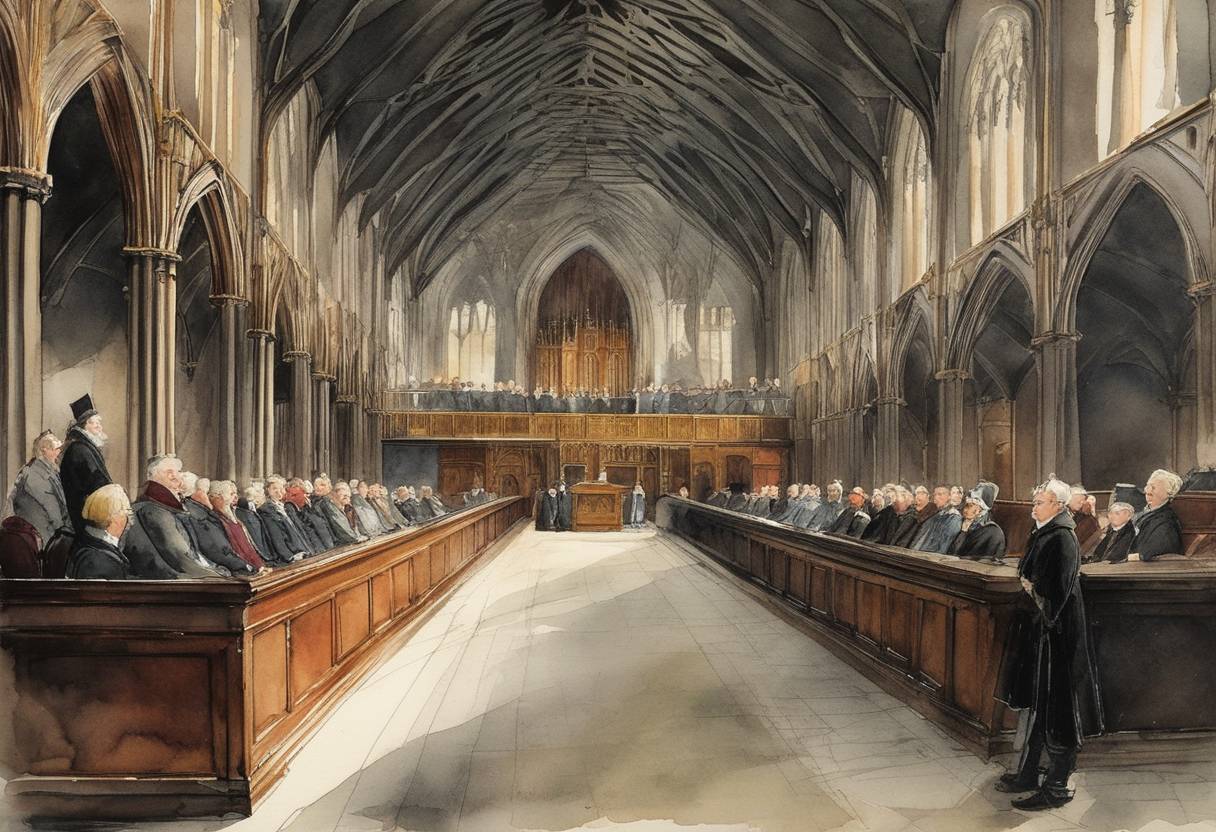
The First Assembly of the Parliament of Ireland in Kilkenny on June 18, 1264
On June 18, 1264, the Parliament of Ireland convened for the first time in the city of Kilkenny. This gathering marked a significant moment in the evolution of Ireland’s parliamentary history under English dominion. During this period, Ireland was experiencing a transformation influenced heavily by Anglo-Norman invaders who had settled in the country since the late 12th century.
Historical Context
The establishment of the Parliament of Ireland was part of a broader process of integrating Irish governance with English political structures. The Anglo-Norman conquest resulted in the distribution of land to English lords, which fragmented and weakened traditional Gaelic rule. The English crown sought to consolidate its control over Ireland by establishing a governance system that mirrored its own parliamentary institutions.
The Assembly at Kilkenny
The assembly at Kilkenny in 1264 was significant as it reflected an attempt to administer English law and order more effectively within the Irish lordships. This was driven by the need to manage the complex socio-political landscape comprised of Gaelic Irish tribes and Anglo-Norman settlers. The Parliament of Ireland had a dual purpose: governance and a means for the nobility to discuss their affairs and grievances.
Kilkenny, as the site of this assembly, was strategically chosen. By this time, Kilkenny was becoming an influential settlement, central to the Anglo-Norman domains in Ireland. The convening of parliament here underscored its rising importance.
Legislative Outcomes
Although records from this early period are sparse, the parliament would have focused on key issues such as land disputes, levying taxes, and managing relations between different factions. The legislation and ordinances established were intended to solidify English rule and address the immediate needs of the ruling classes in Ireland.
Legacy and Significance
This meeting in Kilkenny laid the groundwork for the future development of the Irish parliamentary system, marking a shift towards more localized governance that was still underpinned by English laws and interests. The Parliament of Ireland would eventually evolve, adapting to the complex interplay between English authority and Irish autonomy aspirations.
The 1264 gathering represents an early attempt at structured legislative governance in Ireland, setting a precedent for more formalized legal and political institutions. Over the subsequent centuries, the Irish Parliament played a crucial role in shaping Ireland’s political landscape, eventually being subsumed by the Acts of Union in 1801.
In sum, the Parliament of Ireland meeting in Kilkenny on June 18, 1264, was a crucial step in the institutional development of Irish governance during a period of significant socio-political transformation.