Comet Hale-Bopp's Closest Approach to Earth
1997 · Global, Earth
The Comet Hale-Bopp made its closest approach to Earth, a notable astronomical event observed by millions.
July 1, 1770
Lexell's Comet, a comet with a notably close approach to Earth, was observed. It remains the closest comet approach recorded, passing at a distance of 2.2 million kilometers.
, | Astronomical observation
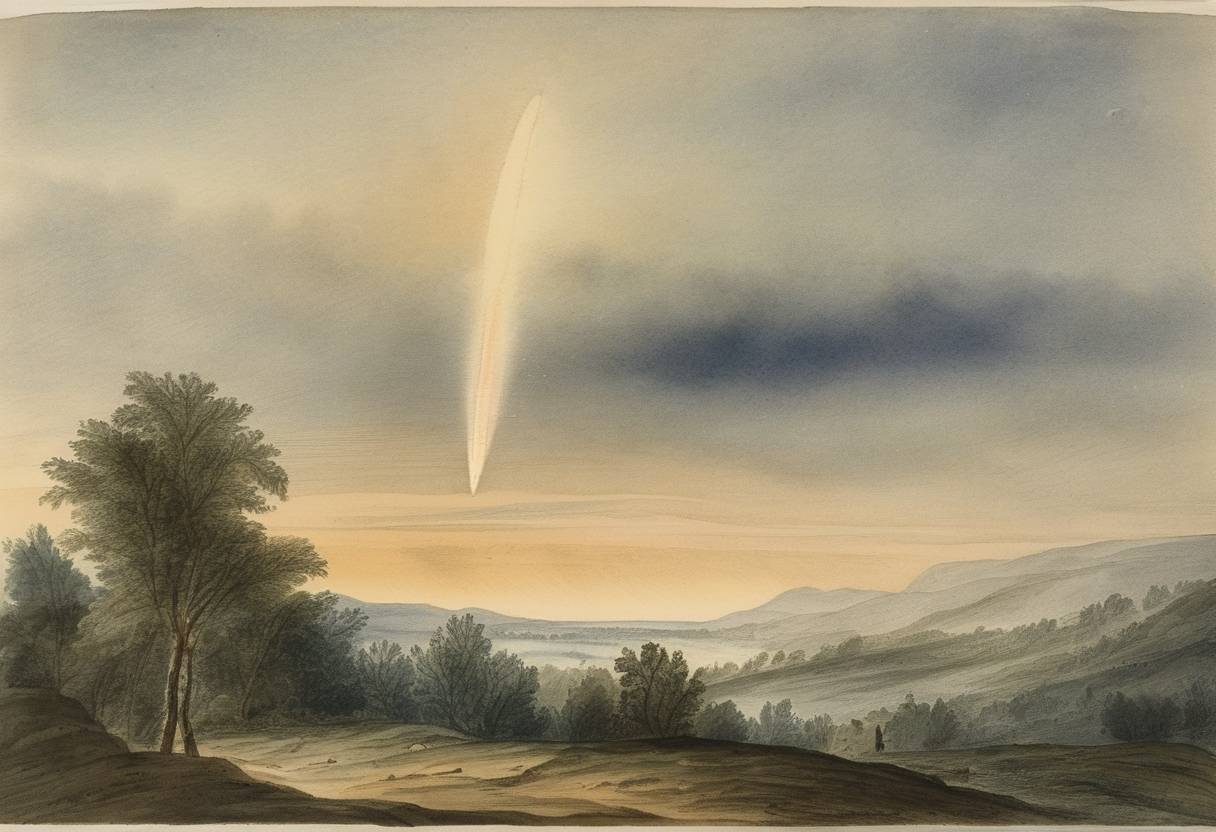
On July 1, 1770, Lexell’s Comet made an exceptionally close approach to Earth, coming within approximately 2.2 million kilometers (about 1.4 million miles). This remains the closest recorded approach by a comet in history. The event marked a significant moment in the field of astronomy and the study of celestial bodies, providing critical insights into the dynamics of comets.
Lexell’s Comet, officially designated as D/1770 L1, was discovered by French astronomer Charles Messier on June 14, 1770. Initially, Messier mistook it for a nebula before confirming its cometary nature. The comet’s trajectory was calculated by the Baltic-German astronomer Anders Johan Lexell, who recognized the unprecedented proximity of its approach to Earth.
The passage of the comet at such a close distance offered astronomers of that era a unique opportunity to study a comet in detail. Lexell’s calculations were pivotal, marking an early attempt to predict cometary orbits with precision. His work supported the growing understanding of gravitational influences on comet paths, particularly how close encounters with planetary bodies could drastically alter their trajectories.
The event did not result in any visual spectacle akin to a meteor storm, but it did spark great interest in the scientific community. The proximity of the approach challenged contemporary ideas about the solar system’s dynamics and collective safety.
Following its close pass by Earth, Lexell’s Comet continued on a trajectory that ultimately took it out of visibility. Its orbit was significantly altered by gravitational interactions with Jupiter in 1779, and the comet has not been observed since, becoming a “lost” comet.
This close encounter prompted further discussion and study about the potential threats comets could pose to Earth. The observations and calculations made during this event contributed to setting the stage for future advances in astronomy, particularly in celestial mechanics and the understanding of orbital dynamics.
Ultimately, Lexell’s Comet highlighted human curiosity and scientific determination to comprehend the universe, encouraging deeper inquiry into the complex movements of celestial objects and laying foundational knowledge that would benefit subsequent generations of astronomers.
Source: en.wikipedia.org