Discovery of the Higgs Boson Particle
2012 · Geneva, Switzerland
The discovery of the Higgs boson particle was announced by scientists at CERN, confirming a key part of the Standard Model of particle physics.
November 20, 2009
The Large Hadron Collider (LHC) at CERN successfully circulated two beams simultaneously for the first time, marking a significant milestone in particle physics.
Geneva, Switzerland | CERN
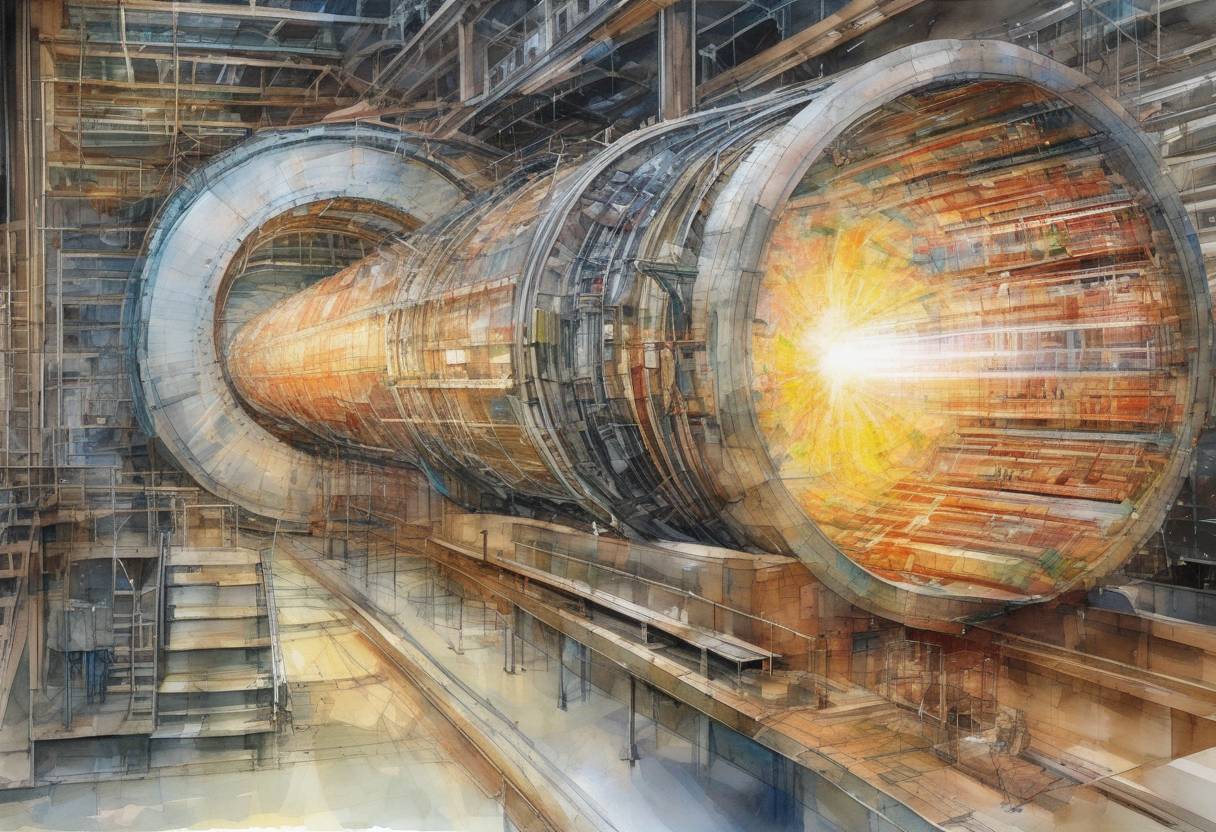
On November 20, 2009, the Large Hadron Collider (LHC) at CERN achieved a significant milestone in the field of particle physics by successfully circulating two beams of protons simultaneously for the first time. This event marked a crucial step in the LHC’s journey towards becoming the world’s largest and most powerful particle accelerator.
The LHC, located near Geneva, Switzerland, is a monumental scientific instrument designed to explore the fundamental particles that constitute the universe. It is housed in a 27-kilometer ring of superconducting magnets and advanced detectors, buried underground. The primary goal of the LHC is to recreate conditions similar to those just after the Big Bang, allowing scientists to study particle collisions at unprecedented energy levels.
Construction and Initial Tests: The construction of the LHC began in the late 1990s, with the aim of pushing the boundaries of particle physics. Initial tests and the first beam circulation occurred in September 2008, but a major technical fault soon after led to a year-long shutdown for repairs and upgrades.
Repairs and Preparations: During the shutdown, extensive repairs were carried out, particularly on the superconducting magnets and the cryogenic systems. This period also allowed for further testing and calibration of the LHC’s complex systems.
On this date, the LHC successfully circulated two beams of protons in opposite directions within the collider’s ring. This achievement was a pivotal moment, as it demonstrated the collider’s ability to handle and control high-energy particle beams simultaneously, a prerequisite for future collision experiments.
Technical Success: The successful circulation of the beams was a testament to the engineering prowess and collaborative efforts of thousands of scientists and engineers from around the world. It confirmed that the LHC’s systems were functioning as intended after the repairs.
Scientific Implications: This milestone paved the way for the LHC to begin high-energy collisions, which would eventually lead to groundbreaking discoveries, including the observation of the Higgs boson in 2012.
The successful circulation of beams on November 20, 2009, set the stage for the LHC to achieve its full operational potential. In the following months, the collider gradually increased the energy levels of the beams, culminating in the first high-energy collisions in March 2010.
Discovery of the Higgs Boson: The LHC’s experiments eventually led to the discovery of the Higgs boson, a fundamental particle that provides other particles with mass, confirming a key part of the Standard Model of particle physics.
Ongoing Research: The LHC continues to be at the forefront of particle physics research, exploring new frontiers and deepening our understanding of the universe.
In summary, the events of November 20, 2009, were a critical step in the LHC’s journey, underscoring its role as a cornerstone of modern scientific inquiry and its potential to unlock the mysteries of the universe.
Source: www.bbc.com