The Battle of Hastings - October 14, 1066
1066 · Hastings, England
The Battle of Hastings took place, where William the Conqueror defeated King Harold II of England, leading to the Norman conquest of England.
September 27, 1066
William the Conqueror's fleet sets sail from the mouth of the Somme River, beginning the Norman invasion of England.
Somme, France | Norman Army
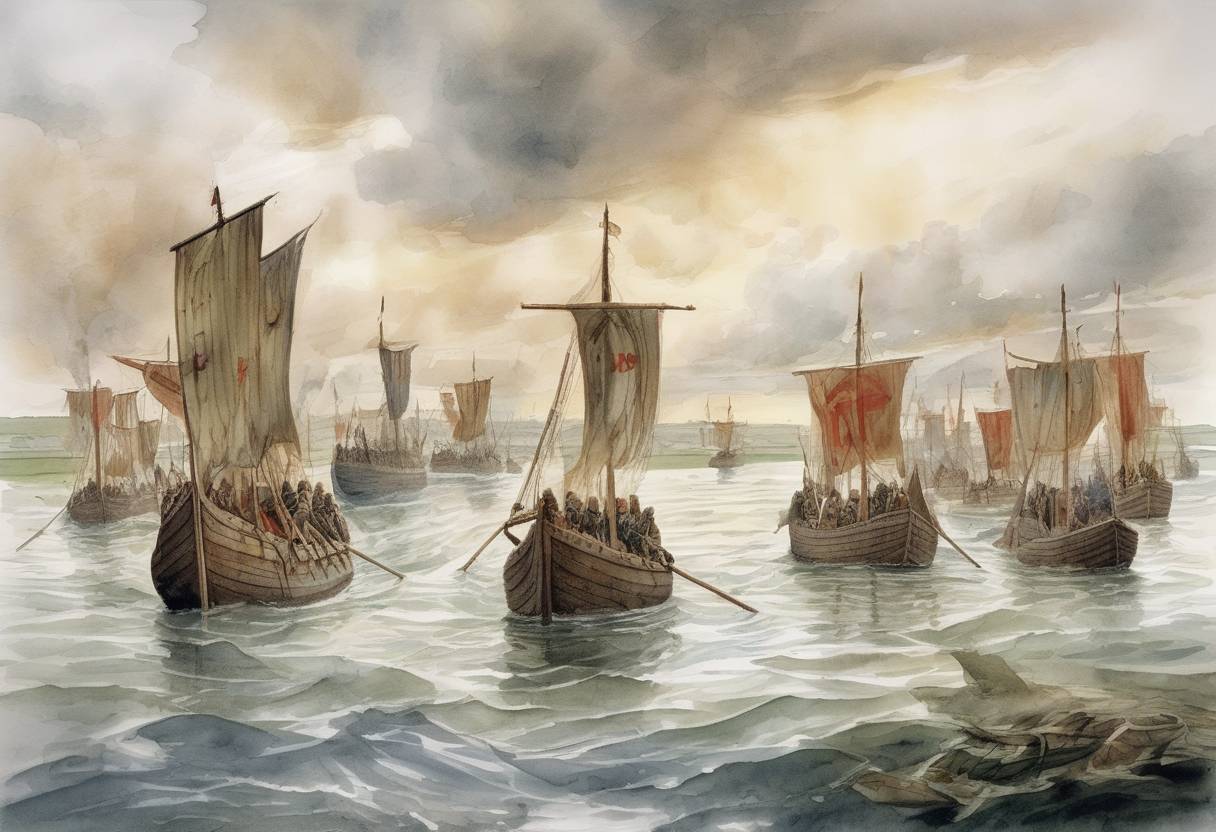
On September 27, 1066, a pivotal moment in European history unfolded as William the Conqueror, Duke of Normandy, set sail from the mouth of the Somme River, marking the beginning of the Norman invasion of England. This event was a crucial step in the Norman Conquest, which would dramatically alter the course of English history.
The roots of the invasion trace back to a succession crisis in England. King Edward the Confessor died in January 1066 without a direct heir, leading to a power struggle. Harold Godwinson, a powerful English noble, was crowned king. However, William of Normandy claimed that Edward had promised him the throne, and that Harold had sworn an oath to support his claim. This dispute set the stage for conflict.
William spent much of 1066 preparing for the invasion. He secured the support of the Pope, who provided a papal banner, symbolizing divine approval. This endorsement was crucial in rallying Norman and other continental support. William amassed a formidable fleet and army, consisting of knights, infantry, and archers, drawn from across Normandy and neighboring regions.
On September 27, 1066, favorable winds allowed William’s fleet to set sail from the mouth of the Somme River. The fleet, comprising hundreds of ships, carried thousands of soldiers, horses, and supplies across the English Channel. The crossing was a significant logistical feat, demonstrating William’s organizational prowess and determination.
William’s forces landed at Pevensey on the southern coast of England on September 28, 1066. They quickly established a beachhead and began fortifying their position. The invasion forced King Harold to march his army south, having just repelled a Norwegian invasion at the Battle of Stamford Bridge.
The decisive encounter between William and Harold occurred on October 14, 1066, at the Battle of Hastings. William’s forces emerged victorious, and Harold was killed in battle. This victory paved the way for William’s coronation as King of England on December 25, 1066, fundamentally transforming English society, governance, and culture.
The Norman Conquest had profound and lasting impacts on England:
William’s successful invasion and subsequent rule established a new dynasty and altered the trajectory of English history, with effects that resonated throughout Europe.
In summary, the sailing of William the Conqueror’s fleet on September 27, 1066, was a decisive moment that set in motion the Norman Conquest, reshaping the political and cultural landscape of England for centuries to come.
Source: en.wikipedia.org