The Monroe Doctrine: December 2, 1823
1823 · Washington, D.C., United States
U.S. President James Monroe delivered the Monroe Doctrine, a key policy statement warning European nations against colonizing or interfering in the Americas.
December 6, 1904
Theodore Roosevelt articulated his corollary to the Monroe Doctrine, asserting the United States' right to intervene in the affairs of Latin American nations.
Washington, D.C., United States | United States Government
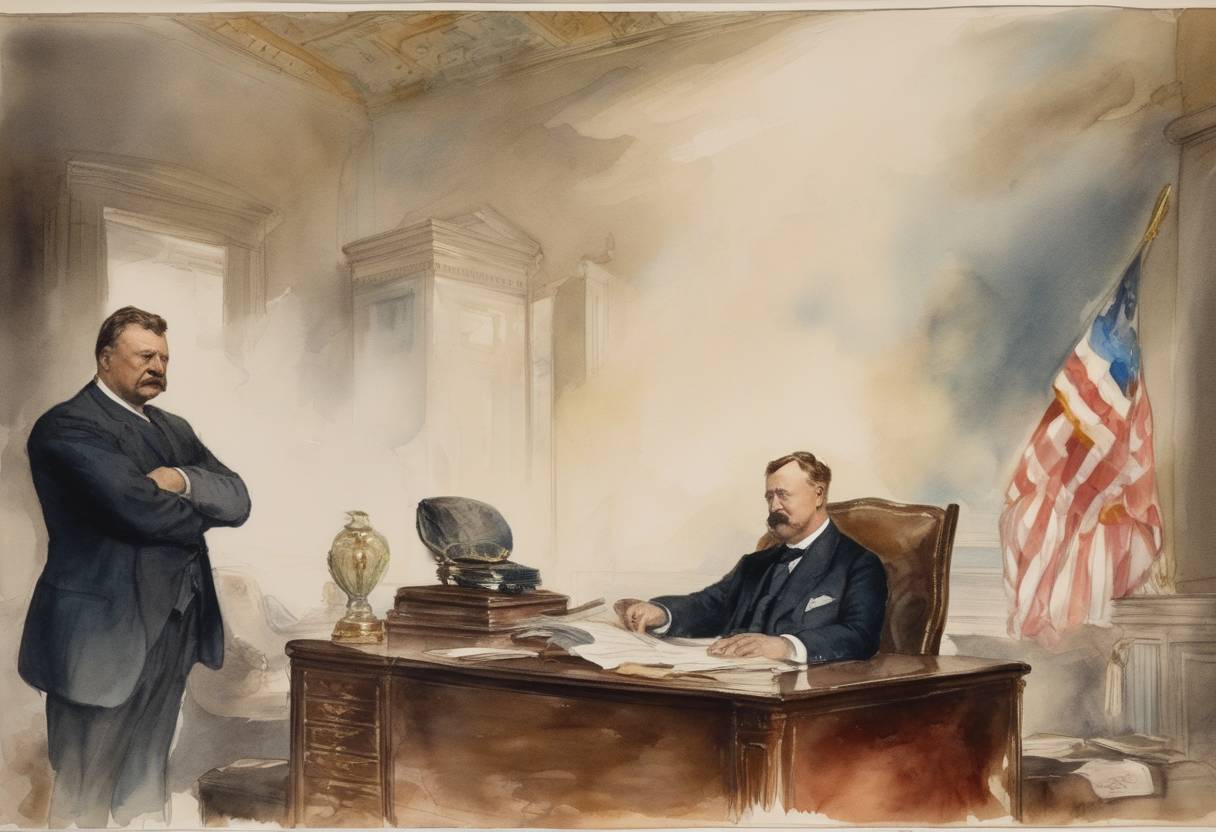
On December 6, 1904, President Theodore Roosevelt articulated what would become known as the Roosevelt Corollary to the Monroe Doctrine during his Annual Message to Congress. This pronouncement expanded upon the Monroe Doctrine of 1823, which originally sought to prevent European intervention in the Americas. Roosevelt’s iteration justified U.S. intervention in Latin American nations to stabilize their economic affairs and maintain order, effectively positioning the United States as the hemisphere’s police power.
The Monroe Doctrine, declared by President James Monroe, was aimed at deterring European colonization and intervention in the Western Hemisphere. However, by the early 20th century, economic instability in Latin American countries, coupled with increasing European financial interests, prompted concerns over potential European actions to enforce debt collections through military means.
Preventative Intervention: Roosevelt asserted that the U.S. had the right to intervene in Latin American countries to forestall actions by other countries that could threaten the region’s stability or sovereignty. This was summarized in his proclamation that “chronic wrongdoing, or an impotence which results in a general loosening of the ties of civilized society,” might require intervention by a civilized nation, with the U.S. stepping in to fulfill this role.
Protection and Responsibility: The Corollary emphasized the United States’ responsibility to uphold order and sovereignty in Latin America, thereby preventing European forces from using military means to enforce financial claims.
Extension of Influence: Roosevelt’s policy not only reinforced American influence in the region but also reflected his broader foreign policy approach characterized by proactive and sometimes aggressive measures, famously summarized by his motto, “Speak softly, and carry a big stick.”
Intervention Policy: The Corollary paved the way for numerous U.S. interventions in the Caribbean and Central America, serving as a justification for actions in countries such as the Dominican Republic, Cuba, Panama, and Nicaragua in the early 20th century.
U.S. Hegemony in the Hemisphere: By formally establishing the U.S. as a regional power with both the authority and responsibility to intervene in neighboring states, the Corollary significantly influenced U.S.-Latin American relations and cemented American hegemony in the hemisphere.
Criticism and Legacy: While the Corollary was intended to stabilize the region, it drew criticism from those who viewed it as imperialistic and as undermining the sovereignty of Latin American countries. Its legacy is mixed, with some scholars praising the stability it brought and others critiquing the dependency and control it imposed on Latin American nations.
The Roosevelt Corollary to the Monroe Doctrine marked an important development in U.S. foreign policy, reflecting the nation’s rising power and its strategic interests in the Western Hemisphere during the early 20th century.