Ferdinand I Elected King of the Romans on February 24, 1538
1538 · Frankfurt, Holy Roman Empire
Ferdinand I is elected King of the Romans, which is a key step toward him becoming Holy Roman Emperor.
August 1, 1308
Henry VII of Luxembourg was elected Holy Roman Emperor. His election marked the brief restoration of the significance and power of the Holy Roman Empire in European politics.
Frankfurt, Holy Roman Empire | Holy Roman Empire
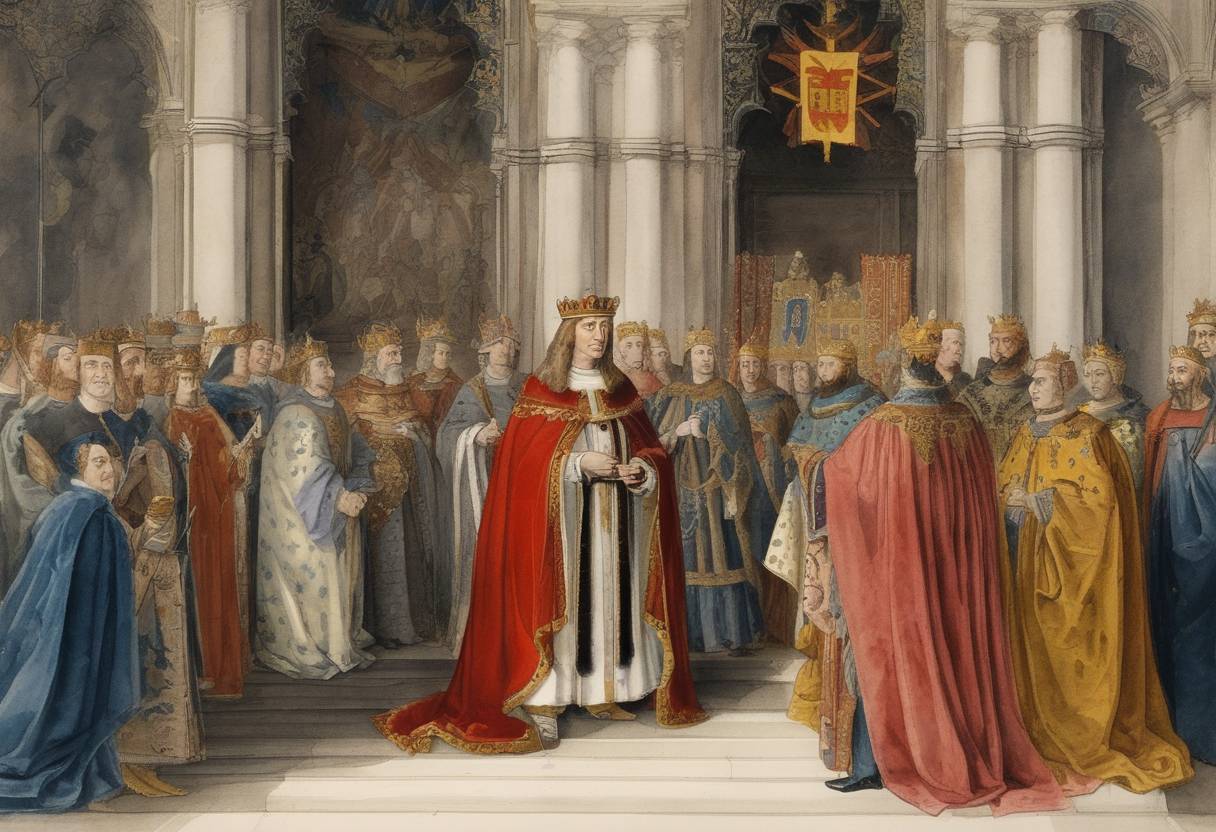
On August 1, 1308, Henry VII of Luxembourg was elected King of the Romans, a crucial step toward becoming Holy Roman Emperor. Henry’s election marked a pivotal moment in the history of the Holy Roman Empire, particularly as it represented a resurgence in the imperial influence within European political dynamics. This election took place against a backdrop of significant challenges and political fragmentation within the empire.
The Holy Roman Empire during the late 13th and early 14th centuries was characterized by weakened central authority and internal strife. The sudden assassination of the previous king, Albert I of Germany, in 1308, left the throne vacant and the empire in a precarious position. The need for a ruler who could unify the various principalities and assert control was pressing.
Henry VII, Count of Luxembourg, was a prominent figure with robust political connections, most notably through his familial ties across Europe. His election on August 1, 1308, by the prince-electors, was a strategic choice aiming to stabilize the empire by selecting a candidate perceived as neutral and capable of mediating between conflicting factions.
Henry VII’s reign is significant for several reasons:
Reestablishment of Imperial Authority: Henry sought to rejuvenate the imperial presence in Italy, traditionally a core part of the empire but increasingly autonomous. His Italian campaign, although not entirely successful, underscored his commitment to restoring imperial influence.
Revival of the Imperial Crown: Henry was crowned Holy Roman Emperor by Pope Clement V in 1312, the first coronation since Frederick II fifty years earlier. His coronation symbolized the restoration of the Holy Roman Empire’s prestige.
Economic and Diplomatic Efforts: Henry VII worked to strengthen the economic foundations of the empire and fostered diplomatic relations within Europe, setting the stage for future imperial policies.
Henry VII’s reign, although short—he died in 1313—had lasting implications for the empire. His efforts highlighted the persistent challenges of unifying a diverse collection of semi-autonomous regions under a centralized rule. His rule offered a template for future emperors, particularly emphasizing the importance of balancing the interests of the papacy and the various dynastic states within and surrounding the empire.
Henry VII’s election and subsequent actions were instrumental in temporarily restoring the significance of the Holy Roman Empire as a central European power during a period of political fragmentation.
Source: www.britannica.com