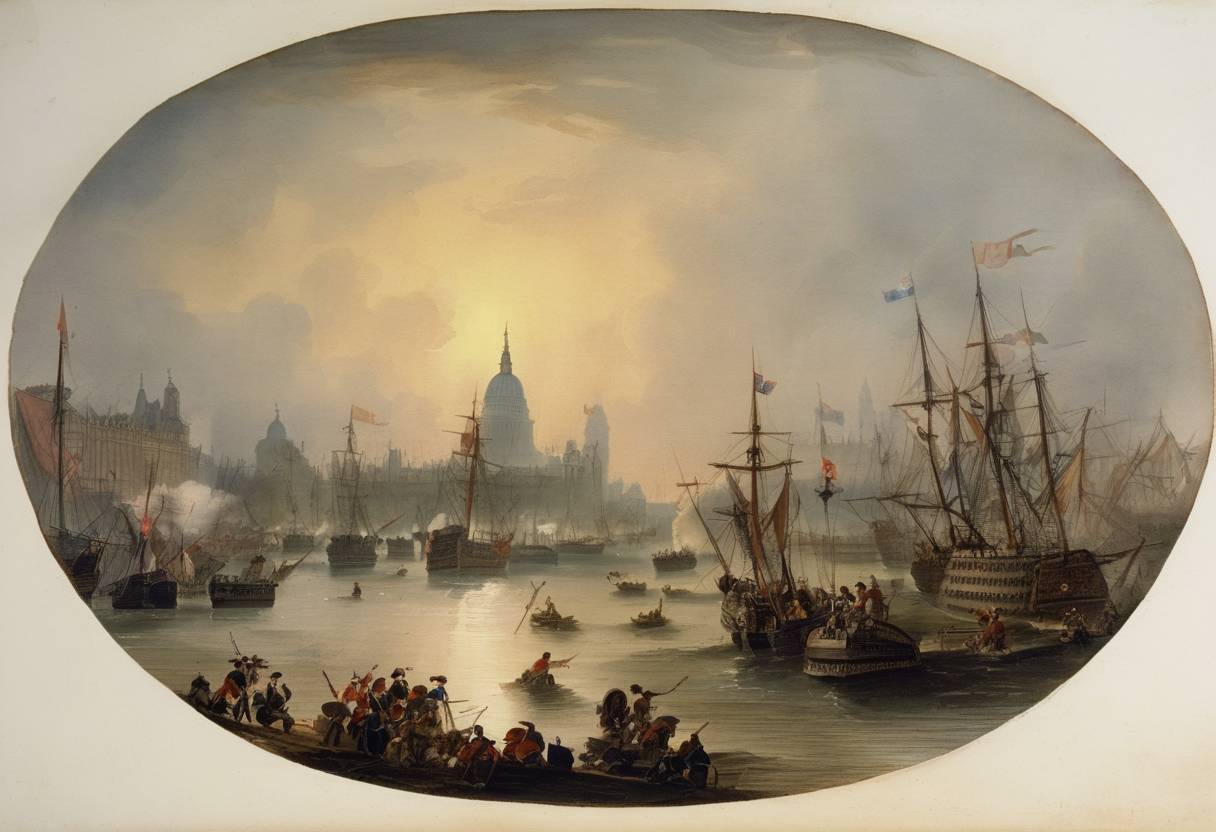
The Beginning of the Seven Years’ War: May 17, 1756
On May 17, 1756, Great Britain formally declared war on France, marking the beginning of the Seven Years’ War, a global conflict that spanned multiple continents and involved many of the world’s great powers. This declaration signified the escalation of hostilities into a full-scale war, transitioning from what was previously colonial skirmishes and tensions in North America into a broader confrontation.
Context Leading Up to the War
The Seven Years’ War’s origins are rooted in the imperial rivalry between Britain and France, primarily focused on supremacy in North America, the Caribbean, India, and European territories. Tensions were particularly high in the Ohio Valley, where British and French interests clashed over fur trading routes and territorial claims.
The earlier part of this conflict, known as the French and Indian War (1754–1763), had already seen sporadic fighting in North America. Here, British colonial forces, supported by Native American allies, engaged in battles with French troops and their Native American allies. The situation was exacerbated by various European alliances, with the British aligned with Prussia and Hanover, while France counted Austria, Russia, and Sweden among its allies.
Key Events on the Day
On May 17, 1756, the official declaration of war by Britain against France formalized the state of conflict, setting the stage for a wide-ranging war that would involve much of Europe, as well as regions in Africa, Asia, and the Americas. The declaration emanated from London, as the British government sought to solidify its position and strategically engage France across several terrains.
Impact and Aftermath
The Seven Years’ War would become one of the most significant global conflicts of its time, resulting in substantial shifts in territorial control. The Treaty of Paris, which concluded the war in 1763, ultimately saw Britain gaining significant territories, including Canada and some Caribbean islands, as well as recognition of dominance over India.
This war also had profound economic and political consequences, significantly influencing colonial policy and inter-European dynamics. It laid the groundwork for British colonial expansion and increased colonial tensions that would eventually lead to the American Revolutionary War.
The war also highlighted the importance of naval power and the increasingly global nature of 18th-century conflicts, as battles were fought not only in Europe but across the world’s oceans and various continents. The Seven Years’ War set a precedent for future global conflicts and reshaped the political landscape of the time.