Battle of Jonesborough: August 31, 1864
1864 · Jonesborough, United States
During the American Civil War, the Battle of Jonesborough began, leading to a significant Union victory that resulted in the fall of Atlanta.
February 15, 1862
During the American Civil War, the Battle of Fort Donelson ended on February 15, 1862. Union forces, led by Ulysses S. Grant and Andrew H. Foote, captured the fort in Tennessee after Confederate forces attempted a breakout. This victory was significant for the Union, opening the Cumberland River as an invasion route into the Southern states.
Stewart County, United States | Union Army
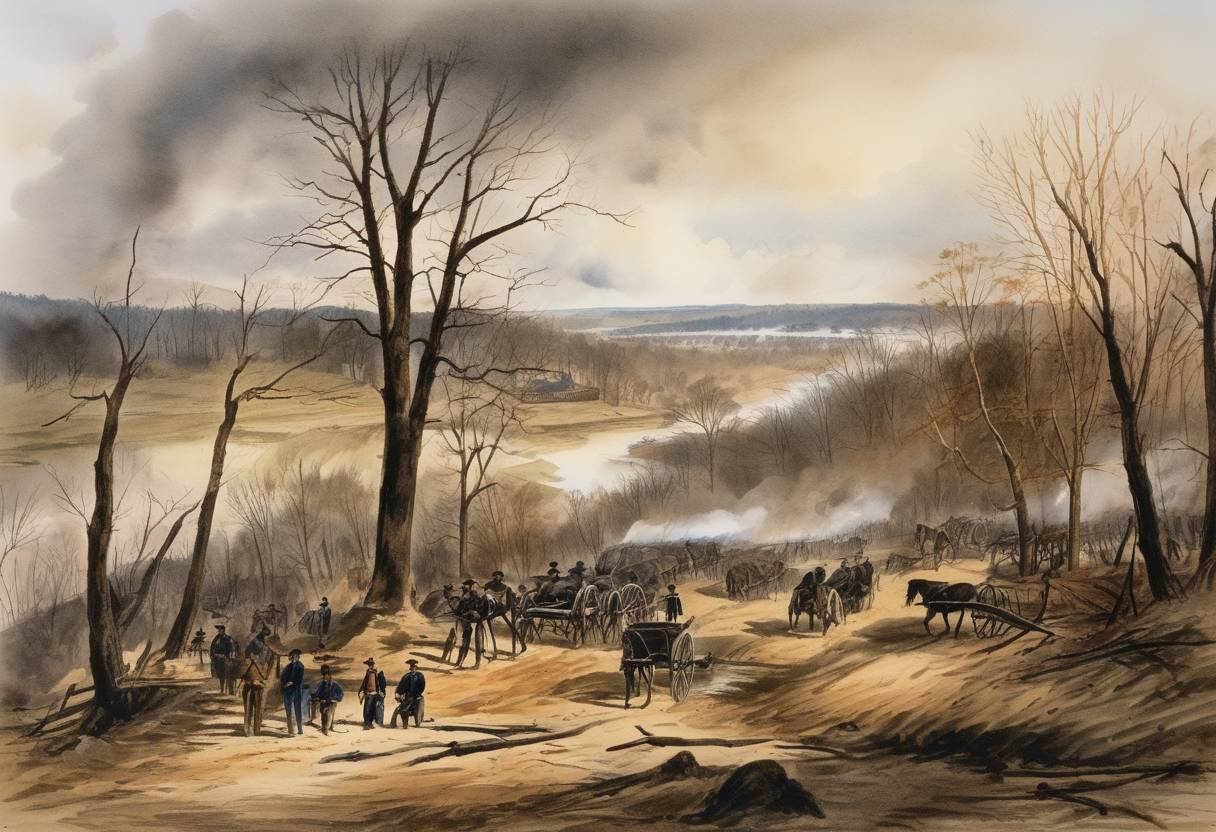
On February 15, 1862, the Union achieved a pivotal victory in the American Civil War at the Battle of Fort Donelson, located in Tennessee. This battle marked a critical point in the Union’s Western campaigns, significantly influencing the control of strategic waterways and the movement into Confederate territory.
The Battle of Fort Donelson was part of the Union’s strategic efforts to secure key rivers, which were vital for penetrating Confederate defenses and supply lines. Following the successful capture of Fort Henry on February 6, 1862, Union forces, commanded by Brigadier General Ulysses S. Grant and naval elements led by Flag Officer Andrew H. Foote, turned their attention to Fort Donelson. Positioned on the Cumberland River, the fort was a crucial Confederate stronghold intended to protect Tennessee from northern advances.
The Confederate forces, realizing the strategic importance of maintaining control over Fort Donelson, attempted a breakout on February 15. Generals John B. Floyd, Gideon J. Pillow, and Simon B. Buckner led Confederate troops in a vigorous attack aimed at breaking through Union lines to allow withdrawal. Initially met with some success, the Confederate breakout began unravelling due to a lack of coherent strategy among the commanding officers.
Grant, seizing the opportunity presented by the faltering Confederate assault, counterattacked with determination. His orders to flood the weakened Confederate lines with fresh Union troops led to the collapse of the Confederate perimeter. Facing inevitable defeat and with winter conditions setting in, Confederate commanders conferred on the night of February 15 about their dire situation.
The following day, on February 16, Brigadier General Simon B. Buckner, left in command after Floyd and Pillow evaded capture, requested surrender terms from Grant. Grant famously replied with, “No terms except an unconditional and immediate surrender can be accepted.” Buckner, recognizing the futility of further resistance, complied, surrendering approximately 13,000 Confederate troops.
The loss of Fort Donelson was a devastating blow to the Confederacy. It effectively opened the Cumberland River, providing a vital invasion route into the Southern states and facilitating further Union advances into Tennessee and the heart of the Confederacy. The victory propelled Ulysses S. Grant into national prominence, earning him the nickname “Unconditional Surrender” Grant.
The fall of Fort Donelson also demoralized the Southern war effort and marked a significant shift in momentum, as it forced the Confederates to abandon central Tennessee, including the strategic city of Nashville, which became the first Confederate state capital to fall to Union forces. The triumph at Fort Donelson laid the groundwork for subsequent Union victories in the Western Theater of the American Civil War.
Source: en.wikipedia.org