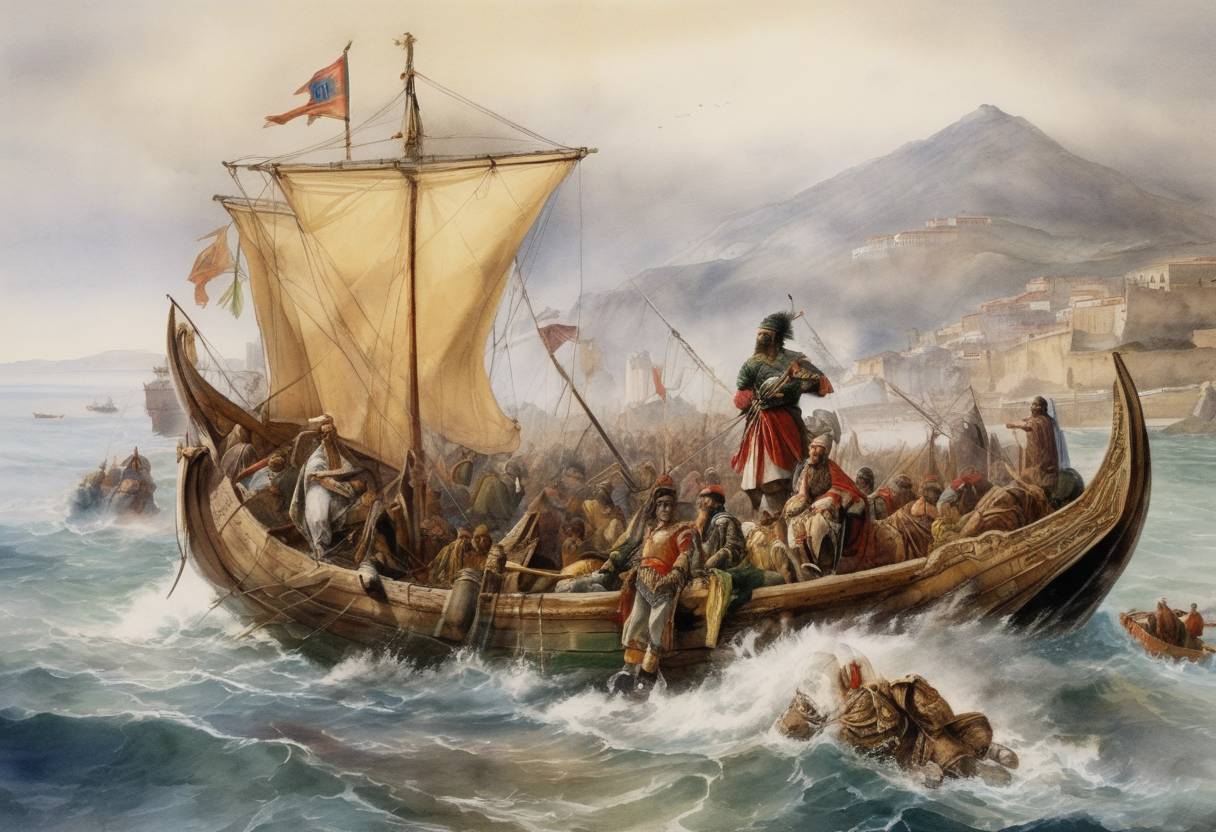
The Muslim Conquest of Hispania: Tariq ibn Ziyad’s Landing
On April 30, 711, Tariq ibn Ziyad, a general of Berber origin serving the Umayyad Caliphate, initiated a significant chapter in European history by crossing the Strait of Gibraltar. Commanding a force of approximately 7,000 Berber soldiers, Tariq landed on the Iberian Peninsula, a pivotal event in the early stages of the Muslim conquest of Hispania.
Context and Prelude
The Iberian Peninsula, controlled predominantly by the Visigothic Kingdom, was experiencing internal strife and political fragmentation. These conditions were partially responsible for the relatively swift success of the Muslim forces. The Visigothic King, Roderic, faced opposition from rival factions within his own realm, which weakened the kingdom’s defenses.
Prior to Tariq’s crossing, the Umayyad Caliphate, under the leadership of Caliph Al-Walid I, had been expanding its territories rapidly from its base in Damascus. The conquest of North Africa had paved the way for this push into the Iberian Peninsula.
The Landing and Initial Successes
Upon landing near the pillar of Rock of Gibraltar—later named Jabal Tariq or “Mountain of Tariq” after him—Tariq quickly established a foothold. The choice of landing at Gibraltar enabled his forces to capitalize on the strategic advantage provided by the landscape.
His initial incursion into the peninsula marked the commencement of the seven-year Iberian campaign. Tariq’s forces quickly encountered and defeated local resistance, and the geographical and strategic complexities of the region helped subdue the Visigothic defenders.
Battle of Guadalete
In the summer of 711, just a few months after landing, Tariq engaged King Roderic’s forces in the pivotal Battle of Guadalete. Reports suggest that internal betrayal within Roderic’s ranks may have contributed to Tariq’s decisive victory. The defeat of the Visigothic army effectively opened Andalusia to the advancing Umayyad troops.
Significance and Aftermath
Tariq ibn Ziyad’s successful campaign rapidly accelerated the Muslim conquest of the Iberian Peninsula. Within a span of several years, most of Visigothic Hispania fell under Umayyad control, fundamentally altering the region’s cultural, religious, and political landscape.
The Islamic presence in Iberia would endure for nearly eight centuries, influencing the development of European arts, science, and philosophy. The coexistence and exchange among Muslims, Christians, and Jews created a unique legacy that shaped medieval European society.
The crossing by Tariq ibn Ziyad on April 30, 711, thus marked not just the beginning of Muslim rule over large parts of the Iberian Peninsula but also initiated a period of profound cultural transformation that would resonate for centuries.