The Abdication of Charles V: Division of the Habsburg Empire
1556 · Brussels, Belgium
Charles V, Holy Roman Emperor, abdicated his throne, leading to the division of the Habsburg Empire between his brother Ferdinand I and his son Philip II.
October 26, 1520
Charles V is crowned Holy Roman Emperor by Pope Clement VII in Aachen.
Aachen, Holy Roman Empire | Holy Roman Empire
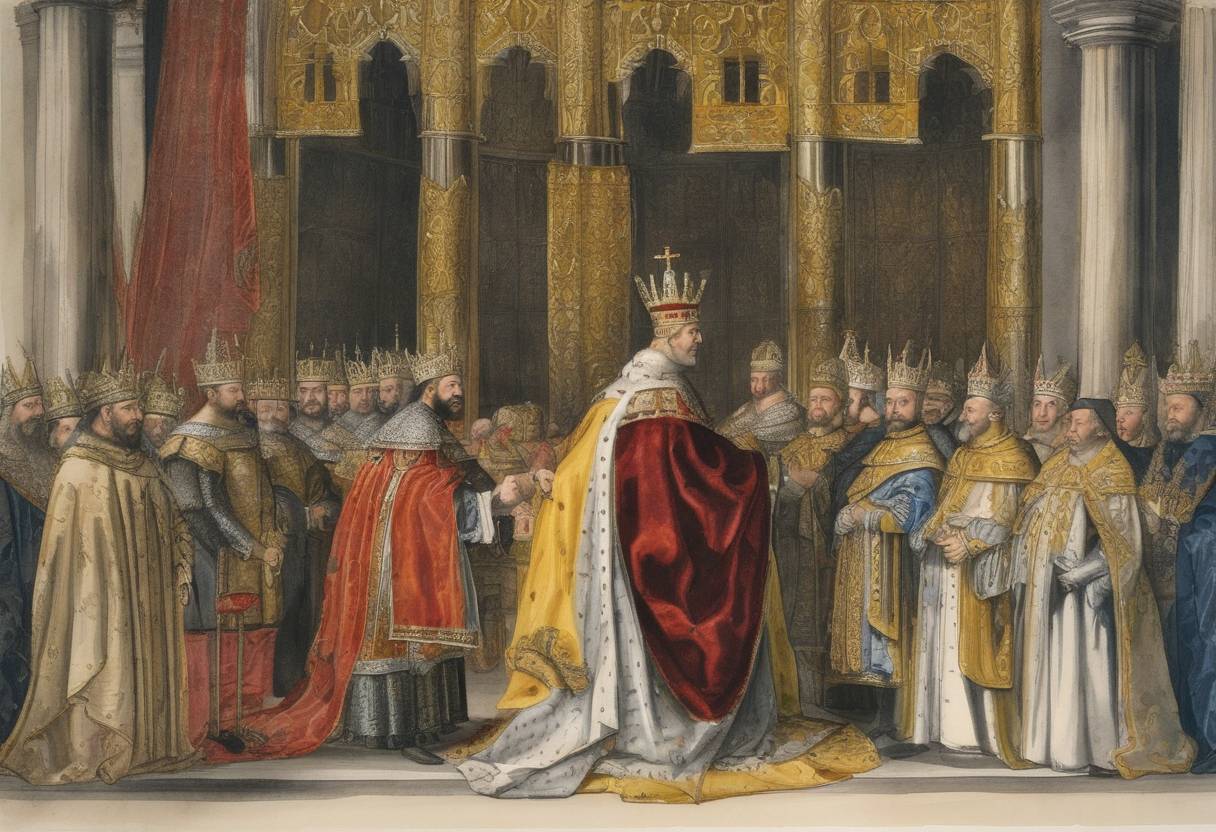
On October 26, 1520, Charles V was crowned Holy Roman Emperor by Pope Clement VII in the city of Aachen, Germany. This event marked a significant moment in European history, as Charles V became one of the most powerful sovereigns of his era, ruling over an empire that spanned from Europe to the Americas.
Charles was born in 1500 into the Habsburg dynasty, a family that had expanded its influence across Europe through strategic marriages. Charles inherited a vast collection of titles and lands from his family, including the Burgundian Netherlands from his father, Philip the Handsome, and the crowns of Castile and Aragon, along with their colonial possessions, from his maternal grandfather, Ferdinand II of Aragon.
In 1519, upon the death of his paternal grandfather, Emperor Maximilian I, Charles was elected as the Holy Roman Emperor. However, the official coronation could only be performed by the Pope, and this tradition brought Charles to Aachen.
The coronation was a grandiose affair, reflecting the power and prestige of the Holy Roman Empire. Aachen was chosen for its historical significance as the seat of Charlemagne, the founder of both the Carolingian Empire and the tradition of the Holy Roman Emperors. The ceremony involved elaborate religious rituals symbolizing the divine right of kings, as well as Charles’ commitment to defend the Catholic Church.
Charles V’s reign marked a period of immense challenge and transformation for Europe. His vast empire was frequently at odds with France, England, and the expanding Ottoman Empire, leading to several military conflicts. His rule also coincided with the burgeoning Protestant Reformation, which began with Martin Luther’s Ninety-Five Theses in 1517, fundamentally altering the religious landscape of Europe.
Charles’ position as Holy Roman Emperor demanded constant attention to both the political tensions and religious disputes of the period. His efforts to maintain Catholic orthodoxy in his realm were central to his agenda, even as Protestant movements gained traction among his subjects.
Despite his power, Charles V found it difficult to maintain control over the disparate territories of his empire. In 1556, he abdicated his many titles, passing the Holy Roman Empire to his brother Ferdinand I, and retiring to the Monastery of Yuste in Spain, where he lived until his death in 1558.
The coronation of Charles V as Holy Roman Emperor was a cornerstone event in European history, setting the stage for a period of religious and political upheaval. His reign underscored the complexities of ruling a vast, multi-national empire in an era of growing national consciousness and religious reform.
Source: en.wikipedia.org