Battle of Abukir: July 20, 1799
1799 · Cairo, Egypt
On July 20, 1799, French forces under General Jean Baptiste Kléber defeated an Ottoman army near Cairo, Egypt, in the Battle of Abukir during the French campaign in Egypt.
July 1, 1798
Napoleon Bonaparte's Egyptian campaign began with the capture of Alexandria after the French expeditionary forces landed in the country.
Alexandria, Egypt | French Army
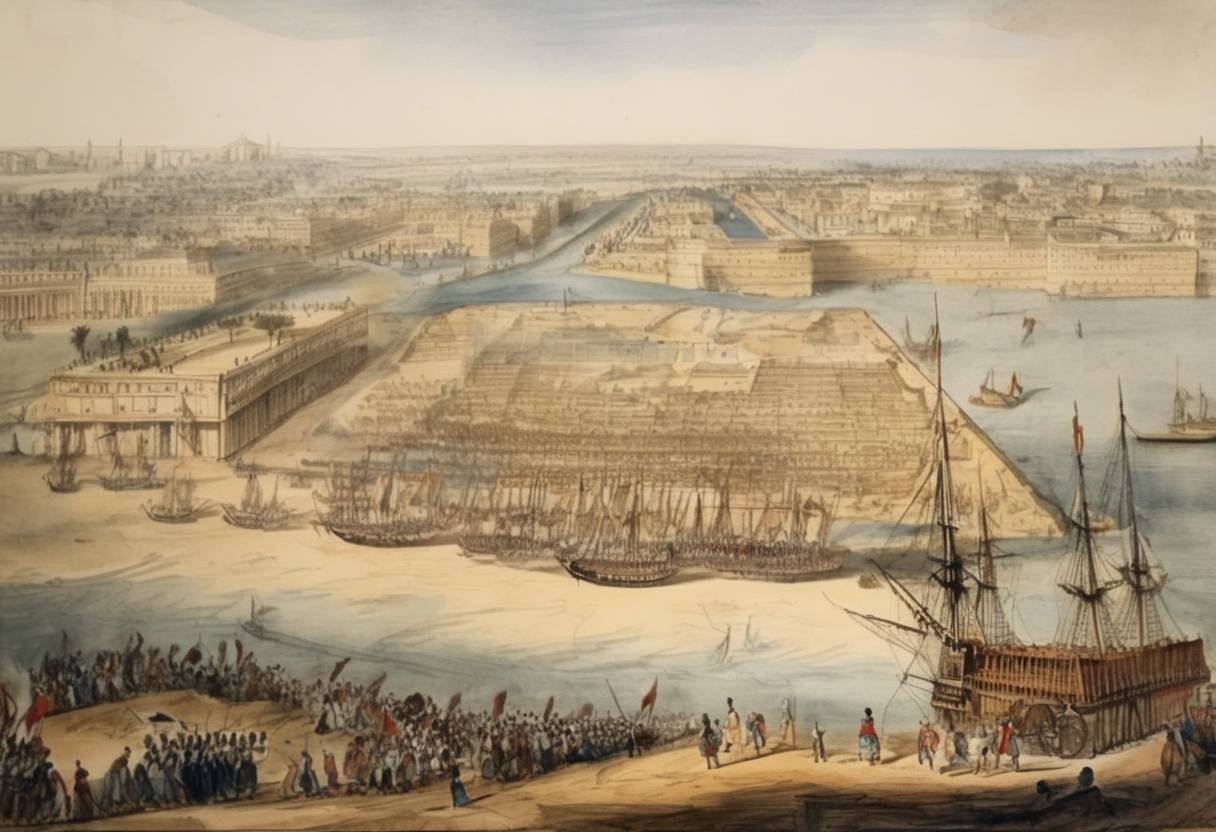
On July 1, 1798, Napoleon Bonaparte commenced his ambitious Egyptian Campaign with the landing of French expeditionary forces in Alexandria. This marked a significant opening maneuver in Napoleon’s broader aspiration to undermine British influence and disrupt their trade routes in the East.
The Directory, then ruling France, had given Napoleon the command of the expedition with the dual goals of both threatening Britain’s access to its colony, India, and acquiring scientific knowledge and artifacts. The French government was eager to capitalize on Napoleon’s previous military successes in Italy, and saw Egypt as a strategic target that could enhance France’s global standing.
On this day, Napoleon’s fleet arrived near the shores of Alexandria. The landing was executed with swift precision. Approximately 35,000 troops disembarked, alongside scientists, engineers, and scholars, collectively known as the “savants,” tasked with exploring and documenting Egypt’s ancient civilization.
Despite initial resistance, the French forces swiftly overcame the local garrison in Alexandria. The city’s capture was facilitated by the element of surprise and the lack of organized Egyptian defenses. Moreover, the local population, disenchanted with the ruling Mamluk elites’ oppressive rule, offered little resistance.
Napoleon issued proclamations to the Egyptians emphasizing respect for Islam and promising prosperity under French administration, aimed at securing local support or at least neutralizing potential hostility.
The seizure of Alexandria set the stage for Napoleon’s further incursions into Egyptian territory, leading to his pivotal victory at the Battle of the Pyramids later in July. This campaign, however, was not solely military—Napoleon envisioned transforming Egypt by introducing modern institutions and sciences.
Despite these early successes, the long-term outcomes of the campaign were mixed. It provoked Britain’s strategic response, culminating in Admiral Nelson’s decisive triumph at the Battle of the Nile in August 1798, which isolated French forces.
Napoleon’s Egyptian Campaign had lasting implications. While it ultimately failed militarily, it sparked a renewed European interest in the ancient East, leading to cultural and scientific developments, including the discovery of the Rosetta Stone, which enabled the eventual deciphering of Egyptian hieroglyphs.
This ambitious campaign epitomized Napoleon’s vision of empire, blending military conquest with cultural and scientific enlightenment, and left an indelible mark on both European and Middle Eastern histories.
Source: en.wikipedia.org